Ask any corporate banking head in India what their ideal customer looks like and the answer is consistent: a mid-to-large employer with a stable workforce, regular payroll cycles, and employees who will use the bank's other products over time.
Salary accounts are not just current accounts with a different label - they are the entry point into a relationship that can compound into personal loans, credit cards, insurance, and wealth products for hundreds or thousands of individuals simultaneously.
The economics are attractive. The strategic logic is sound. And yet the process of actually activating that relationship - of going from a signed corporate agreement to live salary accounts for every employee - remains, at most banks, a manual, slow, and error-prone exercise that quietly undermines everything the relationship is supposed to deliver.
The problem is not one that banks advertise. It does not appear in annual reports or investor presentations.
But it sits in the day-to-day reality of every corporate banking operations team in the country, and it has a specific technical cause: banks have no reliable, scalable way to connect directly to the payroll and HRMS systems their corporate clients use.
What the process actually looks like today
When a corporate client signs a salary account agreement, the bank needs three things to get accounts live: a verified list of employees, their employment and salary details, and KYC information for each individual.
In a world where this data flowed seamlessly from the employer's HRMS to the bank's systems, activating 500 accounts would be a largely automated exercise taking a few hours.
In practice, here is what typically happens.
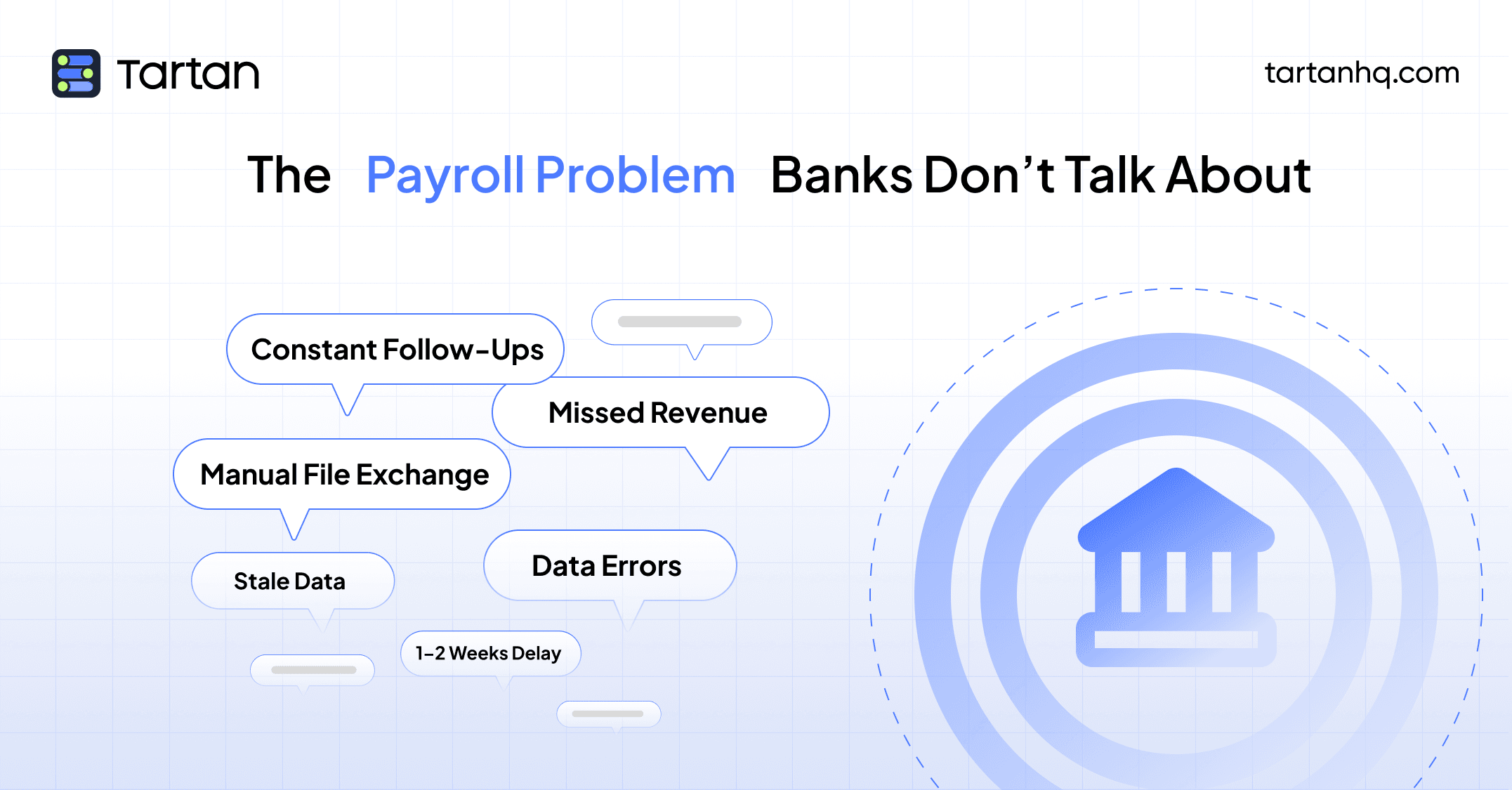
The bank's relationship manager sends an email to the client's HR or finance contact requesting an employee data file. A template is attached - usually a spreadsheet with specific column headers the bank needs. The HR team fills it in, or exports something close from their HRMS and reformats it manually to match the template. This takes a day or two if the HR team is responsive. Longer if they are not.
The file arrives at the bank. Someone in operations checks it. Columns are misnamed, or missing, or populated in an unexpected format. There are employees with incomplete PAN details. A few records have salaries listed in a different denomination than expected. The operations team flags the issues, sends a query back to the client, and waits for a corrected file. This round trip takes another day or two.
Eventually a clean file arrives. It is uploaded to the account opening system. KYC checks run. Accounts that pass are activated. The ones that fail manual review pile up in a queue. By the time all accounts are live, a week has passed. Sometimes two. A handful of employees still don't have active accounts when the first payroll cycle arrives. Complaints filter through to the RM. Apologies are made. Promises of improvement are given.
And then, next month, an employee joins the company. The HR team sends a new file - or forgets to, and the RM chases them. The whole cycle repeats at a smaller scale, forever.
1–2 weeks typical time from deal close to live accounts | 50+ distinct HRMS platforms in active use across Indian enterprise | 0 banks with a unified integration covering all of them |
Why banks haven't solved this already
If the problem is this obvious, why haven't banks built direct integrations with HRMS platforms and eliminated the spreadsheet workflow entirely? The answer is more interesting than it might appear.
The first reason is scale of the problem.
A bank managing a large corporate salary account portfolio is dealing with clients who collectively use dozens of different HRMS platforms - Darwinbox, GreytHR, Keka, SAP SuccessFactors, Oracle HCM, Workday, Zoho People, and numerous legacy systems. Building a direct, production-grade integration with each of these is not a single project.
It is an ongoing programme of work, each integration requiring its own authentication approach, data schema mapping, error handling, and maintenance commitment as each platform evolves.
The second reason is that corporate banking technology teams are not typically resourced to build and maintain fintech-grade API integrations at this level of breadth. Core banking modernisation, regulatory compliance systems, and customer-facing digital products compete for the same engineering bandwidth.
A unified HRMS connectivity layer - however valuable - rarely wins that prioritisation battle against a mandated regulatory upgrade or a digital product the CEO has announced publicly.
The third reason, and perhaps the most honest one, is that the pain has been diffuse enough to tolerate. The spreadsheet process is slow and imperfect, but it works well enough that no single incident creates enough urgency to force a fix.
It takes a step back - looking at the aggregate cost across hundreds of corporate accounts, across thousands of monthly updates, across every RM hour spent chasing data files - to see how expensive the status quo actually is.
The cost is larger than it appears
Let's make the cost concrete, because it is easy to dismiss "operational inefficiency" as an abstraction until you put numbers to it.
A mid-sized private bank with 500 active corporate salary account relationships processes updates - new joiners, exits, salary changes - across those accounts every month.
If the average corporate account requires one manual data exchange cycle per month, and each cycle takes two hours of combined time across the bank's operations and the client's HR team, that is 1,000 person-hours per month spent on data movement that should be automated.
At a conservative cost per hour, this is a material expense - and it does not include the cost of errors, rework, or the occasional account that falls through the cracks and generates a customer complaint.
Then there is the opportunity cost.
Every week that passes before a new corporate client's accounts are live is a week without payroll cycle activity, without debit card transactions, without the behavioural data the bank needs to make pre-approved product offers. For a 500-person company, a two-week delay in account activation is two weeks of relationship value that has simply evaporated.
And there is the competitive cost. Banks that have solved this - that can credibly promise a corporate client that their employees will have live accounts within 24 hours of agreement signing - are walking into every corporate banking pitch with a meaningful differentiator.
Against competitors who are still promising "we'll sort out the data process" and delivering two weeks later, same-day activation is not a minor operational improvement. It is a sales argument.
What payroll API connectivity actually unlocks
Fast account opening is the most visible benefit of connecting directly to a corporate client's payroll system, but it is not the most valuable one. The bigger value is what becomes possible once the bank has a live, ongoing data connection - not just a one-time file at onboarding.
Real-time employee roster management is the operational foundation. When a new employee joins the company, the bank knows immediately - not when the HR team remembers to send an update file. When someone exits, their salary account transition is triggered automatically. The bank's corporate account data is always current, not periodically current.
But the strategic value sits one level above this. A live payroll connection gives the bank continuous, verified visibility into each employee's income trajectory.
When an employee's salary crosses a threshold - perhaps from ₹8 lakh to ₹12 lakh annually - the bank can trigger a pre-approved personal loan offer in real time, backed by verified current income rather than an estimate based on the salary data from the account opening form eighteen months ago. When someone gets promoted, that is a signal for a credit limit increase conversation. When a long-tenured employee approaches a milestone, that is a wealth management opportunity.
This is the shift that a payroll API connection makes possible: from a bank that reacts to customer behaviour to one that anticipates it, because it has access to the employment data that predicts it.
The difference in conversion rates between a generic product offer and one triggered by a verified salary event - sent at the right moment, to a customer whose income eligibility has just been confirmed - is not marginal. It is the difference between mass marketing and genuinely intelligent cross-sell.
The HRMS diversity problem - and the unified layer answer
The catch in all of this is the fragmentation problem. A bank cannot build direct integrations with every HRMS its corporate clients use.
The diversity is too great, the maintenance burden too high, and the return on each individual integration too uncertain to justify the investment at scale.
This is where a unified HRMS API layer changes the architecture of the problem. Instead of the bank building fifty integrations, it connects once to a unified layer that already covers all the HRMS platforms its clients might use. The bank's systems interact with one standardised API.
The unified layer handles the diversity underneath - different authentication methods, different data schemas, different update mechanisms - and returns consistent, normalised employee data regardless of which HRMS the client is running.
For the bank's engineering team, this is a tractable project. One integration, one data model, one maintenance relationship. For the bank's corporate banking team, it means walking into every deal knowing that whatever HRMS the prospect uses, the bank can connect to it. For the prospect's HR team, it means a simple consent-based authorisation that replaces the recurring data export workflow entirely.
This is what HyperSync by Tartan is built to do - a unified API layer covering 80+ HRMS, CRM, and ERP platforms under a single integration point, with consent management and real-time sync built in.
Banks connecting through HyperSync get live payroll connectivity to their corporate clients without the fragmentation problem, without the maintenance overhead, and without the compliance risk of unstructured data exchanges.
The window for differentiation
Corporate banking in India is competitive in a way that makes relationship quality and operational reliability genuinely important differentiators. Large corporates evaluate their banking relationships carefully.
Treasury and HR teams notice when onboarding is smooth versus when it generates three weeks of follow-up emails. Finance heads notice when payroll reconciliation is clean versus when it requires a manual correction cycle every month.
The banks that move earliest to solve the payroll connectivity problem will establish a structural advantage in corporate salary account acquisition that compounds over time. It is not just that they will onboard accounts faster - it is that they will do so in a way that signals operational maturity to the corporate client, reduces friction throughout the relationship lifecycle, and creates the data foundation for the kind of intelligent cross-sell that turns a salary account into a full-service banking relationship.