Manual Verification Is No Longer an Ops Detail - It Is a Margin Variable
In a scaled digital lending operation, verification is not a background function. It is a blocking layer between application intake and balance sheet deployment.
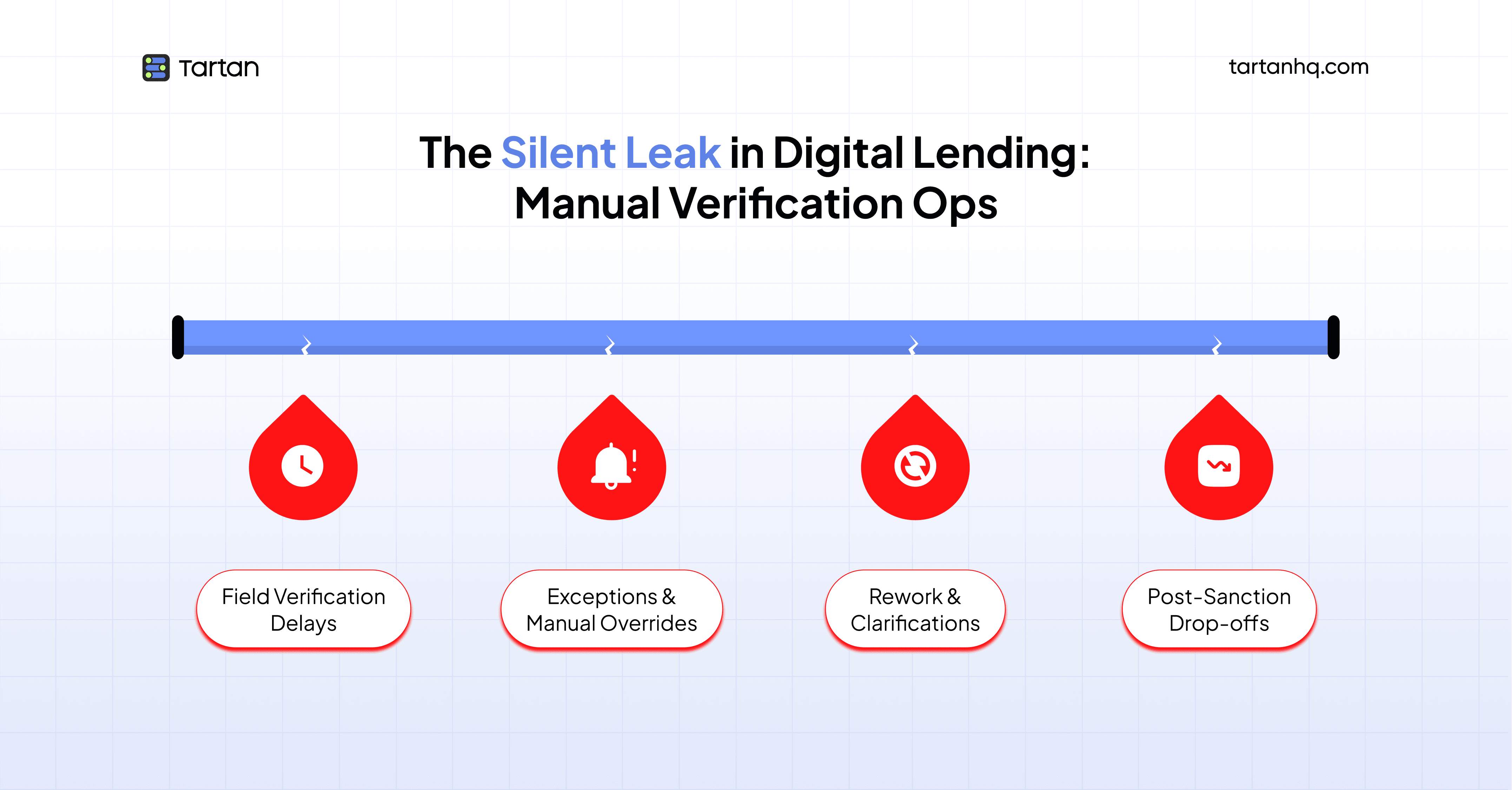
Every application that breaches disbursal TAT, cycles back for re-underwriting, gets parked in a clarification queue, is repriced post-sanction, or drops between sanction and booking has typically gone through multiple verification loops.
These loops are driven by manual address checks, income clarifications, and exception handling that introduce queue resets, credit rework, and discretionary overrides. The net effect is increased unit economics friction: higher cost per loan booked, unstable post-sanction conversion, inflated ops capacity requirements, and margin compression originating from verification inefficiencies rather than portfolio risk.
Verification is a universal choke point in the lending value chain - any inefficiency here scales linearly with volume and compounds across cost, time-to-cash, and risk outcomes.
Yet in most lending orgs, verification ops are managed as:
a staffing problem (more vendors),
a compliance obligation (minimum checks to clear audit),
In a scaled lending business, verification is a capital-control layer rather than an operational step; because every sanctioned exposure must clear verification before funds are deployed.Friction at this stage directly constrains balance-sheet velocity, increases unit cost of growth, and forces compensating risk or pricing decisions elsewhere in the system.
Why Manual Verification Persists Even After Digital Onboarding
Most lending enterprises have already digitized the front of the funnel.
Customer acquisition, application intake, document uploads, and initial checks are API-driven, vendor-integrated, and SLA-tracked. From the outside, onboarding appears automated.
Manual verification persists not because digital infrastructure is missing, but because digital onboarding and verification were architected as separate layers with different objectives.
Digital onboarding was built to maximize reach and conversion. Verification was built to minimize downside risk and regulatory exposure.
Manual intervention continues to dominate verification because the system itself produces uncertainty that technology alone does not resolve:
Vendor coverage is probabilistic, not deterministic.
Inconsistent outcomes trigger manual fallbacks.
Processes were built for low-volume, branch-led lending.
Risk controls prioritize downside protection over flow efficiency.
Digital onboarding has increased application inflow without redesigning how verification decisions are made. Intake systems now scale linearly with more channels, faster journeys, broader reach but verification architecture remains exception-driven, human-reviewed, and sequential.
As a result, higher volumes do not flow through faster, they accumulate downstream.
Field Verification: A Legacy Control That Distorts Scale Economics
Field verification was not designed as a throughput control.
It originated as a risk validation mechanism for a lending environment characterized by low application volumes, limited data exhaust, and branch-led origination. In a scaled digital lending model, that assumption no longer holds.
Yet field checks continue to sit inside modern credit flows not because they add incremental risk insight, but because they compensate for low-confidence verification signals elsewhere in the system. What appears as a tactical safeguard is, in reality, a structural fallback for unresolved uncertainty.
Why field checks still get triggered in digital-first lending stacks
Field checks are not a parallel verification method. They are triggered only when the system cannot confidently move a sanctioned loan to disbursal.
In lending, this gap appears when verification outputs are insufficient to support final credit booking.:
Address confidence falls below policy thresholds
Employment verification lacks source-level certainty
Automated outcomes are not audit-defensible
This is not an operational choice.
It is a system response to unresolved verification ambiguity, where physical validation substitutes for missing decision-grade signals.
Why delay between sanction and disbursal is the real economic loss
The primary cost of field verification is not the expense of the visit itself. It is the time during which sanctioned credit remains undisbursed.
In lending economics, value is realized only when approved exposure converts into earning assets. The moment a case is routed to field verification, that conversion is paused. Credit has been approved, pricing has been locked, and risk has been accepted but capital is not yet deployed.
This pause creates a structural inefficiency:
Approved loans sit idle: Sanctioned exposure earns nothing until funds are disbursed.
Disbursal timelines lose predictability: Field checks introduce external dependencies that break fixed TATs.
Customers drop off after approval: Delays cause silent fallout that never shows up as formal rejection.
From a CXO perspective, this is not a verification expense problem.
It is a capital efficiency problem, where operational interruptions slow how quickly approved risk turns into deployed capital, directly impacting ROA, growth efficiency, and margin predictability.
Exceptions Are Not Edge Cases - They Are the System
An exception is triggered when an application cannot be cleared through standard verification rules, even though it may already be credit-approved in principle. This does not mean the borrower is high-risk. It means the system lacks sufficient confidence to complete verification without human intervention.
Common verification exceptions in lending:
Partial address match across sources
Employer not found in payroll databases
Income data inconsistent across periods
Name variations across ID documents
Device or location anomalies
Multiple vendors produce conflicting signals
From a CXO perspective, rising exceptions are not an ops issue to manage. They are a signal that the verification layer cannot reliably support disbursal-grade decisions at scale.
What Exceptions Actually Do to the Lending System
When an application enters exception handling, it does not slow down incrementally, it changes lanes entirely. The file exits straight-through processing and enters a manual, sequential resolution path where progress depends on human intervention rather than system logic.
Once a case enters exception handling, it no longer follows a deterministic path:
Verification outcomes are interpreted, not resolved
Additional documents are requested to compensate for weak signals
Credit or risk teams apply judgment to bridge uncertainty
Files cycle between ops, credit, and verification before booking
This is not a rare detour. It becomes a secondary clearance mechanism that operates alongside automated verification.
Why Exceptions Create Economic Drag at Scale
Exception handling changes the operating model of lending. What begins as a small share of files requiring manual resolution quickly alters throughput, cost, and capital efficiency once volumes scale. The impact is not linear, and it is rarely visible in headline metrics.
Exceptions slow throughput disproportionately: Manual resolution cannot scale, so backlogs grow faster than volumes.
Ops capacity gets tied up post-sanction: Teams spend time clearing approved files instead of enabling new disbursals.
Approved credit stays idle: Sanctioned loans wait in queues, delaying balance-sheet deployment and yield.
Decision consistency weakens: Manual judgment replaces policy logic, producing uneven outcomes for similar profiles.
At scale, these effects compound.
Exceptions stop being a small operational adjustment and become a structural drag on growth efficiency, capital deployment, and decision discipline.
Rework Is Where Lending Efficiency Quietly Breaks
Rework is introduced when a loan file that is already verification-cleared in parts cannot be closed for booking and is sent back for additional checks or clarification. This is not driven by borrower behaviour. It is caused by verification outputs that are directionally acceptable but not strong enough to support final capital deployment. At scale, rework becomes one of the largest hidden consumers of operational capacity because the same sanctioned exposure is processed multiple times before it ever generates yield.
At scale, rework becomes one of the largest consumers of operational capacity without being tracked as a distinct problem.
Verification is performed more than once on the same file.
Each rework cycle resets internal SLAs
Customer drop-off increases after approval
Ops effort compounds on near-complete applications
The economic impact of rework is cumulative.From a CXO perspective, rework is not an execution inefficiency to be optimized. It is a verification design problem that raises cost per booked loan, slows how quickly approved credit converts into revenue, and forces the organization to push more applications through the system to achieve the same business output.
The Shift Enterprises Are Making: From Checks to Signal-Oriented Verification
Leading lending enterprises are no longer trying to optimize verification by replacing manual steps with digital equivalents. That approach digitizing checks has largely plateaued. It improves speed at the surface but does not change how decisions are made or how confidently capital can be deployed.
The real shift underway is architectural: from discrete checks to signal-driven verification.
Signal-oriented verification works differently. Instead of treating verification as a sequence of independent validations, it treats it as a confidence-building system designed to support a final, defensible decision.
In a signal-based model, multiple verification inputs - identity, address history, income behavior, employment indicators, device intelligence are evaluated together to produce a graded confidence outcome.
This changes how verification behaves operationally and economically:
Decisions are confidence-based, not checklist-based
Outcomes are directly tied to policy intent
Verification becomes continuous, not episodic
Consistency is enforced across products and teams
In this model, manual intervention still exists but it is deliberately constrained. Humans step in only when signals are genuinely inconclusive, not because the system cannot synthesize what it already knows.
This shift matters because it directly addresses the root causes of verification drag: exceptions, rework, field dependency, and post-sanction delays. Signal-oriented verification does not just make onboarding faster; it makes capital deployment more predictable, scalable, and governable.
How HyperVerify Closes the Verification Ops Leak
In most lending stacks, verification complexity is not eliminated, it is displaced.
Conflicting vendor responses, partial matches, and low-confidence outcomes are passed downstream to ops and risk teams as exceptions, clarifications, or manual overrides. This is where cost, delay, and inconsistency accumulate.
HyperVerify is designed with a different premise: verification systems should absorb uncertainty themselves, rather than relying on human intervention to resolve it.
Unified signal ingestion replaces fragmented checks
Traditional verification executes checks in isolation - address, identity, income, device often through separate vendors and workflows. HyperVerify ingests these inputs as signals within a single decision context, allowing the system to evaluate how signals reinforce or offset one another. This reduces false exceptions created purely by vendor mismatch rather than genuine risk.
Policy-driven decisioning replaces discretionary overrides
Instead of leaving resolution to individual judgment, HyperVerify encodes verification logic into explicit, product-aligned policies. Decisions are executed consistently based on risk tolerance, exposure size, and product context, reducing dependence on human overrides and preserving decision discipline at scale.
Audit-ready verification replaces post-facto reconstruction
Manual verification relies on notes, emails, and vendor artifacts to explain decisions after the fact. HyperVerify generates machine-readable audit trails by default, allowing every decision to be reconstructed from inputs, rules, and confidence scores. This lowers regulatory exposure without adding procedural friction.
Why the Next Efficiency Gains Will Not Come From Credit Models Alone
Lending efficiency has traditionally been driven by underwriting improvements—better models, more variables, sharper segmentation, and tighter pricing. These investments continue to matter, but in scaled lending systems they are no longer the primary constraint on performance.
The binding constraint has shifted from decision quality to decision execution.
Credit models determine which customers can be approved and at what risk-adjusted price. Verification determines whether those approvals can be operationalized - cleared, booked, and disbursed within acceptable cost, time, and governance limits. When verification execution is weak, model accuracy does not translate into deployable exposure.
When verification operations are fragmented, manual, or exception-heavy, even strong models underperform in practice.
Approvals stall between sanction and disbursal, risk teams add conservative buffers to compensate for low verification confidence, and ops teams introduce discretionary checks that dilute the precision of model outputs. The model may be correct, but the system cannot act on it cleanly.
The limiting factor is not underwriting intelligence.
It is the absence of a verification layer that can reliably convert model output into disbursal-ready decisions at scale.
Until verification operates as a decision system, signal-driven, policy-aligned, and auditable credit model improvements will continue to underdeliver on their economic potential.
The next efficiency gains in lending will come from fixing execution, not just improving prediction.