Designing Enterprise-Grade Systems That Withstand Audits, Investigations, and Incident Reviews
Enterprise verification systems rarely fail during onboarding. They fail during scrutiny.
Under normal operating conditions, most verification stacks appear stable. APIs respond within SLA thresholds. Vendors typically return simplified outcome indicators - pass, fail, or refer without exposing the underlying decision logic.
Case management tools log decisions.
Audit teams receive periodic reports.
Risk dashboards display aggregate metrics.
Operationally, the system seems controlled.
This operational stability masks architectural fragility. The stack is optimized for transaction processing not for evidentiary reconstruction. When subjected to regulatory review, forensic investigation, or incident escalation, the underlying design assumptions are tested in ways routine operations never simulate.
The verification layer assumed to be a compliance safeguard often lacks structural defensibility.
Under audit pressure, enterprises discover that verification decisions cannot be reconstructed. Risk logic cannot be explained. Vendor dependencies cannot be justified. Exception handling is undocumented. Data lineage is fragmented.
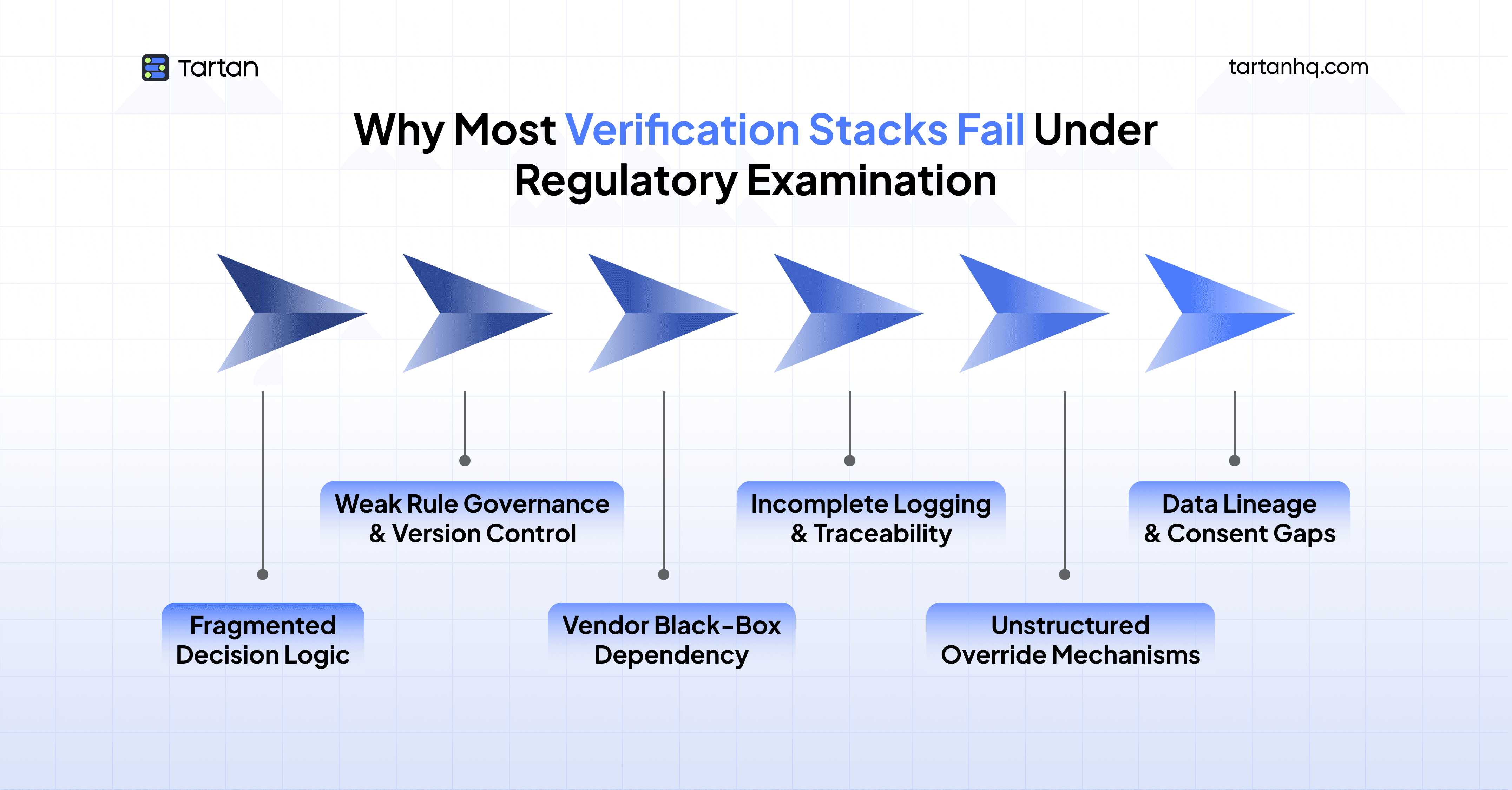
At this stage, many enterprises discover that their verification layer was engineered for execution efficiency rather than regulatory defensibility. Decision logic is dispersed across codebases and vendor systems. Threshold changes lack formal version governance.
What appeared to be a controlled verification framework during scale reveals structural gaps under scrutiny. The system functions when measured by throughput and approval ratios. It fractures when measured by traceability, explainability, and evidentiary integrity.
The difference between operational success and regulatory resilience becomes visible only when a regulator asks a single question: Provide a clear, time-stamped breakdown of the data, rules, and approvals behind this decision.
Verification Architecture Is Optimized for Throughput, Not Regulatory Defensibility
In most enterprises, verification systems are engineered to maximize onboarding velocity and processing efficiency. Performance metrics typically focus on approval rates, turnaround time (TAT), API latency, and conversion impact.
As long as customers move through onboarding without friction and fraud losses remain within modeled thresholds, the verification layer is considered effective.
This operational focus shapes architectural decisions. Integrations are implemented to return fast, deterministic outputs. Each integration improves signal coverage, but rarely contributes to a unified control framework. The objective is functional completion, not structural coherence. Over time, enterprise verification environments evolve through incremental integrations rather than centralized design.
Each new requirement - identity validation, AML screening, document checks, device intelligence, address verification introduces another vendor or microservice into the stack. Individually, these components function as expected. Collectively, they rarely operate as a unified control system.
As this layering progresses, decision logic becomes structurally distributed across multiple control surfaces: application-level code embeds conditional logic; third-party dashboards house configurable thresholds; workflow engines sequence signal evaluation; manual review tools enable discretionary overrides; CRM or case systems log final outcomes. The architecture reflects operational expediency rather than systemic control integrity.
Logging frameworks compound the issue. Most systems capture the final decision outcome and may archive vendor payloads, but they do not consistently preserve the full computational pathway. Missing visibility typically includes:
The exact rule version active at the time of decision
The sequence in which signals were evaluated
Threshold configurations applied at that timestamp
Whether any signals failed or were substituted
Whether overrides were applied and by whom
Under normal operating conditions, this fragmentation remains invisible because throughput metrics remain stable and approval ratios align with portfolio expectations. Under regulatory or forensic scrutiny, the absence of unified decision traceability becomes a structural control gap rather than a minor operational gap.
What Breaks During Audits and Regulatory Reviews
When regulators initiate an audit or supervisory review, the focus shifts from outcomes to causality. It is no longer sufficient to demonstrate that onboarding volumes were processed within SLA or that fraud metrics remained within tolerance bands. The enterprise must demonstrate how each material decision was derived, governed, and recorded.
Operational environments evaluate verification systems on execution metrics processing speed, approval rates, fraud loss tolerance, and SLA compliance. Regulatory examinations apply a different lens control robustness, audit traceability, and decision explainability.
When the evaluation framework shifts from performance to defensibility, structural weaknesses that remain hidden during high-volume operations become immediately visible.
Several control failures typically surface during this phase:
Decision Reconstruction Gaps
Enterprises often cannot precisely reconstruct historical decisions. Auditors require a time-stamped breakdown of signals, rule versions, thresholds, and overrides, but most systems retain only the final outcome with fragmented logs. Without replay capability, reconstruction becomes manual and unreliable.
Rule Governance Ambiguity
Regulators assess whether rule changes follow formal approval and version control. In practice, thresholds often shift due to business pressures without structured documentation, clear ownership, or impact tracking, leaving teams unable to justify why a specific configuration was active at a given time.
Vendor Dependency Exposure
Third-party verification vendors often function as black boxes. Enterprises rely on summary outputs without full visibility into underlying data sources or scoring logic. During audits, if the enterprise cannot clearly explain source coverage, refresh cycles, model governance, or fallback controls, accountability remains with the enterprise not the vendor.
Data Lineage and Consent Mapping Gaps
Regulatory reviews extend into data governance. Enterprises must prove signal origin, retrieval timing, consent linkage, storage controls, and retention policy. Fragmented systems make end-to-end lineage difficult to demonstrate, weakening compliance defensibility.
Under audit scrutiny, these gaps compound. The system may process transactions efficiently, but it fails to generate authoritative, time-stamped, and reproducible evidence to defend how decisions were made.
Regulatory scrutiny shifts verification from a workflow function to a formal control framework. Architectures optimized for speed and scale are tested on traceability and governance depth. When structured oversight, replay capability, and signal transparency are absent, the gap is viewed as a systemic control deficiency - not a minor process lapse.
The Illusion of Compliance Through Vendor Aggregation
Many enterprises equate the addition of multiple verification vendors with stronger compliance posture. The underlying assumption is straightforward: more data sources, more checks, and more integrations should reduce risk exposure and strengthen regulatory defensibility. In practice, the opposite often occurs.
As vendors accumulate, architectural fragmentation increases.
Each provider introduces its own response formats, confidence scores, risk categories, and configuration controls. Without a centralized orchestration layer, these signals operate in parallel rather than within a unified decision framework.
This aggregation creates structural complexity across several dimensions:
Divergent rule configurations across vendors
Overlapping or contradictory risk signals
Inconsistent logging standards
Separate SLA definitions and escalation paths
Variable consent capture and data retention handling
Instead of strengthening compliance integrity, vendor sprawl expands the audit surface area. Regulators do not measure compliance maturity by the number of integrations in place. They assess whether the enterprise can demonstrate standardized governance, consistent rule enforcement, and centralized accountability.
When multiple vendors operate without normalization, enterprises face explainability gaps. During audit, the enterprise must justify how discrepancies are resolved and which source takes precedence. Without codified hierarchy, decisions appear discretionary rather than controlled.
Each integration introduces dependency on external data quality, refresh frequency, model governance, and infrastructure resilience. If oversight mechanisms are weak, enterprises inherit not only signal benefits but also unmitigated external control weaknesses. Regulatory accountability remains internal even when signal generation is externalized.
In incident scenarios, this fragmentation slows root-cause analysis. When a disputed onboarding decision involves three or four vendors, investigative teams must retrieve logs from multiple systems, reconcile inconsistent timestamps, and interpret heterogeneous response schemas.
Without these controls, vendor expansion produces the appearance of layered defense while increasing structural fragility. What appears to be comprehensive coverage under normal operations becomes difficult to explain under scrutiny.
Compliance maturity is measured by coherence, not quantity. Aggregation without orchestration creates complexity without control.
Architectural Principles for Audit-Resilient Verification
Designing verification systems that withstand regulatory scrutiny requires a structural shift from workflow orchestration to control engineering. The objective is not only to validate user data in real time, but to ensure that every decision can be reconstructed, justified, and defended months or years later. Audit resilience is an architectural outcome, not an operational add-on.
An audit-resilient verification framework is built on the following core principles:
Centralized Decision Engine: All signals should flow into one controlled decision layer. This ensures consistent rule sequencing, defined signal precedence, and reproducible outcomes.
Version-Controlled Rules: Every rule and threshold must have a version ID, deployment record, owner, and approval trail. Configuration changes should be auditable control events, not silent edits.
Replay Capability The system must recreate historical decisions exactly as they were executed. This requires storing raw payloads, rule states, timestamps, and override metadata.
Vendor Signal Normalization: External responses should be standardized into internal schemas. Retain original payloads, document fallback logic, and avoid black-box dependency.
Immutable Logging: Logs must be tamper-evident, centralized, and time-synchronized. Capture signal inputs, rule evaluations, thresholds, overrides, and access activity.
Structured Override Governance: Manual approvals must follow defined criteria, documented justification, and supervisory review. Override patterns should be monitored as control indicators.
Consent and Data Lineage Mapping: Each verification call must link to consent artifacts, purpose limitation, retention policy, and access controls. Signal-level lineage should be demonstrable end-to-end.
Clear Control Ownership: Every rule, integration, and vendor relationship must have accountable ownership and review cadence. Verification governance should sit within enterprise risk oversight not remain embedded only in engineering.
Audit resilience is not achieved by layering additional vendors or increasing signal density. It is achieved by designing verification as an integrated control framework with deterministic logic, governed change management, and end-to-end traceability.
Enterprises that adopt these architectural principles reduce audit friction, strengthen incident response capability, and elevate verification from an operational necessity to a governed risk infrastructure.
HyperVerify as the Control Layer for Regulatory-Grade Verification Architecture
Regulatory pressure does not create weaknesses in verification systems, it exposes architectural choices made long before scrutiny began.
When regulators, auditors, or investigative authorities demand historical reconstruction, defensible incident analysis, or rule-level transparency, enterprises face a fundamental architectural test: Was verification built as a governed control system, or layered incrementally to optimize operational speed?
Under scrutiny, integration density does not translate into defensibility. What matters is coherence centralized decision authority, governed configuration management, immutable logging, and reproducible decision pathways.
HyperVerify is architected with this scrutiny model in mind.
Rather than functioning as a collection of loosely connected verification APIs, it operates as a unified control layer. Every signal is evaluated within a governed decision engine. Rule configurations are version-controlled.
Decision pathways are logged with time-stamped traceability. Vendor signals are normalized and retained for audit transparency. Override activity is structured, recorded, and reviewable. This design ensures that when regulators request evidence, enterprises can provide authoritative, reproducible documentation not interpretive reconstruction.
Verification engineered for defensibility reduces audit friction, strengthens incident response precision, and reinforces enterprise credibility in regulated markets. Under regulatory examination, architecture becomes the differentiator. HyperVerify is designed to operate under that level of scrutiny.