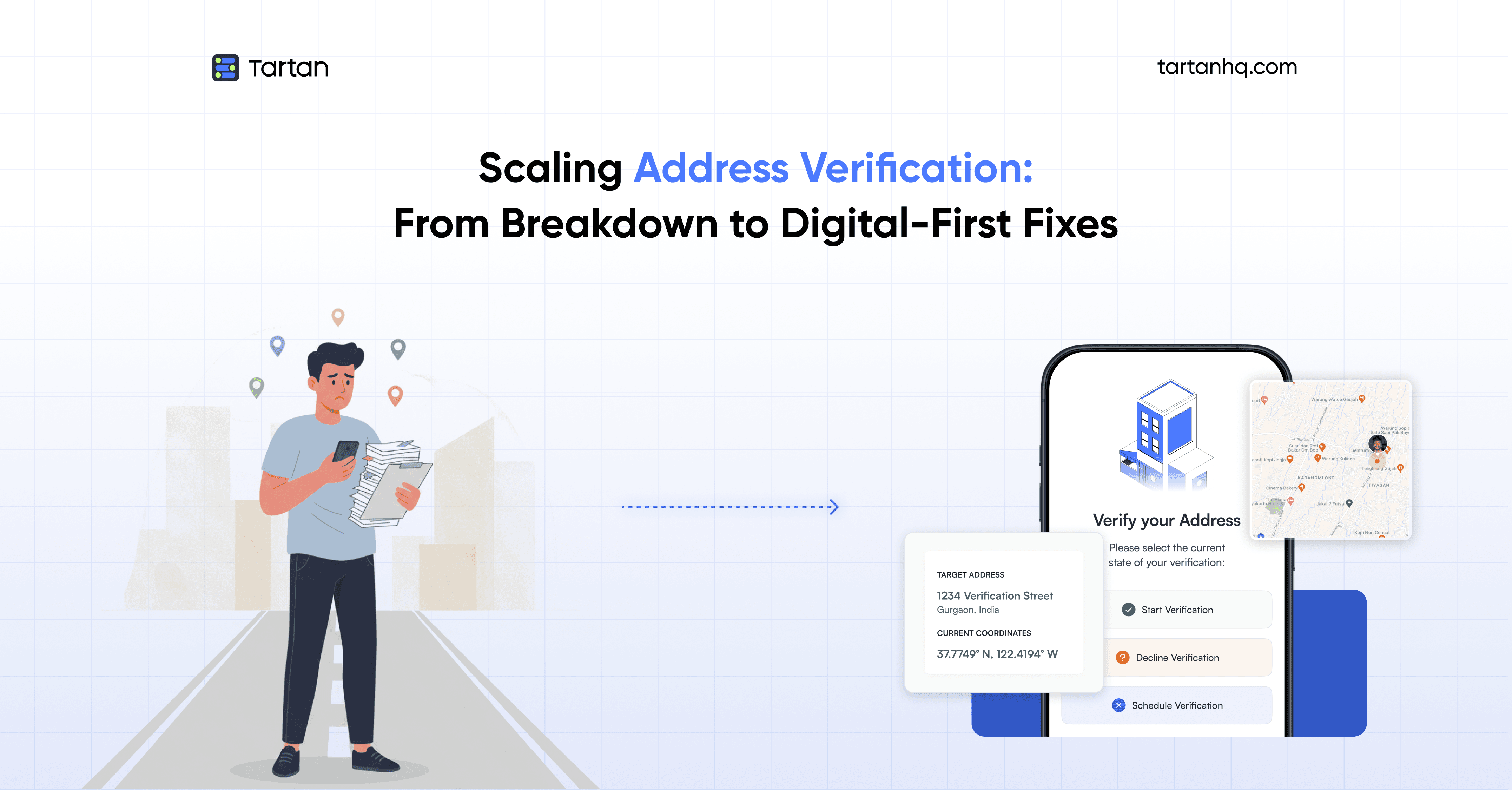
Address verification looks deceptively simple. An address exists. A user submits it. The business verifies it. Move on.
In practice, address verification is one of the hardest trust problems to solve at scale, especially in financial services, insurance, and enterprise onboarding. It sits at the intersection of identity, risk, compliance, and operations - and inherits the failure modes of all four.
Most organizations don’t realize this until they scale. What worked at 10,000 users quietly collapses at 100,000. What felt “safe” starts creating friction. What looked compliant starts failing audits.
This article explains why address verification fails structurally, what a modern digital alternative actually looks like, and how teams can move faster without lowering their risk bar.
The Core Mistake: Treating Address as Static Data Instead of a Living Signal
Traditional address verification systems treat an address as a static attribute. Something you collect once, validate once, and store forever.
That assumption is wrong.
Addresses are not static facts. They are behavioral signals that decay over time.
People move. They use different addresses for different systems. Some addresses are real but not relevant. Others are temporarily valid. Fraudsters exploit all of this.
When verification systems fail, it’s usually because they are trying to answer a binary question (“Is this address valid?”) to a problem that is inherently probabilistic (“How confident are we that this address meaningfully belongs to this identity right now?”).
Why Proof-Based Address Verification Stops Working
Most legacy systems rely on proof collection - documents, visits, or declarations. These methods fail not because they are old, but because they optimize for the wrong thing.
Documents optimize for appearance, not truth
A utility bill or rental agreement verifies that a document exists. It does not verify:
Whether the person currently resides there
Whether the address is actively used
Whether the same address is being reused across identities
Whether the address aligns with other verified behavior
As soon as documents become digital, they become replicable artifacts, not trusted signals. Fraud evolves faster than document formats.
Physical verification optimizes for certainty, not scalability
Field visits feel “strong” because they resemble ground truth. But at scale, they introduce systemic problems:
High latency that directly impacts conversion
Inconsistent outcomes across geographies and vendors
Weak audit trails (photos and notes are not evidence of presence)
Linear cost growth with volume
Most importantly, physical verification does not compound. Every check is isolated. The system never gets smarter.
The Real Challenge: Address Verification Is a Correlation Problem
High-confidence address verification does not come from a single source. It comes from correlation across systems.
An address becomes trustworthy when:
It appears independently in multiple systems
It is used consistently over time
It aligns with financial, employment, and behavioral signals
Changes occur in explainable patterns
No single document can establish this. Only systems can.
This is why modern address verification shifts from proof to signals.
What “Digital Address Verification” Actually Means (Beyond the Buzzword)
Digital address verification is often misunderstood as “online checks instead of offline ones.” That framing dramatically undersells the shift that’s actually required. Moving a physical process onto a screen does not make it digital-first; it merely makes it faster to submit the same weak signals.
A true digital-first system changes how verification decisions are formed, not just how address data is collected. It replaces one-time proof with continuous signals, human judgment with deterministic logic, and binary outcomes with confidence-aware decisioning.
This shift becomes especially important in sectors like lending and insurance, where address accuracy directly impacts risk exposure, regulatory compliance, and downstream financial outcomes.
At its core, modern digital address verification differs in three fundamental ways - and each of these differences matters more in production than teams expect.
It evaluates usage, not just existence
Traditional verification systems ask a narrow question: does this address exist on a document? Digital-first systems ask a much harder and more useful one: is this address actively used by this identity across real systems?
Usage-based verification looks at whether an address appears in contexts that require sustained, real-world interaction. This includes linkages with financial accounts, employment or payroll systems, service subscriptions, and other environments where addresses are not merely declared but operationally relied upon.
These signals are harder to fabricate because they require ongoing participation, not a one-time upload.
In lending, this distinction is critical. An address that exists on a document but shows no usage in financial or employment systems is a common pattern in both first-party misrepresentation and organized fraud.
Conversely, borrowers with thin documentation but strong address usage across legitimate systems are often unnecessarily rejected by document-heavy workflows. Usage-based verification allows lenders to separate lack of paperwork from actual risk.
In insurance, especially group and health insurance, address usage directly affects policy integrity. Policies tied to inactive or non-operational addresses increase the likelihood of misuse, false claims, and enrollment anomalies. Verifying that an address is meaningfully in use - rather than merely listed - helps insurers maintain cleaner risk pools without slowing down enrollment flows.
These are some of the questions that Digital Address verification helps you ascertain answers to -
Is the address linked to active financial accounts?
Does the address appear in employment or payroll systems?
Is the address associated with recurring service usage?
Has it remained stable relative to other identity attributes?
These signals are harder to fake because they require ongoing participation in real systems, not one-time uploads.
Crucially, no single signal needs to be perfect. Confidence emerges from independent agreement across sources.
It measures confidence, not binary validity
Real-world addresses do not behave in binary ways. They are not simply “valid” or “invalid.” They exist on a spectrum of confidence that changes over time.
Digital-first systems acknowledge this reality by producing confidence scores, not yes/no outcomes. These scores reflect factors such as recency of usage, consistency across systems, stability over time, and correlation with other verified attributes. The goal is not certainty, but sufficient confidence for a given decision.
This is where traditional systems quietly create risk. Binary checks force teams to either approve everything that passes minimal criteria or reject anything that doesn’t fit a rigid definition of proof. Confidence-based models allow organizations to align verification outcomes with their actual risk appetite.
For lenders, this means low-confidence address signals can increase pricing, require additional checks, or trigger post-disbursal monitoring - without blocking the entire application. For insurers, confidence scoring allows automated acceptance of clean cases while flagging only those enrollments that show unusual address behavior, rather than slowing down entire cohorts.
A confidence-based model allows teams to:
Automatically approve low-risk cases
Apply stricter scrutiny only where signals conflict
Adjust thresholds without rewriting workflows
Align verification with downstream risk appetite
The result is faster decisions that are more risk-aware, not less.
It produces explainable decisions, not opaque outcomes
Automation without explainability creates compliance debt. Many verification tools can produce a decision quickly, but cannot clearly explain why that decision was made.
This becomes a serious liability during audits, disputes, or regulatory reviews.
Digital-first address verification systems are built to make decisions legible. They record which signals were used, how those signals were weighted, and how the final confidence outcome was reached. Decisions are time-stamped, replayable, and defensible.
In lending, this explainability is essential when applicants challenge rejections or when regulators examine underwriting consistency. In insurance, it supports claim investigations, policy audits, and internal risk reviews by making it clear how address legitimacy was established at the time of issuance.
Explainability also has an internal benefit: it allows risk, compliance, and product teams to evolve policies without guesswork. When teams can see why decisions are being made, they can improve them systematically rather than relying on manual overrides or ad-hoc exceptions.
Why Manual Review Becomes the Enemy at Scale
Manual review feels like control. In reality, it introduces hidden risk.
Human reviewers:
Apply inconsistent standards
Fatigue under volume
Create unstructured audit trails
Can’t reason across multiple systems in real time
Most importantly, manual workflows do not improve over time. They don’t learn. They don’t adapt.
Digital verification systems encode policy once and apply it consistently, producing deterministic, replayable decisions that compliance teams can actually defend.
Where This Shows Up Operationally
When address verification shifts from proof-based checks to signal-based confidence, the change rarely announces itself with a dramatic overhaul. Instead, it quietly rewires how workflows behave across the organization.
In lending, address verification stops acting as a hard gate that pauses applications and starts functioning as an input into credit decisioning itself. Address confidence becomes another risk signal - one that can increase scrutiny, adjust pricing, or trigger follow-up checks without blocking disbursal by default. Low-risk borrowers move through faster, while edge cases are handled proportionately rather than being pushed into the same manual queue.
In insurance, especially in group and health insurance, signal-based bulk verification removes one of the biggest operational choke points: enrollment validation. Instead of slowing down entire employee cohorts or policy batches due to a handful of questionable records, insurers can automatically verify the majority and isolate anomalies early.
This reduces policy leakage and claim misuse while preserving the speed that employer-led onboarding demands.
In enterprise onboarding, address verification no longer sits as a separate compliance task owned by operations. Vendor and partner addresses are verified continuously and consistently across systems, allowing procurement and compliance teams to approve faster without sacrificing audit readiness. Decisions are easier to justify because the reasoning is embedded in the system, not scattered across emails, documents, and manual notes.
Across all these cases, address verification stops being something teams work around. It becomes infrastructure - quietly running in the background, improving speed, reducing risk, and supporting scale without demanding attention.
Why This Problem Is Harder in India (and Similar Markets)
India exposes every weakness in traditional address verification:
Non-standardized addressing
High residential mobility
Informal housing
Uneven document quality
Global, document-heavy systems struggle here because they were built for markets where addresses behave like IDs.
Signal-based systems work because they adapt to how people actually interact with institutions, not how addresses are formatted.
How Tartan Fits Into This Model
Tartan’s Digital Address Verification is built around these digital-first principles:
Live system integrations instead of uploads
Multi-source signal correlation
Confidence scoring with full explainability
API-first automation for production workflows
It doesn’t ask users to prove addresses.
It helps systems understand them.
The Bigger Shift: Address as a Living Trust Signal
The most important change is conceptual.
Address verification is no longer a step you complete before onboarding.
It becomes a continuously verifiable signal your systems can rely on - one that can be re-evaluated as behavior changes, risk evolves, or new data becomes available.
That shift enables faster growth, lower risk, and real operational leverage, because trust is no longer frozen at the point of entry. It compounds over time.
And that’s why teams that scale don’t “optimize” address verification.
They rebuild it as part of their core trust infrastructure.