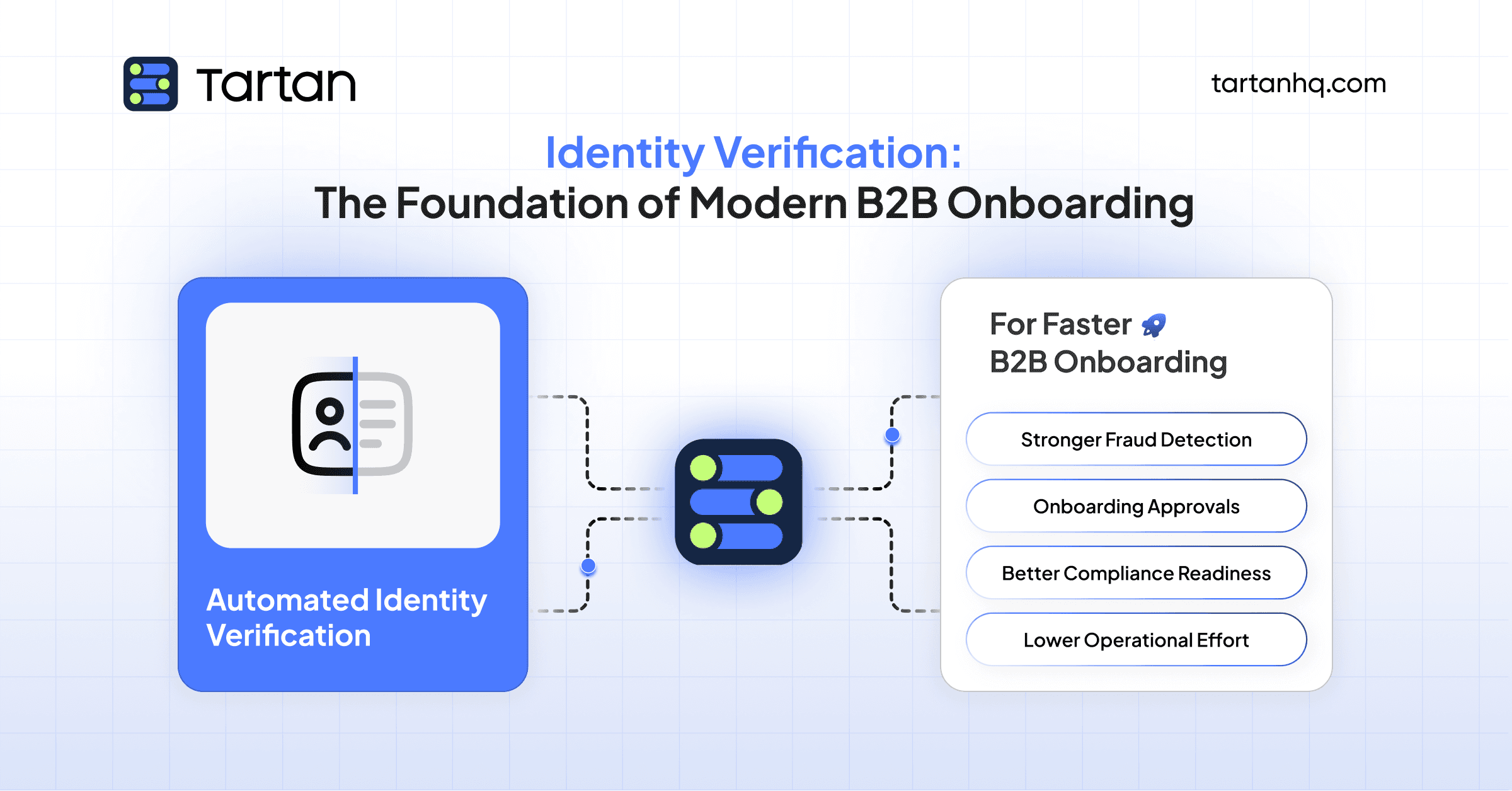
B2B onboarding is no longer a support function.
It directly impacts revenue velocity, fraud exposure, compliance posture, and operating cost.
Yet across industries - financial services, marketplaces, SaaS, and large enterprises - onboarding is still handled through manual identity checks, document uploads, and fragmented verification processes. This approach does not scale with current onboarding volumes or risk expectations.
Automated identity verification is not about efficiency alone. It is about making onboarding reliable, measurable, and defensible at scale.
The Business Cost of Manual Onboarding
Manual onboarding introduces structural inefficiencies that compound as businesses grow.
Slower Activation Impacts Revenue Realisation
In B2B environments, revenue is realised only after onboarding is completed. When identity and compliance checks take days or weeks:
Customers and partners remain inactive despite signed contracts
Sales cycles effectively extend beyond closure
Activation delays reduce realised ARR and GMV
This is especially visible in lending, marketplaces, and enterprise SaaS, where onboarding sits between deal closure and value delivery.
Operations Scale Linearly With Volume
Manual verification requires:
Human review of identity documents
Back-and-forth for corrections or missing data
Exception handling across Ops and Compliance teams
As onboarding volume increases, teams must either accept delays or increase headcount. Neither option is sustainable. Onboarding becomes a fixed cost center instead of a scalable process.
Risk and Compliance Are Addressed Too Late
When identity checks are manual, verification often happens:
After initial approvals
In disconnected systems
Without real-time cross-validation
This increases exposure to:
Identity fraud
Shell entities
Duplicate or misrepresented businesses
The issue is not lack of checks, but lack of timely, system-level verification.
Where Manual Onboarding Breaks in Practice
Fragmented Identity and Business Data
Identity information typically enters the system through multiple channels:
Uploaded documents
Form fields
Email attachments
Third-party portals
Without a unified verification layer, teams are forced to reconcile data manually, increasing errors and reducing confidence in downstream decisions such as underwriting, vendor activation, or partner enablement.
One-Size-Fits-All Verification
Manual onboarding treats all entities the same:
Low-risk and high-risk businesses follow identical flows
Verification depth is not adjusted dynamically
High-quality entities experience unnecessary friction
This increases drop-offs while still failing to address risk optimally.
No Visibility Into Onboarding Status
Business teams lack real-time insight into:
Which stage an entity is in
Why onboarding is delayed
What verification step is blocking activation
This limits accountability, increases internal dependencies, and degrades partner and customer experience.
What Automated Identity Verification Enables
Automated verification shifts onboarding from a document-driven process to a signal-driven system.
Real-Time Identity and Business Validation
Automated systems validate identities directly against authoritative data sources such as:
Government identity registries
Business and corporate databases
Compliance and watchlist sources
This removes dependency on manual document review and ensures that identity is verified before critical decisions are made.
With platforms like Tartan, this means identity is validated as data flows into onboarding-not reviewed after the fact.
Risk-Based, Adaptive Onboarding Flows
Automation enables onboarding flows to adapt based on risk signals:
Low-risk entities are verified and activated quickly
Higher-risk cases automatically trigger deeper checks
Exceptions are routed intelligently instead of manually identified
This reduces friction without weakening compliance or control.
Centralised Visibility and Auditability
With automated verification:
Every verification step is logged
Status is visible in real time
Compliance evidence is persisted automatically
This supports internal governance, regulatory audits, and operational reviews without additional effort.
Scale Without Operational Overhead
Automated verification scales independently of headcount:
APIs process identity checks consistently
Volume spikes do not impact turnaround times
New geographies or entity types can be supported without redesigning workflows
This is critical for enterprises onboarding thousands of entities across markets.
High-Impact Enterprise Use Cases
Lending and Financial Services
Automated identity verification enables faster KYB, director validation, and SME onboarding. Verified data reaches underwriting systems early, improving decision quality and reducing fraud at origination.
Business impact: Faster disbursals, lower risk exposure, stronger compliance.
Marketplaces and Platform Businesses
Vendor and seller identities are verified before activation, preventing duplicate or fraudulent accounts while accelerating onboarding for legitimate businesses.
Business impact: Higher marketplace liquidity with controlled risk.
Enterprise SaaS and Partner Ecosystems
Partner onboarding becomes predictable and fast, reducing delays between contract execution and revenue activation.
Business impact: Improved partner conversion and faster expansion.
Procurement and Vendor Management
Automated verification reduces onboarding delays while maintaining audit readiness for vendors and MSMEs.
Business impact: Lower procurement friction and better compliance control.
Identity Verification as Infrastructure
Enterprises that scale do not treat identity verification as a discrete onboarding task. They design it as foundational infrastructure, embedded across onboarding, risk assessment, decisioning, and compliance workflows.
In these organisations, verification is not something that happens after data is collected. It happens as data enters the system, shaping downstream decisions in real time. This shift is critical because every core business system - underwriting engines, vendor management platforms, partner portals, procurement workflows - depends on the quality and trustworthiness of the data flowing into it.
When identity verification is isolated or manual, unverified data propagates through multiple systems, creating operational rework, compliance exposure, and downstream risk. Treating verification as infrastructure prevents this at the source.
Embedded Directly Into Workflows
Tartan integrates identity and business verification directly into onboarding and operational workflows rather than positioning it as a separate review layer.
As entities are onboarded, whether vendors, SMEs, partners, or customers, identity checks are executed automatically within the flow. This ensures that verification is not dependent on human intervention or process handoffs. Workflows progress only when identity signals meet defined thresholds, enforcing consistency across teams and use cases.
The result is predictable onboarding outcomes, regardless of volume or geography.
Validation Before Data Reaches Core Systems
In traditional setups, unverified or partially verified data often enters core systems such as CRMs, underwriting engines, or procurement platforms, requiring later clean-up and revalidation.
Tartan reverses this model. Data is validated before it reaches downstream systems. Only verified identity and business information is allowed to persist, ensuring that:
Decision engines operate on trusted inputs
Risk models are not polluted by inaccurate data
Manual rework is minimised across functions
This upstream validation significantly reduces operational friction and improves decision quality across the enterprise.
Verification Metadata Persisted for Compliance and Audit
Verification is not only about approval or rejection. It is also about defensibility.
Tartan persists verification metadata, what was checked, when it was checked, against which sources, and with what outcome. This creates a clear audit trail that supports:
Regulatory reviews
Internal risk assessments
Policy enforcement and governance
Instead of reconstructing compliance evidence after the fact, enterprises have it available by design.
From Process to Platform Capability
By embedding identity verification at the infrastructure level, onboarding shifts from a manual, exception-driven process to a platform capability.
Operations teams are no longer gatekeepers
Compliance teams move from reactive review to proactive oversight
Business teams gain confidence in activation timelines
Scale is achieved without proportional increases in cost or risk
Onboarding becomes a reliable system function, not a coordination challenge.
Why This Matters
In high-growth, high-regulation environments, the question is no longer whether identity verification exists, but where it lives.
When verification is infrastructure:
Trust is established early
Decisions are made faster
Risk is controlled systematically
Compliance is built in, not bolted on
This is the architectural shift Tartan is built for, and the model required for enterprises onboarding at scale.
B2B onboarding is no longer about collecting documents.
It is about verifying trust early, consistently, and at scale.
Manual onboarding introduces delays, risk, and cost that compound as businesses grow. Automated identity verification addresses these challenges at a system level-enabling faster activation, stronger compliance, and sustainable scale.
For enterprises building for the next phase of growth, this is not an optimisation.
It is a prerequisite.