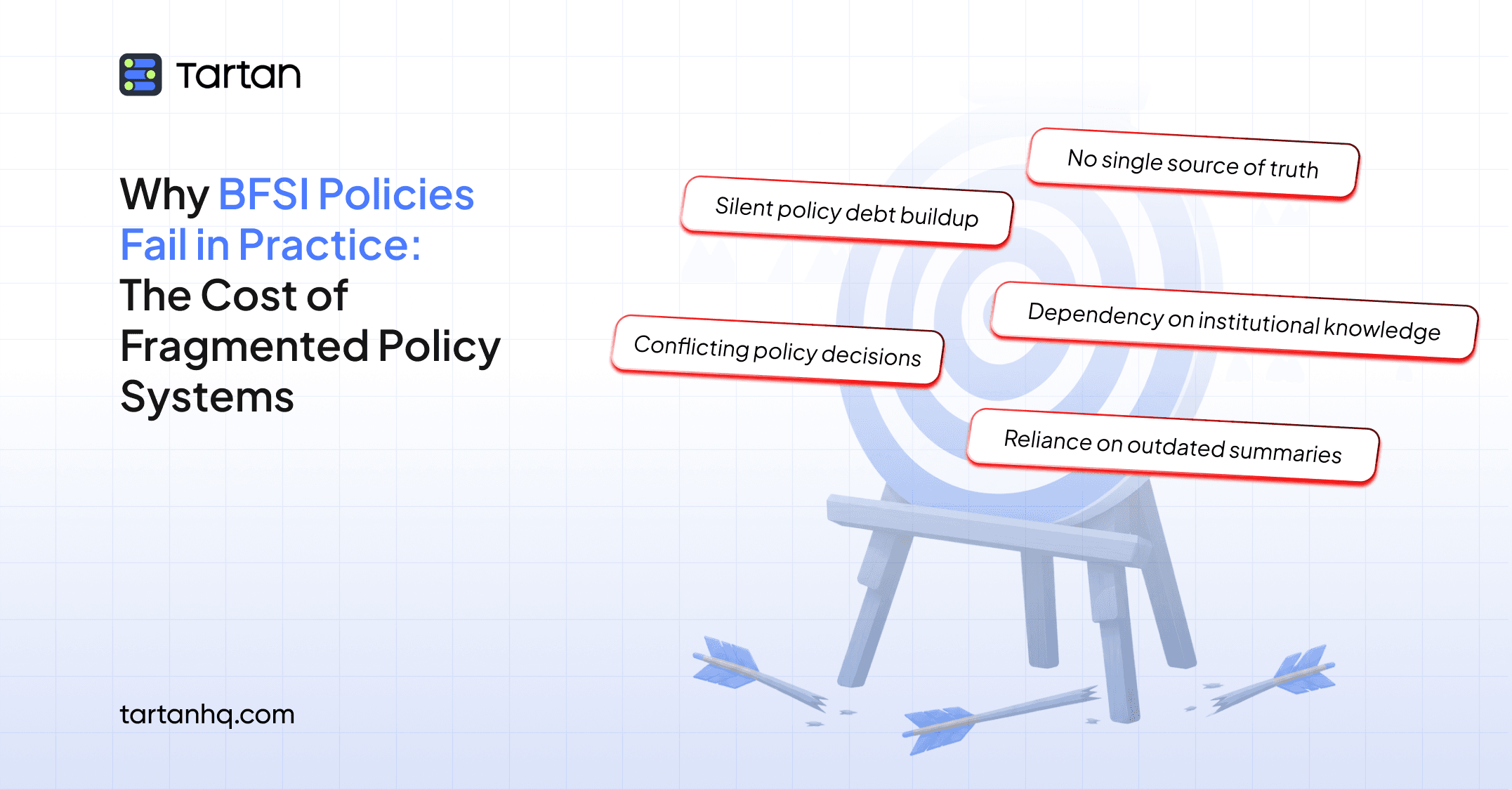
There is a document sitting somewhere in your organisation right now - probably in a shared drive, possibly in someone's email, almost certainly in a folder called something like "Policies_Final_v3_APPROVED_USE THIS ONE" - that is technically the authoritative source on how a particular product, process, or customer scenario should be handled.
Nobody has read it in full in the last six months. The person who wrote it left the company two years ago. There are two other documents that partially contradict it, and everyone has silently agreed to ignore the conflict rather than escalate it. The frontline team that actually enforces the policy is working from a summary that a manager put together in 2022.
This is not a small company problem. This is not a legacy bank problem. This is a BFSI problem - and it is nearly universal.
How policy debt accumulates
Every financial institution starts with reasonable intentions. You write a lending policy. You write a claims policy. You write a KYC policy. Each document is reviewed, approved, and filed. Leadership signs off. Compliance ticks the box.
Then the regulator issues a new circular. So you update the KYC policy - but only partially, because the full update requires sign-off from three departments and the meeting keeps getting rescheduled. Meanwhile, the product team launches a new variant of an existing loan product.
The original lending policy doesn't quite cover it, so someone writes a product-specific addendum. The addendum references clauses from the original policy. The original policy has since been revised. Nobody updates the cross-reference.
A year later, you have a policy ecosystem. Not a policy. An ecosystem - layered, interconnected, and increasingly difficult for any single person to hold in their head. New joiners try to get up to speed and quickly discover that the only way to really understand how things work is to ask someone who has been around long enough to know where the bodies are buried.
This is policy debt.
It accumulates exactly the way technical debt does - gradually, through individually reasonable decisions, until the weight of it starts to slow everything down.
The conflict problem nobody talks about
The most dangerous form of policy debt is not the outdated document. It is the conflicting document - two policies that give different answers to the same question, both technically in force, neither flagged as the winner.
In financial services, these conflicts are more common than most leadership teams realise, because they typically surface only when something goes wrong. A loan officer approves a case that the credit policy permits but the risk policy would have declined.
A claims executive rejects a claim that the product terms would have paid out, because the internal processing guideline says something different. An operations team follows a procedure that was correct eighteen months ago but has since been superseded by a regulatory update that didn't make it into the training material.
Each of these situations creates exposure - regulatory, financial, reputational. And in every case, the root cause isn't a rogue employee or a broken process. It's a policy environment that has become too complex for any individual to navigate reliably.
"The frontline team that actually enforces the policy is working from a summary that a manager put together in 2022. The manager has since moved teams. Nobody updated the summary."
The institutional knowledge trap
Here is the coping mechanism that most BFSI organisations have developed in response to policy complexity: they rely on people.
Not systems. Not documentation. People - specifically, the two or three individuals in each function who have been around long enough to understand how things actually work versus how the documents say they work.
The compliance manager who knows which clauses were added to satisfy a regulator but are never actually applied.
The underwriter who knows that the written policy has a gap in it and has an informal workaround that everyone uses.
The claims head who can resolve a borderline case in ten minutes because she has seen fifty similar ones.
This is institutional knowledge, and it is genuinely valuable.
The problem is that it is also entirely fragile. When that compliance manager leaves, she takes her understanding with her. The informal workaround gets applied inconsistently by different people with different interpretations. The borderline claims start taking three days instead of ten minutes because there is nobody who can call them on sight.
BFSI organisations routinely underestimate how much of their operational reliability rests on individual people who carry policy knowledge in their heads rather than in any system. The risk doesn't show up on a dashboard. It shows up when that person puts in their papers.
What happens when the regulator comes knocking
Regulatory audits are the moment when policy debt becomes acutely visible - and acutely painful.
An auditor asks: what is your current policy on income verification for self-employed borrowers?
The answer should be retrievable in seconds. Instead, what typically happens is a scramble - someone pulls the lending policy from the shared drive, discovers it references a 2021 RBI circular, checks whether that circular has been superseded, finds a product note from last year that seems relevant, and puts together an answer that is mostly correct but cannot be verified against a single authoritative source.
The auditor notes the gap. Not because the policy is wrong, but because the organisation cannot demonstrate control over its own policy environment.
That observation goes into the audit report. It becomes a finding. It requires a remediation plan. The remediation plan takes three months and involves four departments. None of this was necessary if the policies had been maintained in a structured, version-controlled, queryable system from the start.
The irony is that most BFSI organisations are actually compliant in substance - they are doing the right things. The failure is in the ability to demonstrate that they are doing the right things, consistently, with evidence. That is a documentation and governance problem, not a conduct problem. But it carries the same consequences.
Why this doesn't get fixed
Most CROs and compliance heads know this problem exists. The question worth asking is: why doesn't it get fixed?
The honest answer is that fixing it has never felt urgent enough to prioritise over everything else. Policy cleanup is important but not on fire. It competes for bandwidth with regulatory deadlines, product launches, technology migrations, and a hundred other things that have someone senior escalating them.
The policy repository stays in the state it's in because the pain is diffuse - spread across dozens of small decisions and delays - rather than concentrated in a single visible incident.
Until an incident happens. A regulatory penalty, a mis-sold product that generates complaints, an audit finding that requires board-level response. At that point, the policy environment suddenly has everyone's attention. But by then, the remediation is ten times harder than it would have been if the structure had been put in place earlier.
What structured policy governance actually requires
The organisations that have got this right share a few characteristics. They treat policies as living documents in a version-controlled system, not static files in a shared folder. Every change is tracked - who made it, when, what it replaced, and whether it was tested before deployment. Conflicts between policies are surfaced systematically, not discovered accidentally.
They also treat policy access as an operational capability. The frontline team should be able to query a policy in plain language and get a precise, sourced answer - not flip through a 60-page PDF and hope they find the right clause. When a new circular comes in from IRDAI or RBI, the impact on existing policies should be assessable in hours, not weeks.
And critically, when the regulator asks "what is your current policy on X?" - the answer should come from a system, not from a person. Because systems don't leave the company, and systems don't forget.
The question worth asking this week
If your chief compliance officer left tomorrow, how confident are you that her successor could reconstruct a complete, accurate picture of your current policy environment from your documentation alone?
If the answer is "not very" - that's the problem. Not a vague, future problem. A current one, sitting quietly in your shared drive.
The BFSI sector is entering a period of significantly tighter regulatory scrutiny - DPDP Act enforcement, evolving IRDAI guidelines, RBI's increasing focus on governance and controls.
The organisations that have their policy house in order will navigate this with confidence. The ones that are still relying on institutional memory and PDFs that nobody fully understands are one audit away from finding out exactly how expensive that approach has been.