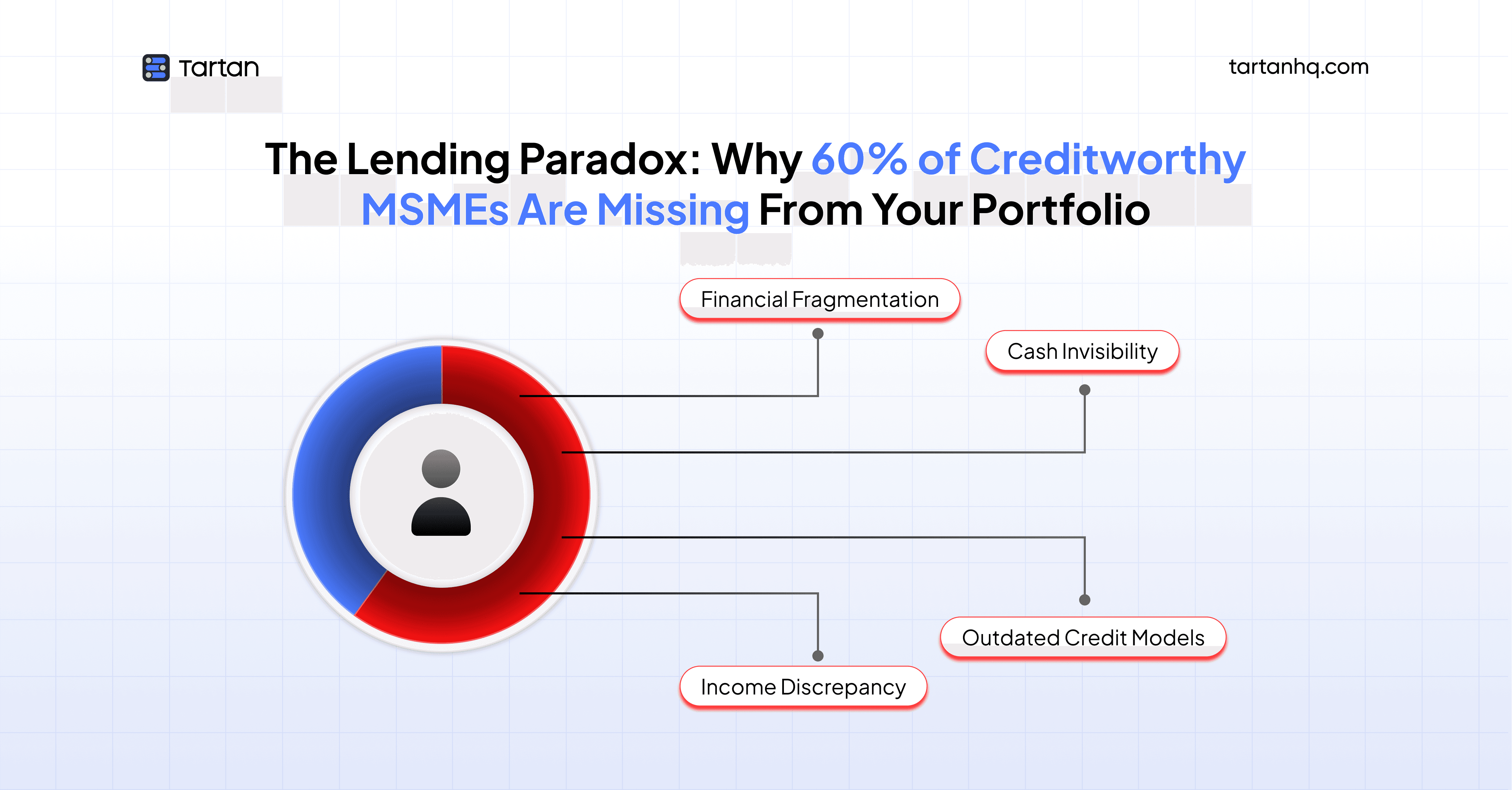
India's MSME credit gap sits at approximately ₹25 trillion. That's not a typo. Twenty-five trillion rupees in unmet credit demand from small and medium businesses that need capital to grow, hire, and contribute to the economy.
The conventional explanation is straightforward: MSMEs are risky, documentation is poor, and lending to this segment requires caution. But this narrative misses something crucial.
The problem isn't that MSMEs are unbankable.
The problem is that our methods for assessing them are fundamentally misaligned with how these businesses actually operate.
A significant portion of loan rejections aren't identifying actual credit risk. They're identifying verification limitations. And that distinction matters enormously, both for the businesses being rejected and for the lenders missing profitable lending opportunities.
The Profitable Business That Looks Risky on Paper
Meet Rajesh, who runs a mid-sized catering business in Pune. His company has operated for seven years, serves 15-20 events monthly, employs 25 people, and generates approximately ₹40 lakhs in monthly revenue. He's never defaulted on a payment to suppliers, maintains long-term relationships with vendors, and has consistent repeat clients including several corporate accounts.
Rajesh applies for a ₹50 lakh working capital loan to purchase new equipment and expand operations. His application gets rejected.
The reason? His bank statements show only ₹18 lakhs in monthly deposits. The business appears to generate less than half the revenue he claims, making the requested loan amount seem disproportionate to repayment capacity.
But here's what the bank statement doesn't capture. Roughly 35% of Rajesh's clients pay in cash, particularly for wedding and social events. Another 25% pay through UPI directly to his personal account, which he uses for operational expenses before transferring profits to the business account. Payment gateway settlements from his online booking system take 2-3 days and don't always fall within the statement period being reviewed.
The actual business generates ₹40 lakhs monthly. The verified business generates ₹18 lakhs monthly. The loan gets rejected not because Rajesh can't repay it, but because the lender can't see the income that would prove he can.
This scenario repeats thousands of times daily across lending platforms in India. Profitable, stable businesses with genuine repayment capacity get rejected because verification infrastructure can't see what's actually there.
The False Choice Between Risk and Opportunity
Lending executives face constant pressure to balance two competing priorities: minimize defaults while maximizing portfolio growth. In practice, this often translates into conservative underwriting criteria that prioritize avoiding bad loans over approving good ones.
The logic seems sound. When income can't be fully verified, err on the side of caution. Reject the application or approve a smaller amount than requested. Better to miss an opportunity than take unnecessary risk.
But this framing assumes that unverified income and actual credit risk are the same thing. They're not.
A business with ₹40 lakhs in actual monthly revenue but only ₹18 lakhs in verified income isn't necessarily riskier than a business with ₹18 lakhs in fully verified income. The first business might actually be more stable, more profitable, and more capable of servicing debt. The only difference is visibility.
When lenders treat verification gaps as risk signals rather than infrastructure limitations, they're not being cautious - they're being systematically wrong about which businesses can actually repay loans.
The consequence isn't just missed individual opportunities. It's systematic underservice of entire business segments that don't fit traditional verification models, even when those segments contain thousands of creditworthy borrowers.
What Traditional Verification Actually Sees
Bank statement analysis has been the backbone of income verification for decades because it provides standardized, relatively tamper-proof evidence of financial activity. For salaried individuals with single income sources deposited regularly to one account, bank statements work brilliantly.
For businesses operating across multiple payment channels, maintaining separate personal and business accounts, or handling significant cash operations, bank statements capture fragments of a larger financial picture.
Consider the income streams that typically don't show up clearly in business bank statements:
Cash payments from customers, particularly in retail, hospitality, and service sectors where cash remains a primary payment method. These transactions happen, the income is real, but it never touches the business bank account before being used for operational expenses or personal withdrawals.
Digital payments to proprietor personal accounts, especially UPI transactions where customers pay the business owner directly rather than through formal business payment channels. This is extremely common in small businesses where the separation between personal and business finances is fluid.
Payment gateway and aggregator settlements that may appear as lump sums rather than individual transactions, making revenue patterns difficult to assess. Or settlements that route through multiple accounts for different payment methods, fragmenting income visibility.
Inter-account transfers between business accounts at different banks, which can look like income but are actually just fund movements. Without seeing the complete picture across all accounts, individual bank statements can be misleading in either direction.
Revenue that's invoiced but not yet collected, particularly in B2B businesses with net-30 or net-60 payment terms. Bank statements show cash flow, not business activity, and for businesses with longer collection cycles, there's often significant lag between earning revenue and banking it.
None of these scenarios indicate financial instability or credit risk. They indicate normal business operations in sectors where multiple payment channels, cash handling, and complex financial flows are standard operating procedure.
Traditional verification wasn't built for this complexity. It was built for simpler financial structures, and applying it to modern MSME operations creates blind spots that look like risk signals.
The Market Lenders Are Missing
When significant percentages of loan applications get rejected due to verification limitations rather than actual credit risk, the aggregate impact becomes substantial.
Consider a digital lending platform processing 10,000 MSME applications monthly with a 40% approval rate. If even 15% of rejections are creditworthy businesses with incomplete income verification, that's 900 potentially profitable loans per month being declined.
At an average loan size of ₹25 lakhs, that's ₹22.5 crores in monthly disbursement opportunity. Annualized, it's ₹270 crores in foregone lending volume from a single platform.
Scale this across India's digital lending ecosystem, and the numbers become staggering. Billions in profitable lending opportunities sit in rejected application databases because verification infrastructure can't see the complete income picture.
The businesses being systematically excluded aren't edge cases. They're mainstream MSMEs operating in cash-heavy sectors, managing multi-channel payments, or maintaining business structures that don't align with verification assumptions built around salaried employment models.
These are restaurants and catering businesses where customer payments span cash, cards, UPI, and aggregator platforms, with settlements flowing through multiple accounts.
Small manufacturing units where B2B payments come through NEFT to business accounts but raw material purchases often happen in cash, creating income-expense mismatches in any single data source.
Professional services firms where client payments might go to partner personal accounts before profit distribution to business accounts, making revenue appear lower than it actually is.
Retail businesses with significant cash operations where end-of-day deposits don't always match daily sales because working capital gets retained for next-day operations.
These aren't risky businesses. They're businesses operating normally within their sectors, and they're being rejected at scale.
What Forward-Thinking Lenders Are Discovering
Some lending platforms are starting to recognize that verification gaps represent market opportunity rather than just risk management challenges. They're asking different questions.
Instead of "Can we verify this income through bank statements?" they're asking "What other data sources would confirm this business's actual revenue and repayment capacity?"
Instead of treating alternative data as a compromise when bank statements are insufficient, they're treating comprehensive multi-source verification as the standard approach for MSME lending.
The results are revealing. Businesses that would have been rejected under traditional verification often perform as well as or better than businesses with clean bank statement verification when assessed using comprehensive data.
GST returns that corroborate claimed revenue levels. Utility consumption patterns that indicate operational scale matching stated business size. Regular supplier payments demonstrating consistent business activity. Digital payment gateway data showing transaction volumes that bank statements alone wouldn't capture.
When these data points align with partial bank statement visibility, confidence in income assessment increases dramatically without requiring every rupee to flow through a single bank account.
The lenders implementing these approaches aren't being reckless. They're being more accurate. They're seeing what was always there but previously invisible to traditional verification methods.
The Competitive Dynamics Shifting Beneath the Surface
Markets evolve through competitive pressure. When some lenders figure out how to profitably serve segments that others are rejecting, market dynamics shift quickly.
The platform that can accurately underwrite catering businesses, small manufacturers, and cash-heavy retailers while competitors are still rejecting them gains first-mover advantage in segments with significant growth potential and relatively low competition.
These businesses remember who approved them when others didn't. Customer loyalty in MSME lending is substantially influenced by who was willing to back the business early, especially after experiencing multiple rejections elsewhere.
There's also a regulatory dimension. Government initiatives around MSME credit access, financial inclusion, and digital lending regulation are increasingly focused on expanding credit availability to underserved segments. Lenders who can demonstrate ability to serve these markets while managing risk effectively position themselves favorably as policies evolve.
The transition is already happening. It's not universally visible yet, but the lenders investing in comprehensive verification infrastructure today are building capabilities that will become competitive necessities tomorrow.
The Infrastructure Question
The challenge isn't conceptual - most lending executives understand that bank statements don't capture complete income pictures for many MSMEs. The challenge is operational.
How do you verify income from multiple sources at scale? How do you maintain fast underwriting timelines while adding verification depth? How do you ensure alternative data sources are reliable and tamper-resistant? How do you update credit models to properly weight multi-source income data?
These are legitimate questions, and they explain why many lenders stick with bank statement-centric verification despite its limitations. It's known, it's scalable, and changing it requires investment and organizational commitment.
But the technology exists. APIs can pull GST data, accounting system information, payment gateway records, and utility data in real-time. Automated analysis can cross-reference multiple data sources and flag inconsistencies for human review. Modern verification platforms can handle comprehensive multi-source income assessment at the speed and scale digital lending requires.
The infrastructure question isn't "Can this be done?" It's "When will we implement it?"
Rethinking What Rejection Actually Means
Every loan rejection is a business decision with underlying assumptions. The assumption embedded in most MSME rejections is: "We can't verify enough income to justify this loan amount."
But what if the more accurate statement is: "Our current verification infrastructure can't see enough of this business's actual income to justify this loan amount"?
That's a fundamentally different problem. The first suggests the business itself is the issue. The second suggests the verification system is the limitation.
For lenders, this distinction matters because it reframes rejected applications from "risky businesses we properly avoided" to "potentially profitable opportunities we couldn't accurately assess with current tools."
For MSMEs, this distinction matters because it explains why profitable, stable businesses with genuine repayment capacity struggle to access formal credit despite being perfectly capable of servicing it.
The Questions Worth Asking
If you're involved in MSME lending decisions, a few questions might be worth considering:
What percentage of your rejections are actually verification limitations rather than credit risk? If you could see the complete income picture for businesses currently being rejected, how many would actually qualify?
How much lending opportunity sits in your rejected application database because verification infrastructure couldn't see what was actually there? What would your MSME portfolio look like if you could accurately assess businesses that don't fit traditional verification models?
Where are your competitors building verification capabilities that you haven't invested in yet? What happens to your market position when they can profitably serve segments you're still rejecting?
These aren't rhetorical questions. They're strategic considerations that will increasingly influence competitive positioning in MSME lending markets.
The businesses getting rejected today won't stop needing capital. They'll find it somewhere - from lenders who built verification infrastructure capable of seeing their actual financial capacity.
The only question is whether that lender will be you.