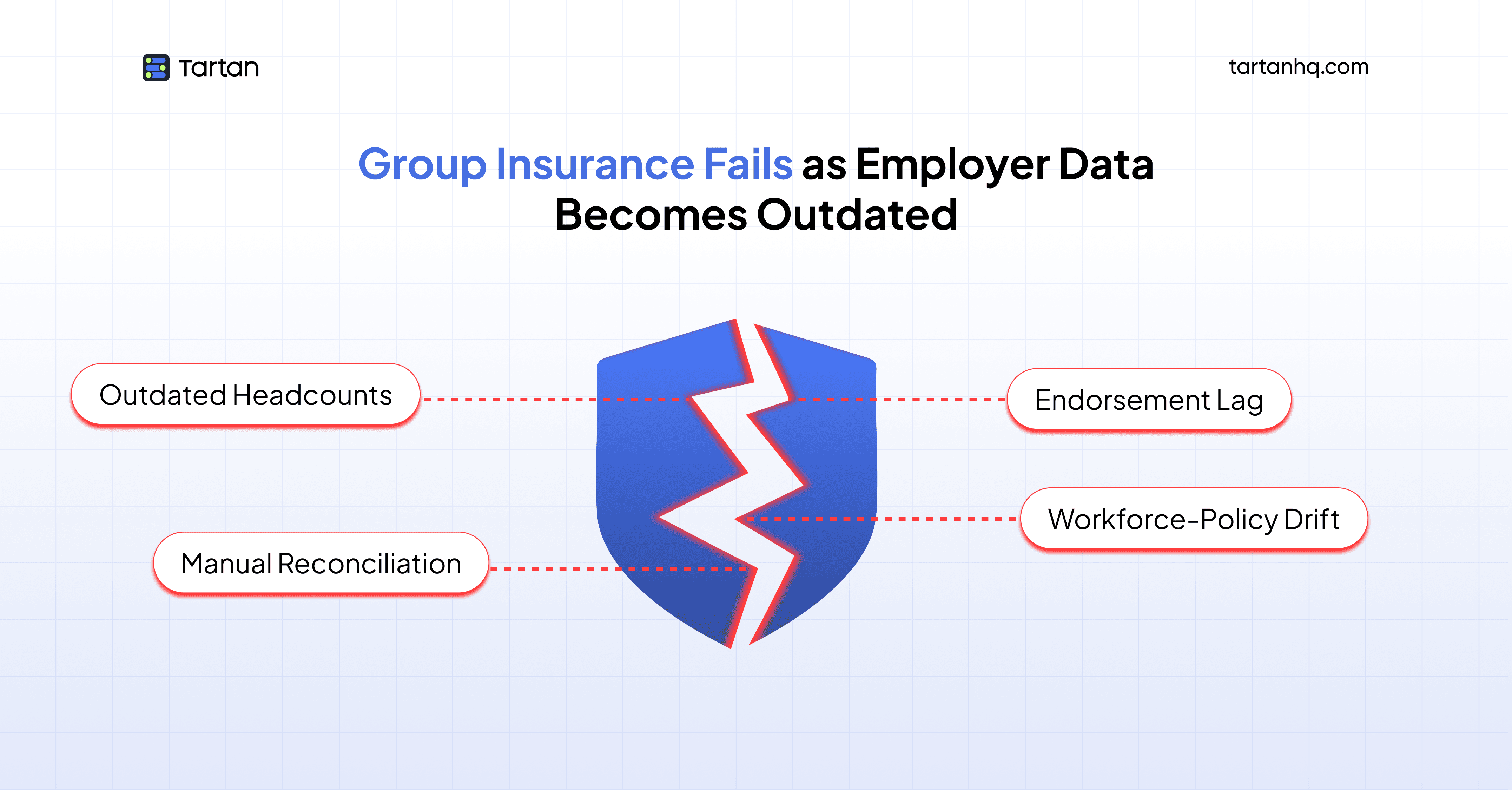
The Invisible Fragility in Group Insurance
Group insurance operates on a paradox: policies are underwritten, priced, and serviced based on workforce data that begins decaying the moment it's captured. Every premium calculation, every coverage decision, every renewal assumes a snapshot of reality that's already outdated by the time the policy goes live.
The problem isn't the initial data - it's what happens after. Employer data isn't static. Employees join, resign, get promoted, go on leave, or shift to contract roles. Yet most group insurance workflows treat workforce information as if it's carved in stone, updated only when someone remembers to send a spreadsheet or when an annual renewal forces a refresh.
This gap between operational reality and policy administration isn't just an inconvenience - it's a structural flaw that quietly undermines profitability, customer trust, and operational efficiency across the entire insurance value chain.
Where Stale Data Quietly Hurts
The damage from outdated employer data isn't always loud or immediate, but it compounds across three critical areas:
Incorrect Active Lives → Premium Leakage
When insurers bill based on headcounts that no longer reflect reality, the financial impact flows in both directions:
Overcharging downsized customers creates immediate disputes and accelerates churn risk, especially with cost-conscious enterprise clients
Undercharging growing organizations leaves 8-15% of premium revenue on the table across typical policy portfolios
Ghost employees (departed staff still on the policy) represent pure cost with zero risk transfer value
Uncovered active employees create liability exposure and potential regulatory issues if discovered during audits
The mismatch doesn't just erode margin - it makes pricing accuracy impossible and turns every renewal into a reconciliation exercise rather than a strategic conversation.
Delayed Joiner/Leaver Updates → Claim Disputes
Timing gaps between workforce changes and policy updates create predictable conflict scenarios:
The March joiner, April claim, May policy update problem: Employee starts March 15, files a claim April 10, gets added to the policy May 1. Who pays? These aren't edge cases - they're monthly occurrences across large group portfolios.
The exit-but-still-covered scenario: Employee resigns January 15, files claim February 5, HR sends exit update February 28, insurer processes it March 15. Result: claim paid for non-eligible member, followed by recovery attempts and relationship damage.
Dependent coverage ambiguity: When employee status changes affect dependent eligibility, delayed updates create cascading claim disputes across family members.
Claims team resource drain: Adjusters spend 30-40% of processing time on eligibility verification rather than claim assessment, directly impacting TAT and customer satisfaction.
Every eligibility dispute at claim time is a triple loss: operational cost to resolve, customer trust erosion, and potential regulatory scrutiny if patterns emerge.
Manual Follow-ups with HR Teams → Operational Drag
The hidden tax of stale data shows up in ops team calendars and email volumes:
Monthly census reconciliation calls with HR teams across hundreds of group accounts consume 15-20 hours per ops manager per week
Spreadsheet version control chaos: "Final_census_v3_revised_actual_final.xlsx" becomes the operational reality
Format inconsistency across employers: Every company sends data differently - CSV, Excel, PDF, email, portal uploads - requiring custom handling and error-prone manual processing
Data quality issues multiply: Missing employee IDs, name spelling variations, inconsistent date formats, unclear employment status codes
Escalation overhead: When data doesn't match, ops teams mediate between underwriting, claims, finance, and customer HR departments
Multiply this friction across 500+ group policies, and what looks like "just some admin work" becomes a significant cost center that doesn't scale and diverts skilled resources from higher-value activities.
Why Annual or Periodic Endorsements No Longer Work
The traditional model - update policies quarterly or annually via endorsements - was designed for a different era of employment. It assumed workforce stability: employees stayed for years, organizational structures changed slowly, and periodic snapshots were good enough proxies for reality.
The Old Assumptions Have Collapsed
That world no longer exists, and the data proves it:
Attrition has accelerated: Average employee tenure has dropped from 4.2 years (2010) to 3.1 years (2024) across major metros, with tech and retail seeing 25-30% annual churn
Hiring volatility has increased: Companies now hire in bursts tied to project cycles, funding events, or seasonal demand rather than steady growth curves
Employment types have diversified: The rise of contract workers, consultants, part-time staff, and gig arrangements means headcount isn't just changing - the composition of "who counts" is constantly shifting
Remote work has removed friction: Geographic barriers to hiring and firing have disappeared, accelerating workforce movement and making census data stale faster than ever
The Endorsement Model's Breaking Points
Policy update cycles haven't kept pace with this velocity:
A quarterly endorsement means 90 days of drift: That's three months where every joiner is uncovered and every leaver is still being charged for
Annual updates mean 12 months of accumulated errors: By renewal time, reconciling a year's worth of workforce changes becomes an archaeological exercise
Endorsement processing takes 15-30 days: Even when data arrives, underwriting review, approval workflows, and policy amendment cycles add weeks of additional lag
Retroactive adjustments create accounting nightmares: Backdating coverage, calculating premium adjustments, and issuing credits/debits for past periods generates finance team overhead and customer confusion
The gap between how fast businesses move their workforce and how slowly policies reflect those moves has become a systemic liability that no amount of manual effort can close.
The Real Cost (CXO Lens)
From a leadership perspective, stale employer data creates multiple categories of business risk that directly impact P&L, growth metrics, and strategic positioning:
Revenue Leakage (CFO Impact)
Premium calculations based on outdated headcounts translate to measurable financial losses:
Underpriced policies across growth accounts: When workforce data lags by 6+ months, high-growth customers pay premiums based on old headcounts while actual risk exposure increases - leaving 10-18% of potential premium unrealized
Missed upsell opportunities: Real-time visibility into workforce expansion should trigger coverage expansion conversations, but delayed data means these moments are discovered months late or never
Premium refund obligations: Overcharging customers who've downsized creates contractual refund obligations that hit as one-time P&L adjustments during reconciliation cycles
Actuarial model drift: When pricing models are trained on historically accurate data but deployed against stale operational data, predicted loss ratios diverge from actual experience, undermining portfolio profitability
Over a portfolio of 1,000+ group policies, these individual leakages aggregate to millions in annual revenue impact that never appears as a line item but steadily compresses margin.
Customer Dissatisfaction at Claim Time (CRO/CCO Impact)
The worst moment for data discrepancies to surface is when a customer needs the product to work:
Eligibility disputes damage trust: When employees are told their claims are denied due to coverage gaps stemming from delayed policy updates, the blame flows to both the employer and the insurer
Support escalation volumes spike: Claims disputes require senior intervention, consuming leadership time and creating bottlenecks in resolution workflows
NPS and retention metrics suffer: Post-claim surveys consistently show data/admin issues as top detractors, directly correlating with reduced renewal rates
Enterprise relationship risk: For large accounts where group insurance is part of a broader benefits partnership, operational friction in one product line can jeopardize the entire relationship
Referral pipeline impact: Dissatisfied corporate clients don't recommend their insurer to peer companies, directly limiting organic B2B growth
In group insurance, where customer acquisition costs are high and growth depends on retention and referrals, every friction point at claim time is a growth tax.
Reputational Damage with Enterprise Accounts (CEO/Growth Impact)
Large employers expect operational excellence from their insurance partners, and stale data failures signal the opposite:
Vendor performance reviews: CFOs and HR heads managing benefits stacks evaluate insurers on operational efficiency - repeated data reconciliation issues lower scores and make renewals contentious
Competitive displacement risk: When competitors pitch with "real-time data integration" capabilities, it highlights operational gaps and provides concrete reasons to switch
Regulatory and audit exposure: Insurance regulators and corporate auditors both scrutinize whether group policies accurately reflect covered populations - systematic data staleness creates compliance risk
Brand perception in enterprise segment: Word travels fast in corporate benefits circles - being known as "the insurer that can't keep employee data current" limits market positioning
For insurers targeting enterprise accounts as a growth strategy, operational reputation is a strategic asset. Stale data problems erode it systematically.
Operational Cost Inflation (COO Impact)
Beyond revenue and reputation, outdated data directly inflates the cost to serve:
Ops team scaling challenges: As policy count grows, manual data reconciliation doesn't scale linearly - it scales exponentially as cross-account complexity increases
Technology debt accumulation: Building custom integrations with each employer's HRIS or maintaining legacy data ingestion processes creates ongoing maintenance burdens
Error correction costs: Fixing coverage gaps, processing retroactive adjustments, and managing premium corrections consumes finance and underwriting resources
Delayed automation ROI: Investments in claims automation, underwriting digitization, or self-service portals all depend on clean, current data - stale data blocks the value realization from these initiatives
The operational cost of managing stale data doesn't shrink as an insurer grows - it becomes a scaling bottleneck that limits efficiency gains and forces continued manual intervention.
The Compounding Effect: How Small Lags Create Big Problems
Data staleness doesn't impact insurance operations in isolation - it creates cascading failures across interconnected processes:
Underwriting Mispricing → Claims Surprise → Loss Ratio Deterioration
When policies are priced on six-month-old census data, the underwriting team is pricing against a ghost workforce. If the actual active lives have grown by 20%, the loss ratio will miss targets because claims volume will exceed projections. This forces reactive pricing corrections at renewal, which customers perceive as rate hikes, triggering churn and adverse selection.
Admin Friction → Customer Escalation → Sales Cycle Elongation
When prospect companies hear from peer references that "their onboarding process requires tons of HR back-and-forth for employee data," it adds friction to the sales cycle. Enterprise buyers now evaluate operational smoothness during the RFP process, and data integration capabilities have become table stakes in competitive evaluations.
Delayed Problem Detection → Accumulated Errors → Renewal Crisis
Many data issues only surface during annual renewal reconciliation, when a year's worth of discrepancies hit simultaneously. This turns renewals from routine administrative events into crisis management exercises, consuming leadership bandwidth and creating customer dissatisfaction at the worst possible moment in the relationship lifecycle.
What "Real-Time Data" Actually Means (and Why It Matters)
The solution isn't faster spreadsheets - it's eliminating the spreadsheet paradigm entirely and replacing periodic data dumps with continuous synchronization:
From Snapshots to Live Sync
Real-time employer data integration means:
Event-driven updates: When an employee joins, leaves, changes role, or updates dependents in the employer's HRIS, the policy reflects that change within hours, not months
Bidirectional validation: The insurer's policy admin system and the employer's HRIS stay synchronized, with automatic conflict detection and resolution workflows
Audit trails and consent management: Every data sync is logged, versioned, and tied to explicit employer authorization, ensuring compliance and transparency
Standardized schema: Data arrives in consistent, normalized formats regardless of whether the employer uses Workday, SAP, BambooHR, or legacy on-premise systems
The Operational Transformation
When data flows continuously instead of periodically, the entire operational model changes:
Underwriting moves from annual events to continuous adjustment: Premiums can be adjusted monthly based on actual headcount, aligning revenue with risk exposure
Claims eligibility becomes deterministic: No more judgment calls about whether someone was covered - the system knows definitively who was active on the date of service
Customer service shifts from reactive to proactive: Ops teams can alert employers about coverage gaps before they become claim disputes
Finance reconciliation becomes automated: Premium billing, adjustments, and collections flow from system data rather than manual spreadsheet reconciliation
The Strategic Unlock
Beyond operational efficiency, real-time data enables new business models:
Usage-based pricing: Charge per active employee per month rather than fixed annual premiums, aligning costs with actual utilization
Embedded insurance: Integrate directly into HR platforms where employers already manage workforce data, reducing friction to zero
Predictive risk management: With continuous data flow, insurers can identify adverse risk trends (like sudden attrition spikes) early and adjust proactively
Product innovation: Real-time workforce visibility enables new coverage types tied to employment events, role changes, or organizational restructuring
Key Takeaway
Group insurance doesn't break at underwriting. The models are sound, the risk calculations are sophisticated, and the pricing logic is robust. It breaks in the gap between updates - in the silent drift between when workforce data changes and when policies reflect that change.
The companies that solve for real-time employer data integration won't just reduce operational friction. They'll fundamentally shift the economics of group insurance by closing the gap between policy intent and lived reality, one data sync at a time.
The question for insurance leaders isn't whether to modernize workforce data integration - it's whether to lead the transition or be disrupted by competitors who move first.