Insurance verification rarely fails when it is executed.
It fails at the point of reliance, when historical verification decisions are expected to carry financial, regulatory, and contractual accountability.
Across onboarding, underwriting, endorsements, renewals, and claims, insurance enterprises execute dozens of checks for identity, address, income, employment, medical disclosures, nominee details, device and location signals, fraud screening, and regulatory validations.
Each step produces an output. Each output is stored. Each decision is logged. The limitation becomes visible only when a claim is triggered.
At the point of claim submission, when earlier verification must hold up under scrutiny, enterprises frequently discover fragmented artifacts rather than defensible evidence.
Verification does not break at onboarding.
It breaks when a claim tests whether earlier decisions were made with enough context to defend them.
Claims Are The Real Stress Test For Verification Architecture
Onboarding and claims serve fundamentally different business objectives, and insurance verification systems are rarely designed to reconcile that difference.
Onboarding workflows are engineered to maximize throughput. The constraints are conversion, turnaround time, and operational efficiency. Verification at this stage is evaluated on whether it enables policy issuance without friction - low drop-offs, minimal manual intervention, and predictable SLA adherence.
Claims operate under an entirely different risk and accountability model. Once financial liability is triggered, verification outcomes are no longer assessed on completion metrics, but on defensibility.
Claims, audit, and regulatory stakeholders require a defensible account of what was verified, the underlying data sources, the decision logic applied, associated confidence levels, and the validity of those conclusions at the time of loss.
These priorities pull the system in different directions:
At onboarding: speed, low friction, and completion
At claims: consistency, traceability, and defensibility
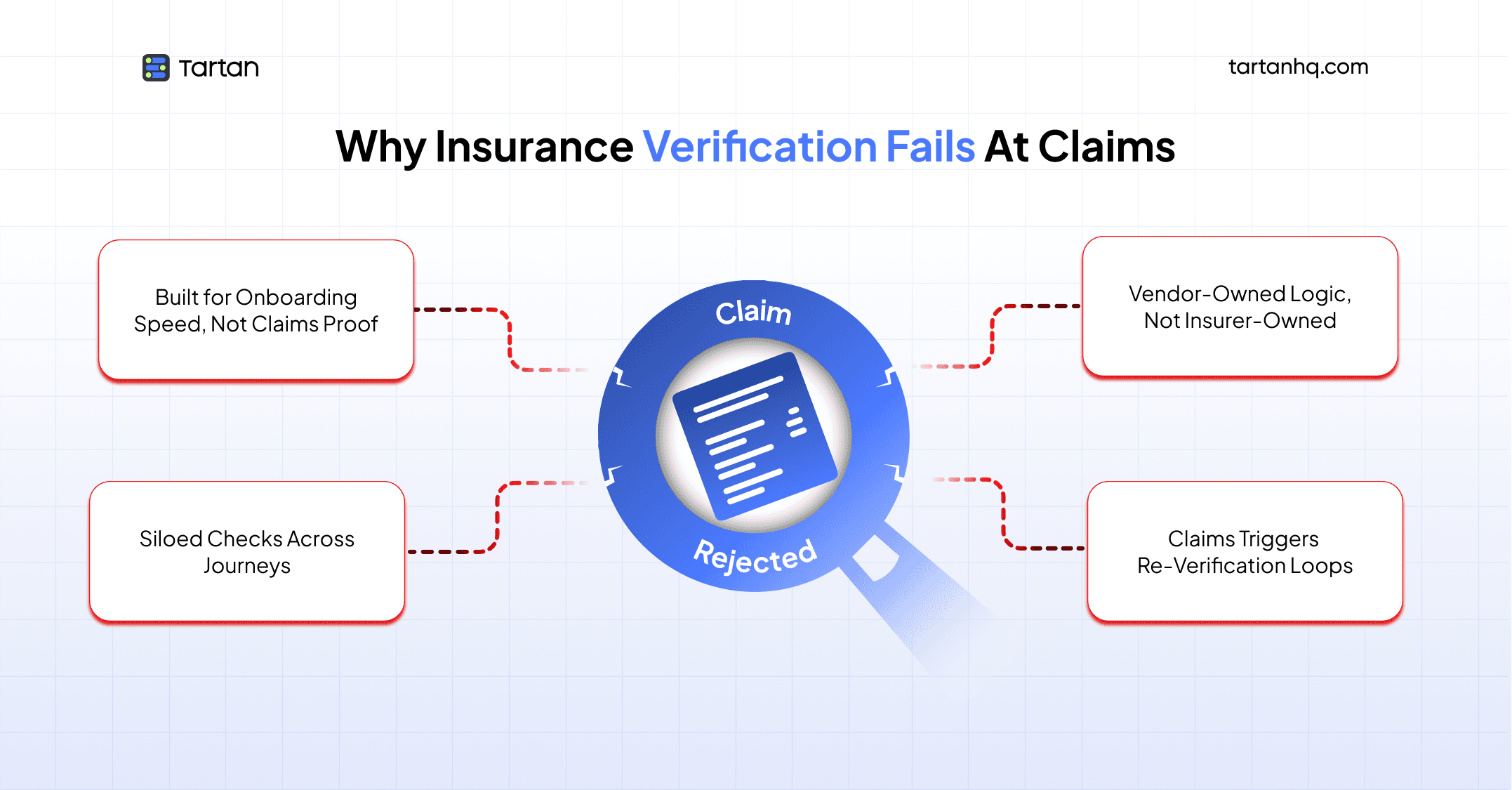
The issue is not that insurance enterprises fail to perform verification early in the lifecycle but early-stage verification decisions are rarely architected with downstream reliance in mind. They are optimized to complete a workflow, not to support future financial, legal, or regulatory accountability.
As a result, verification context decays over time. Policies evolve, customer circumstances change, and risk signals age. By the time a claim is raised often months or years after issuance the original assumptions, thresholds, and confidence levels that informed the onboarding decision are no longer visible or recoverable.
Claims teams are forced to re-verify, reconstruct past decisions, or dispute claims on incomplete evidence, each increasing cost, delay, and regulatory risk.
Verification Breaks Because It Is Designed As A Phase, Not A System
Most insurance verification stacks did not emerge from a single architectural decision. They evolved incrementally, driven by near-term pressures rather than lifecycle design.
A regulatory update introduced a new check.
A fraud pattern triggered a new vendor.
A product expansion required a new workflow.
A distribution change added another verification layer.
Each intervention solved an immediate problem in isolation. Over time, these isolated fixes accumulated into a fragmented verification estate spread across teams, vendors, journeys, and systems, with no single point of control or continuity.
The result is a verification stack that is operationally functional but structurally misaligned with how insurance risk actually unfolds.
Where Verification Fragmentation Enters The System
Workflow-locked checks: Verification is built into individual journeys instead of reused across the policy lifecycle.
Vendor-driven outcomes: Decisions rely on vendor responses rather than enterprise-owned logic and thresholds.
Outcome fixation: Systems record whether a check passed or failed, but not how the conclusion was reached or how confident it was.
These gaps stay hidden during normal operations and become evident only when verification decisions are challenged through claims disputes, fraud reviews, audits, or regulatory scrutiny.
How Fragmentation Gets Embedded Into Verification
One-time verification: Verification is executed once and treated as final, even though customer profiles, exposure, and risk signals continue to change over the policy lifecycle.
Journey-specific logic: Each function - onboarding, underwriting, servicing, claims applies its own verification rules and assumptions, with no shared baseline.
Vendor-owned context: Critical verification details remain inside vendor systems, not within the insurer’s core decision stack.
Verification looks finished from an operational view, but lacks durability when decisions must be relied upon later. When claims, audits, or disputes arise, teams are forced to compensate for missing context rather than act on trusted evidence.
The Real Cost Of Re-Verification At Claims
When prior verification cannot be relied upon at claims, insurance enterprises default to defensive operating modes. Decisions slow down, controls tighten reactively, and teams compensate for structural gaps with manual effort.
What appears as a claimed inefficiency is accumulated verification debt surfacing at the point of financial exposure.
Operational Impact
Extended claims cycle times: Verification checks are repeated or revalidated, introducing delays into what should be a decision-driven process.
Manual workload expansion: Claims handlers, investigators, and ops teams intervene to reconcile gaps across systems, vendors, and documents.
Reactive investigations: Instead of risk-led triaging, investigations are triggered late, based on suspicion rather than signal continuity.
Operational drag compounds quickly at scale. Even a small percentage of claims requiring re-verification creates bottlenecks across claims processing, customer support, and investigation teams, eroding throughput and predictability.
Financial Impact
Delayed settlement of genuine claims: Customers with legitimate claims experience longer turnaround times, increasing escalation handling costs and retention risk.
Higher fraud leakage: Early risk indicators identified during onboarding or underwriting are not connected at claims, weakening fraud detection effectiveness.
Reduced recovery effectiveness: Weak or incomplete historical verification evidence limits subrogation, recovery, and dispute resolution outcomes.
Financial impact rarely shows up as a single line item. It manifests through rising loss ratios, higher operating costs per claim, increased goodwill payouts, and long-term erosion of portfolio profitability.
Regulatory And Audit Impact
Limited decision traceability: Enterprises struggle to demonstrate how verification conclusions were reached across different policy journeys.
Inconsistent standards across similar claims: Claims involving comparable risk profiles are handled differently due to fragmented verification baselines.
Increased audit and compliance overhead: Significant effort is spent reconstructing evidence from multiple systems to satisfy auditors and regulators.
Regulatory exposure is amplified when verification decisions cannot be explained consistently. What begins as an operational workaround can escalate into governance, compliance, and reputational risk.
Why Stored Verification Outputs Fail As Evidence
Insurance enterprises often equate data retention with defensibility. The assumption is: if verification artifacts are stored, decisions can be defended later. In practice, the opposite is true.
Most verification outputs are preserved as static records - documents, images, flags, or PDFs without the surrounding decision context. While these artifacts may confirm that a check was performed, they do not explain:
How a conclusion was reached,
Why it was considered acceptable,
Whether it remained valid as risk evolved over time.
When financial liability is triggered, this distinction becomes critical. Claims, audit, and investigation teams are not evaluating whether verification occurred; they are assessing whether prior conclusions can be trusted under scrutiny.
Where Static Artifacts Fall Short
Missing source lineage: Records rarely capture which data sources informed a verification decision or how source reliability was weighted.
Weak temporal alignment: Verification outcomes are stored without clarity on when they were valid relative to policy issuance, endorsements, or the time of loss.
Absent decision logic: Rules, thresholds, and exceptions applied at the time of verification are not retained alongside the output.
Without these elements, stored artifacts cannot function as evidence. They describe an outcome, but not the reasoning behind it leaving enterprises unable to explain or defend decisions when challenged.
When claims teams cannot determine how, when, or with what confidence a fact was established, they cannot rely on historical verification. Re-verification becomes a necessity not because of fraud, but because evidence lacks integrity.
The Onboarding-To-Claims Gap Is A Verification Continuity Issue
Insurance verification does not fail because checks are absent or insufficient.
It fails because verification decisions do not persist as a reliable asset across the policy lifecycle.
Most verification activity is executed in silos optimized for the immediate needs of onboarding or underwriting. Once those workflows conclude, the verification outputs are treated as complete and archived.
When a claim is eventually raised, earlier verification decisions are expected to support financial liability despite having been designed for a different point in time and a different risk context. What is missing is continuity, the ability for verification decisions to remain relevant, interpretable, and defensible as the policy moves from issuance to loss.
Verification continuity requires three things to hold together across the policy lifecycle.
First, verification signals must persist beyond the journey in which they are generated - identity, address, income, and risk indicators should not silently expire after onboarding, but remain available as decision inputs over time.
Second, each verification outcome must preserve its decision context, including the sources used, thresholds applied, exceptions permitted, and the confidence with which the conclusion was accepted. Without this context, historical verification cannot be reliably reused or defended.
Third, verification must be consumable across underwriting, endorsements, renewals, servicing, and claims, rather than being recreated independently by each function.
Verification is executed and recorded, but not maintained as a dependable decision asset leaving claims teams exposed when outcomes carry financial, regulatory, and reputational consequences.
How HyperVerify Reframes Verification As Enterprise Infrastructure
HyperVerify is architected as a verification layer rather than a point solution because insurance enterprises do not suffer from a lack of checks they suffer from fragmented decision ownership across the policy lifecycle.
Instead of embedding verification logic inside individual journeys such as onboarding, underwriting, or claims, it decouples verification from workflows altogether and positions it as a shared, lifecycle-grade service.
At an architectural level, HyperVerify centralizes verification orchestration across data sources and vendors, establishing a unified signal and data model that standardizes how identity, address, income, and risk indicators are evaluated and stored.
This shift materially changes how verification functions in practice. Onboarding verification is no longer a disposable compliance step, but a reusable evidence layer that downstream teams can rely on.
Underwriting decisions carry forward into claims with their original context intact, strengthening defensibility rather than forcing re-validation. Claims teams inherit structured verification context - sources, logic, confidence, and freshness instead of fragmented documents and flags.
Risk and fraud teams gain longitudinal visibility across the policy lifecycle, enabling pattern recognition and early intervention rather than reactive investigation.
What Lifecycle-Grade Verification Changes For Insurance Enterprises
When verification is designed to persist across the policy lifecycle, the impact is not incremental, it is structural. The benefits show up most clearly at claims, but they extend across risk management, operations, and governance.
Claims And Customer Outcomes
Reduced re-verification loops: Prior verification decisions can be relied upon, limiting the need to re-run checks during claim adjudication.
Faster settlement for genuine claims: Claims teams operate with verified context instead of starting investigations from scratch.
Lower dispute and escalation volume: Decisions are easier to explain and defend, reducing customer friction and grievance handling.
Risk And Fraud Outcomes
Earlier risk signal utilization: Signals identified during onboarding or underwriting remain available at claims, strengthening fraud detection.
Shift from case-led to pattern-led investigation: Risk teams gain longitudinal visibility across policies and customers, enabling proactive intervention.
Improved loss ratio control without added friction: Fraud leakage is reduced through better signal continuity, not heavier customer checks.
Operational Outcomes
Lower manual effort across claims and investigations: Teams spend less time reconstructing history across systems and vendors.
Clear ownership of verification logic: Decision standards and thresholds are governed centrally rather than embedded across journeys.
Reduced dependence on vendor dashboards: Verification intelligence resides within enterprise systems, not external tools.
The Future Of Insurance Verification Is Not More Controls
Insurance enterprises do not gain leverage by adding more vendors, documents, or rules. That approach increases surface area without improving decision confidence.
What is required instead is verification continuity, the ability to treat verification as a continuously evaluated state rather than a series of isolated checks.
In a continuity driven model:
Verification evolves with customer and risk changes
Claims rely on accumulated evidence, not re-checks
Risk decisions are informed by lifecycle signals
Audits interrogate systems, not teams
The onboarding-to-claims gap is not a workflow issue. It reflects how verification has been structurally positioned within the enterprise.
Enterprises that continue to treat verification as a journey-specific compliance task will keep absorbing its cost at claims through delays, disputes, fraud exposure, and regulatory effort. Those that elevate verification into a lifecycle capability gain something more durable than speed or compliance.
The result is not faster onboarding or stricter controls. It is tighter decision ownership across the policy lifecycle and materially lower exposure when liability is tested.