And why "vendor logic" isn't a defensible answer
When a regulator asks why a customer's policy application was rejected, "our vendor flagged it" is not an answer - it's an admission of lost control.
Yet this is precisely where many insurers find themselves when scrutinized about verification outcomes. Not because they lack sophisticated systems, but because verification infrastructure was never designed to answer the question regulators now routinely ask: why?
Verification Has Become a Regulatory Decision
The nature of verification in insurance has fundamentally changed. What was once treated as an operational task - checking boxes to confirm identity, address, or income - now carries the weight of consequential decisions that affect consumer rights.
Modern verification outcomes directly determine policy issuance, claim admissibility, pricing models, and underwriting decisions. When a verification check fails, it's not a neutral data point. It's effectively a declined customer, a delayed claim, or a repriced policy. And regulators increasingly treat it as such.
The shift is subtle but profound. Regulators no longer simply ask "was this verified?" They ask "why was this approved or rejected?" They want to understand the reasoning, the data sources, the thresholds, and the decision logic that led to an outcome that impacted a consumer.
Every failed verification is now a regulated decision, not a backend checkbox. This reframing changes everything about how verification systems must be designed, documented, and defended.
Where Insurers Break Down When Asked "Why?"
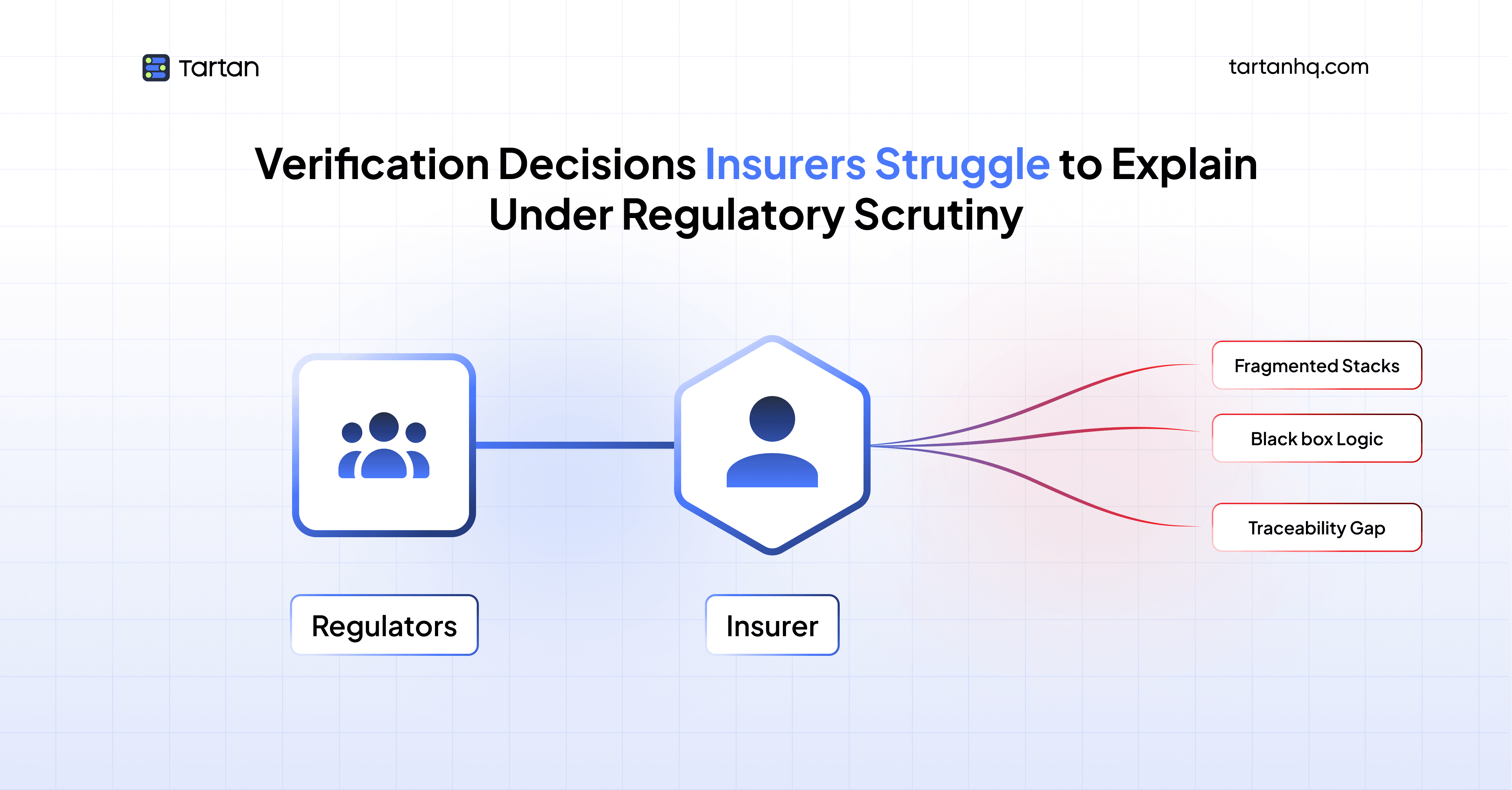
When regulatory inquiries arrive, insurers routinely discover their verification infrastructure cannot answer basic questions about its own decision-making. The breakdowns typically occur in three areas.
Fragmented Verification Stacks
Most insurers operate verification as a constellation of point solutions rather than a unified system. Identity checks run through one vendor, address validation through another, income verification through a third, medical history through a fourth, and vehicle records through yet another provider.
Each system operates independently, producing binary outputs - pass or fail - with minimal context. When all checks complete, operations teams synthesize these disparate signals into a final decision, often through manual judgment or undocumented heuristics.
The problem emerges when regulators ask: "Which specific data points led to this rejection?"
No one can answer. The decision trail exists across multiple systems, vendor portals, and operator notes. Reconstructing the logic that produced a specific outcome becomes an archaeological exercise, often impossible weeks or months after the fact.
Black-Box Vendor Logic
Even when insurers can identify which vendor system triggered a failure, they typically cannot explain why that system reached its conclusion.
Vendor platforms expose results, not reasoning. An identity verification might return "mismatch detected." A fraud score might indicate "risk threshold not met." An address check might simply say "unverifiable."
Insurers are left unable to explain what was actually compared, which data source was deemed authoritative, what tolerance thresholds were applied, or why specific discrepancies were considered disqualifying while others were not.
This opacity creates an accountability gap. Regulators don't regulate vendors - they regulate insurers. When an insurer cannot explain a decision made by its own systems, regulators see a failure of governance, not a vendor limitation.
Accountability cannot be outsourced. But when verification logic lives entirely within vendor black boxes, that's effectively what has occurred.
No Policy-Level Traceability
Perhaps the most critical gap is the disconnect between verification outcomes and policy-level requirements.
Verification decisions are rarely tied to product rules, underwriting guidelines, or regulator-approved policy language. A customer might be rejected based on thresholds and logic that were never formally approved as part of the product design or compliance review process.
This creates a dangerous gap between compliance intent and system execution. The insurer's documented underwriting guidelines might say one thing, while the actual verification systems enforce something else entirely - different thresholds, different data sources, different tolerance for ambiguity.
When regulators compare policy documents to actual decision-making, this divergence becomes indefensible.
Why "Vendor Logic" Fails as a Regulatory Defense
When pressed to explain a verification decision, insurers sometimes retreat to a simple position: "Our vendor's system made that determination based on their proprietary models."
This answer satisfies no one, least of all regulators.
Regulators expect deterministic reasoning, explainable decision flows, and audit-ready documentation for any system that affects consumer rights. Pointing to vendor logic suggests the insurer has ceded control over regulated decisions to an external party without maintaining independent oversight.
If a decision affects consumer rights - whether it's denying coverage, increasing premiums, or rejecting a claim - the insurer must be able to explain it, even if a vendor executed it. The insurer remains the regulated entity. The insurer issues the policy. The insurer makes the promise to the consumer.
"Our vendor flagged it" implies no internal controls, no independent validation of decision criteria, and no meaningful governance over outcomes. It suggests the insurer doesn't actually understand its own decision-making process.
This is not a position any insurer wants to defend during a regulatory examination.
The Operational Reality Inside Insurers
To be clear, this situation rarely stems from negligence or indifference. It's structural.
Verification logic has grown organically over years, often decades. Each business unit added tools to solve immediate problems - fraud in claims, identity theft in new business, address accuracy in policy administration. Each vendor relationship was justified by real operational needs.
No one set out to build an unexplainable system. But no one designed the system for regulator interrogation, post-facto explanation, or cross-vendor reasoning either. These requirements simply weren't on the radar when most verification infrastructure was implemented.
The result is a Frankenstein architecture: functional enough to process transactions at scale, but fundamentally unable to answer questions about its own logic.
What Regulators Increasingly Expect
Regulatory expectations around verification explainability are tightening, both explicitly through formal guidance and implicitly through examination practices.
Regulators now routinely look for decision lineage - the ability to trace from inputs to checks to rules to outcomes. They want to see override visibility, understanding when and why humans overruled automated systems. They expect consistency, where the same data produces the same outcome regardless of channel or timing.
They also scrutinize change control, wanting to know what changed when verification logic or thresholds were updated, and whether those changes were properly reviewed and approved.
These expectations mirror the standards long established in credit underwriting and anti-money laundering systems. Regulators are simply applying the same governance principles to verification decisions, recognizing that these decisions carry similar consumer impact.
What Defensible Verification Actually Looks Like
A verification system capable of withstanding regulatory scrutiny has distinct characteristics that set it apart from the fragmented, vendor-dependent architectures most insurers operate today.
First, it features centralized verification orchestration. Rather than treating verification as a collection of disconnected checks, decisions flow through a unified system that coordinates multiple data sources while maintaining a coherent decision trail.
Second, the insurer maintains explicit ownership of decision rules. Vendor outputs are treated as inputs - signals to be evaluated - not as final decisions. The insurer's rules determine how those signals are weighted, combined, and resolved into outcomes.
Third, every decision generates time-stamped logs that tie data sources to rules applied to outcomes generated. This creates an audit trail that can be reconstructed and explained months or years later.
The governing principle is simple: vendors provide signals, insurers make decisions.
This isn't about eliminating vendors. It's about maintaining control over how vendor data is used to reach conclusions that affect consumers.
The Business Case Beyond Compliance
While regulatory defensibility might be the immediate driver, explainable verification delivers broader business value.
Faster regulatory audits reduce the time and resources spent responding to examinations. Fewer escalations and re-verifications improve operational efficiency. Clearer customer communication reduces friction in the application and claims process. Lower dispute ratios mean fewer complaints and better customer retention.
Perhaps most significantly, insurers with explainable verification systems build stronger trust with regulators and distribution partners. They can move faster in launching new products, entering new markets, or acquiring books of business because they can demonstrate control over their decision-making processes.
This is not compliance overhead. It's operational infrastructure that enables scale.
The Reckoning Ahead
Verification systems were built for speed and automation, not for explanation and governance. For years, that was sufficient. No longer.
Regulators are forcing a fundamental shift from black-box verification to governed decisioning. The gap between current capabilities and regulatory expectations is widening, not closing.
Insurers who address this now - who rebuild verification infrastructure with explainability and control as design principles - will find themselves with a significant advantage. They'll scale faster, defend decisions better, and avoid the reactive compliance firefighting that consumes resources and constrains growth.
Those who wait will eventually be forced to rebuild under regulatory pressure, a far more expensive and disruptive proposition.
The question facing every insurer is not whether verification systems must become explainable, but whether that transformation happens proactively or in response to a regulator's uncomfortable question: "Can you explain why you made this decision?"
If the honest answer is no, it's time to rebuild.