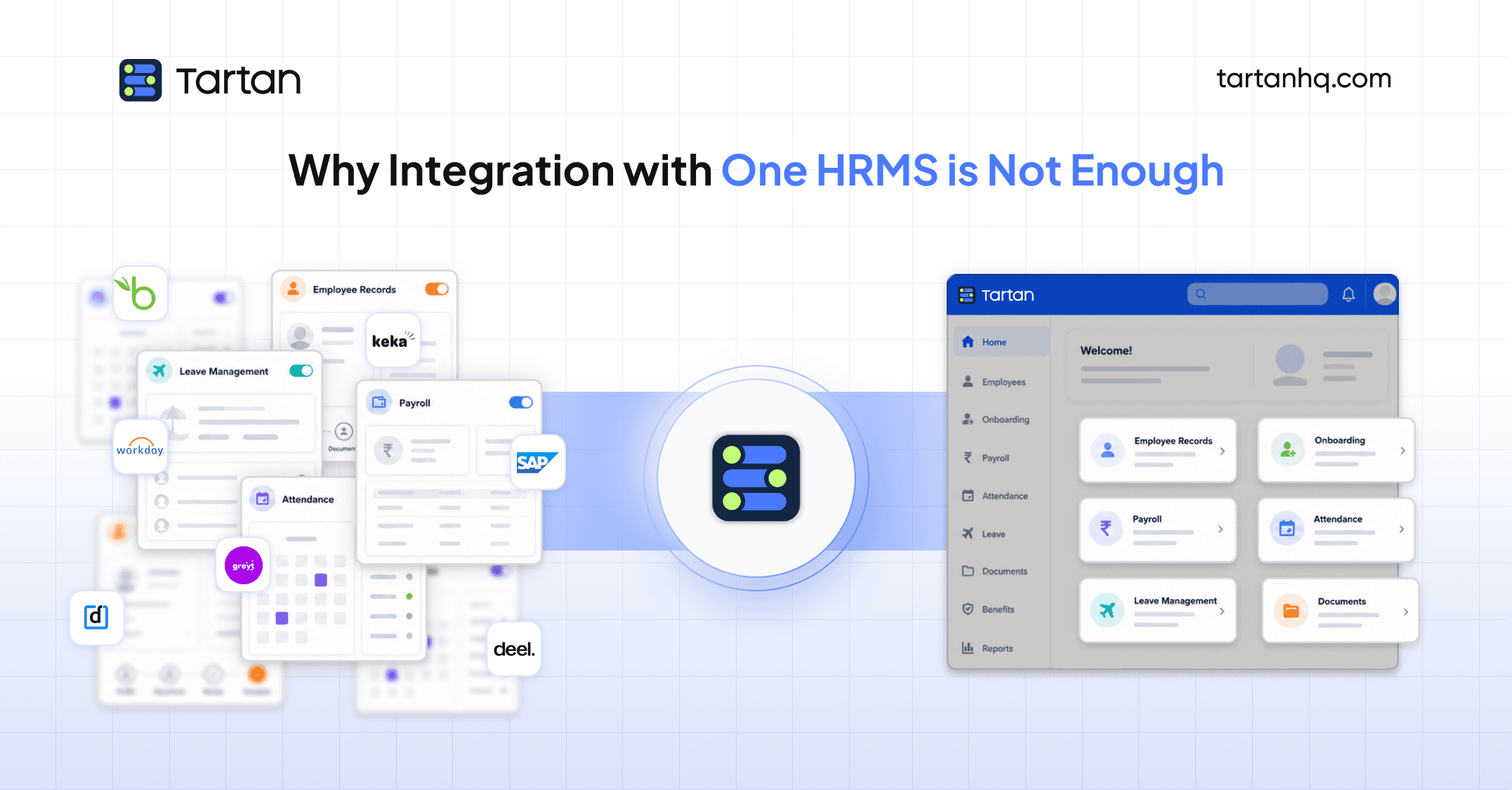
Here is a scenario that plays out constantly across India's B2B SaaS, fintech, and BFSI landscape. A product team spends three months building a deep integration with Darwinbox - India's fastest-growing HRMS.
They test it thoroughly, document it well, and ship it. The sales team is thrilled. Finally, a proper integration story to take into enterprise deals.
Then the first large prospect comes in. A 4,000-person manufacturing conglomerate. The deal is good. The use case fits perfectly. But the prospect runs GreytHR for their India operations, SAP SuccessFactors for their international subsidiary, and a legacy PeopleSoft instance for the entity they acquired two years ago that nobody has migrated yet. The Darwinbox integration is irrelevant to all three.
This is not a rare situation. It is the default situation in Indian enterprise. And it is the reason why "we have an HRMS integration" is not a complete answer to the enterprise data problem - it is the beginning of a much longer, more expensive conversation.
The fragmentation reality of India's HRMS market
India's HRMS market is genuinely fragmented in a way that many product and engineering teams underestimate until they are deep inside an enterprise sales cycle. Unlike the US market, which has consolidated significantly around a handful of dominant platforms, India's enterprise HR software landscape is spread across a wide range of local and global players - each with meaningful market share in specific segments.
Darwinbox has grown aggressively in the mid-market and newer enterprises.
GreytHR and Keka are deeply embedded in SMEs and many mid-sized companies.
Zoho People has a large installed base among businesses already in the Zoho ecosystem.
SAP SuccessFactors and Oracle HCM dominate in large corporates and PSUs.
Workday is present in the largest multinationals.
Bamboo HR, HiBob, and others have pockets of presence.
And then there are the legacy systems - the bespoke payroll software built on old Oracle or Microsoft infrastructure that a 25-year-old company has been running for two decades and has no immediate plan to replace.
At the small-company level, this fragmentation doesn't matter much.
You pick your top two or three platforms and cover most of your market.
But at the enterprise level - and specifically for B2B products that sell to large BFSI institutions, insurance companies, lenders, and corporates - a single prospect frequently brings multiple HRMS platforms into the conversation simultaneously.
Not by design. By history. Acquisitions, subsidiary structures, regional operations, and legacy decisions have left most large Indian enterprises running a patchwork of HR systems that nobody fully intended and nobody is in a hurry to consolidate.
Why this matters beyond the obvious
The most visible cost of HRMS fragmentation is the one every sales engineer encounters: the integration gap. Your product connects to Darwinbox. The client uses Keka. Deal stalls. Everyone scrambles. You promise a roadmap. Three months later you have a Keka integration. Your next prospect uses Zoho People.
But the less visible cost is what happens to the products that do manage to build multiple integrations over time. Each new HRMS integration is not just a development project - it is an ongoing maintenance commitment. APIs change. Authentication methods get updated. Data schemas shift.
A platform releases a new version that breaks your field mapping. Every integration you maintain is a surface area that can break in production, on a Sunday evening, when your enterprise client is trying to run payroll or onboard a new corporate account.
For a fintech or insurtech selling to large companies, this maintenance burden compounds rapidly. Build five integrations and you have five things that can break. Build ten and your engineering team is spending a meaningful portion of their capacity not building product features but keeping existing connections alive.
This is integration debt - and it accumulates exactly the way technical debt does, until the weight of it starts to limit what the product team can actually build.
"Building a production-ready integration with a single HRMS platform typically takes two to three months for an experienced developer. Maintaining five of them is a different problem entirely - and it never gets smaller."
There is also a data quality problem that sits underneath the fragmentation. When a product integrates with multiple HRMS platforms independently, each integration tends to return data in a slightly different format.
Employee IDs are structured differently. Employment status codes mean different things in different systems. Date formats vary. Department hierarchies are organised differently. Every new HRMS integration requires custom normalisation logic to make the data usable downstream. Do this five times and you have five different normalisation pipelines, each with its own edge cases, quirks, and failure modes.
The specific problem for BFSI and fintech
For most B2B SaaS products, HRMS fragmentation is an inconvenience.
For BFSI and fintech products - lenders, insurers, banks, benefits platforms - it is a core business problem, because the employee data sitting inside those fragmented systems is not just operational data. It is the raw material for credit decisions, insurance eligibility, premium calculations, and compliance verification.
Consider a lending platform that uses employment and income data to make underwriting decisions. Their model depends on knowing, in real time, that an applicant is currently employed, at what salary grade, for how long.
If the applicant's employer runs Keka and the lender only has a Darwinbox integration, the lender either asks for manual documents - salary slips, employment letters - or declines to lend. Both outcomes are bad. The first reintroduces the manual process the API was supposed to eliminate. The second is lost business.
Or consider a group insurance platform managing benefits for 200 corporate clients.
Each corporate client uses a different HRMS. New employees join these companies every month.
Exits happen. Salaries change. The insurer needs all of this data, in real time, from all 200 clients, to keep coverage accurate and premiums correct. Building direct integrations with every HRMS in use across those 200 companies is not a project. It is a company.
This is the point at which the "just build more integrations" answer breaks down entirely. The problem is not a matter of building capacity - it is architectural. You cannot scale point-to-point integrations to cover the full diversity of HRMS platforms in Indian enterprise. The math does not work.
What the right architecture looks like
The answer to HRMS fragmentation is not more integrations. It is a different integration model - one that abstracts the fragmentation behind a single, standardised layer.
A unified HRMS API works by sitting between your product and the underlying HRMS platforms. Your product connects once, to the unified layer. The unified layer handles connectivity to every HRMS - Darwinbox, GreytHR, Keka, SAP, Oracle, Workday, Zoho, and every other platform your clients might use. Data comes back in a consistent, normalised format regardless of which HRMS the client is running. When a new HRMS platform needs to be added, it is added once to the unified layer and becomes immediately available to every product built on top of it.
For the product team, this changes the nature of the problem entirely. Instead of managing ten integration projects and ten maintenance commitments, you manage one. Instead of building custom normalisation logic for every platform, you work with a standardised data model.
Instead of stalling on deals because a prospect uses an HRMS you haven't integrated with yet, you walk into every enterprise conversation knowing you support whatever they are running.
The go-to-market implication of this is significant and often underestimated. An enterprise product that can credibly claim to work with any HRMS a prospect uses is not just more technically capable - it removes a common objection from the sales conversation entirely. The question shifts from "do you support our HRMS?" to "how quickly can we go live?" That is a fundamentally different conversation to be in.
The consent and compliance layer
In India, any product accessing employee data from an employer's HRMS has to navigate a clear consent and compliance question - particularly as the Digital Personal Data Protection Act comes into effect and BFSI regulators tighten their expectations around data governance.
A well-designed unified HRMS API handles this not as an afterthought but as a structural feature. Consent is captured at the point of HRMS connection - the employer's HR administrator explicitly authorises the data access, defines its scope, and can revoke it at any time. Every data pull is logged.
The audit trail exists from day one. This is not just good practice - it is increasingly a regulatory requirement for any product operating in the BFSI space.
Products that build direct HRMS integrations without a consent layer are taking on compliance risk that compounds over time. As regulation tightens, retrofitting consent management onto an existing integration architecture is significantly harder than building on top of a layer that already has it. This is one of the less-discussed reasons why a unified API approach makes long-term sense beyond the operational convenience - it positions the product correctly for the regulatory environment that is arriving, not the one that existed two years ago.
What changes when you solve this properly
The products that have built on a unified HRMS layer - rather than managing a portfolio of direct integrations - report a consistent set of changes in how their business operates.
Enterprise sales cycles get shorter, because the integration question is answered before it becomes an objection. Onboarding timelines compress dramatically - what used to take weeks of back-and-forth with client HR teams now takes days, sometimes hours. Data quality improves because normalisation is handled centrally rather than inconsistently across multiple integration pipelines.
Engineering capacity gets redirected from integration maintenance to product development. And the product's addressable market expands - every enterprise client that runs any HRMS is now a viable prospect, not just the ones who happen to run the platforms you've integrated with.
For BFSI products specifically, there is one more change that matters enormously: the quality of the underlying data improves. When employment and income data comes from a live HRMS connection rather than a document or a periodic export, it is current. It reflects the actual state of the employee's relationship with their employer at the moment the data is requested. For credit underwriting, insurance premium calculation, or compliance verification, current data is not a nice-to-have. It is the difference between a decision made on solid ground and one made on an assumption.
The build-vs-buy question
At this point, a CTO reading this will ask the obvious question: should we build a unified layer ourselves, or buy access to one?
Building it yourself is technically feasible - but the economics rarely work. Covering 15 to 20 HRMS platforms with production-grade integrations, normalised data models, consent management, and ongoing maintenance is a multi-year engineering investment. For a product company whose core value proposition is not "we built a great HRMS integration layer," that investment is almost always better deployed elsewhere.
The platforms that have tried to build this in-house consistently find that the ongoing maintenance cost - keeping integrations current as each HRMS platform evolves - is the surprise that makes the build decision look worse in year two than it did in year one. APIs change. Platforms deprecate endpoints. Authentication schemes get updated. The integration that worked perfectly in January is broken by March because a platform released a new version. That is not a one-time cost. It is a recurring one.
India's enterprise HRMS landscape is not consolidating. It is, if anything, getting more fragmented as newer platforms gain traction alongside entrenched incumbents. The number of integration endpoints that an enterprise product needs to cover is not decreasing over time. Products that solve this architecturally - by connecting once to a unified layer that handles the underlying diversity - are building on solid ground. Products that keep adding individual integrations are building a maintenance backlog that will eventually slow them down.
The question is not whether to solve the HRMS fragmentation problem. Every enterprise product in India that touches employee data will eventually have to. The question is whether to solve it once, correctly, or to keep solving it imperfectly, repeatedly, forever.