You've solved KYC. Or at least, you think you have.
Individual identity verification in India has come a long way - Aadhaar-based eKYC, video KYC, DigiLocker integrations. The rails exist. The workflows are mostly figured out. But the moment you try to onboard a business - a private limited company, an LLP, a partnership firm, a sole proprietor - the playbook falls apart fast.
This is the KYB problem. And in India, it's messier than most people in compliance and product teams want to admit.
What Is KYB, and Why Should You Care?
KYB stands for Know Your Business. It's the corporate equivalent of KYC - the process of verifying that a business entity is who it says it is, that it's legitimately registered, that its directors are real people with clean profiles, and that the company isn't being used as a front for fraud or money laundering.
If you're a fintech issuing credit lines to MSMEs, a neo-bank opening current accounts for startups, a lender underwriting invoice financing, or an NBFC offering supply chain financing to vendors - KYB is not optional. It's the foundation of your risk posture.
And yet, most platforms treat it like an afterthought.
The typical "KYB flow" at most companies today looks something like this: someone on the ops team manually pulls GST certificates, COI documents from MCA, and PAN details, then cross-references them in a spreadsheet, then escalates exceptions to a compliance officer. It's slow, error-prone, and doesn't scale past a few hundred onboardings a month without breaking.
What's Actually Broken
Here's the honest picture of where KYB verification in India falls short.
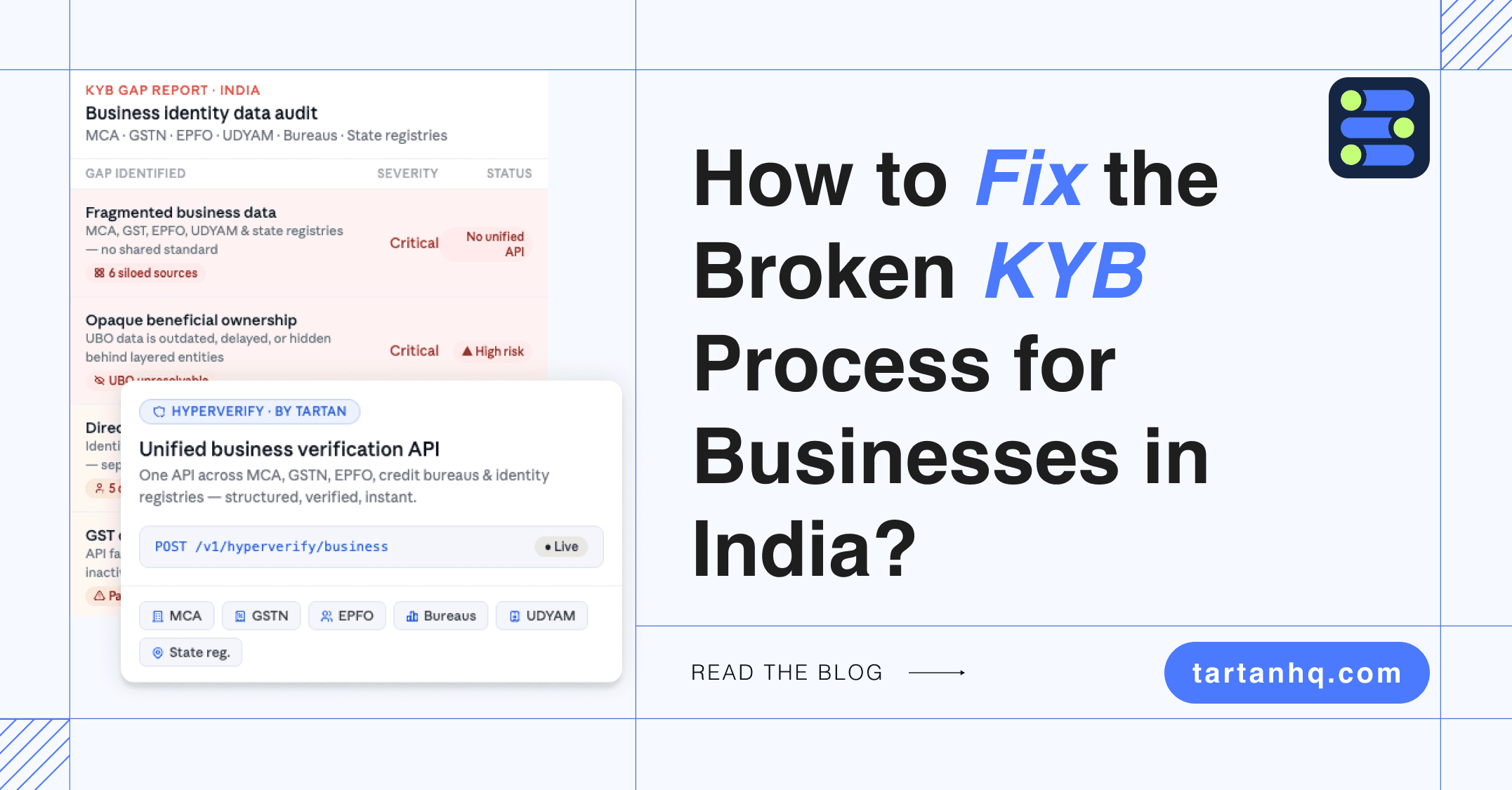
Fragmented data sources, zero standardization. Business identity in India is spread across at least half a dozen registries - MCA21 for company registration, GSTN for tax identity, EPFO for employer registration, MSME Samadhaan for UDYAM registration, CIBIL/Experian for credit bureau data, and state-level registries for certain entity types. None of these talk to each other. None return data in a consistent format. Building against each one individually is a multi-month integration project.
Beneficial ownership is opaque. Regulations - particularly RBI's KYC Master Direction and PMLA guidelines - require platforms to identify Ultimate Beneficial Owners (UBOs). But MCA data on shareholding is often outdated, filed annually with lags, and doesn't surface nested ownership structures. A company with four shell layers above it looks identical to a clean SME at the surface.
Director verification is a separate problem. Verifying that a company's directors are who they claim to be - and that they aren't flagged on CIBIL, court databases, or SEBI enforcement lists - requires pulling from KYC rails that are technically built for individuals. Stitching that into a business onboarding journey is a custom engineering project most teams don't have bandwidth for.
GST data is inconsistently available. GSTN's APIs have historically been unreliable, with rate limits, partial data returns, and gaps in coverage for newly registered businesses or those with lapsed returns. Relying on GSTN as your primary business verification signal is a risk in itself.
Manual review doesn't scale. At 50 onboardings a month, a human-in-the-loop works fine. At 500? At 5,000? The review queue becomes a bottleneck. Compliance teams get overwhelmed. Decisions slow down. And the business that was supposed to benefit from fast digital onboarding ends up waiting three days for a human to verify their CIN.
What Verified Business Data Actually Requires
Real KYB isn't just "did you collect a GST certificate." It's a layered verification exercise that has to answer several distinct questions simultaneously.
Entity legitimacy. Is this business actually registered? Is it active, struck off, or under liquidation proceedings? Has it filed its annual returns? These are MCA-sourced signals, and they need to be pulled in real time - not from a cached dataset that's weeks old.
Tax compliance posture. Is the GST registration valid? Is the business filing returns regularly? Are there significant mismatches between declared turnover and actual transaction volume? These signals matter enormously for lending and payment platform risk.
Director and promoter identity. Each DIN (Director Identification Number) needs to be cross-checked. Are the directors associated with other flagged or dormant companies? Do they show up on court databases, ROC enforcement actions, or credit bureau watchlists?
Bank account ownership. The business claiming to be ABC Pvt Ltd needs to prove that the bank account you're going to transact with actually belongs to ABC Pvt Ltd - not a director's personal account, not a shell account. Penny drop verification and account validation APIs are the mechanism here, but they need to be integrated as part of the KYB flow, not bolted on separately.
MSME and sector-specific status. For lending platforms and insurance companies, knowing whether a business is UDYAM-registered, its enterprise category (micro/small/medium), and its primary industry classification changes the risk model significantly.
Getting all of this from a single integration, with consistent data structures, in a time frame that doesn't destroy your onboarding conversion - that's the actual requirement. And it's where most homegrown solutions fail.
Who This Is Really For
If you're a CTO or VP of Engineering at a fintech, lender, or neo-bank, you've probably already tried to solve this with a mix of internal tooling and point solutions. You know the pain. Every new data source is a new vendor relationship, a new integration sprint, a new support ticket when the API goes down.
If you're a Head of Product or Head of Compliance, you're sitting on a different version of the same problem: your onboarding drop-off rates are higher than they should be because the verification journey is clunky, your ops team is spending hours on manual reviews that should take minutes, and your risk team doesn't have confidence in the data quality coming out of the current flow.
KYB is not a compliance checkbox. It's a product problem with compliance implications. The companies that treat it that way - that invest in getting verified business data right, at the API layer, before building onboarding experiences on top of it - end up with faster approvals, lower fraud rates, and a compliance posture they can actually defend to regulators.
Where HyperVerify Fits
HyperVerify is Tartan's answer to this exact gap. It's a unified business verification API that aggregates data across MCA, GSTN, EPFO, credit bureaus, and identity registries - and returns it in a single, structured response that your product and engineering teams can actually work with.
No stitching together five different vendor relationships. No custom parsers for inconsistent government API responses. No manual ops queue for edge cases that fall outside your happy path.
The integration is a single API. The output is verified, structured business data. The coverage spans the entity types and data sources that actually matter for corporate onboarding in India - private limited companies, LLPs, proprietorships, partnerships, and UDYAM-registered MSMEs.
If you're building or scaling a corporate onboarding flow, KYB is the layer you can't afford to get wrong. And it's the layer that most platforms are still getting wrong - either because they haven't prioritized it, or because they haven't found a solution that actually covers the full stack.
The data problem is solvable. The question is whether you want to solve it from scratch, or pull it through an API that's already done the work.