India's lending ecosystem reported ₹21,367 crore in fraud losses in just the first half of FY25 - an eightfold increase year-on-year. Most of these frauds concentrated in the advances category, exposing what regulators and lenders have quietly known for years: document-based income verification is fundamentally broken.
The issue isn't that lenders don't verify income. They do. The issue is that the primary artifact of income verification - the salary slip - has become so easy to forge, manipulate, and misrepresent that it no longer functions as a reliable source of truth.
Meanwhile, a parallel infrastructure has emerged. Employers maintain verified, real-time payroll data in HRMS systems. This data is structured, auditable, and continuously updated. It represents the actual source of truth for employee income. Yet until recently, lenders had no standardized way to access it.
That's changing. Leading lenders across personal loans, consumer durables, home finance, and digital lending are systematically moving from self-submitted salary slips to employer-verified income data. This isn't a marginal improvement in verification processes. It's a fundamental shift in how income is proven, assessed, and acted upon.
The Salary Slip Problem Nobody Talks About
A salary slip is supposed to prove income. In practice, it proves that someone can produce a document that looks like it proves income.
The distinction matters because salary slip fraud has industrialized. In July 2025, Indore police arrested a fraud ring that siphoned ₹50 lakh in personal loans by submitting counterfeit salary slips and doctored bank statements to HDFC, IDFC, ICICI, Yes Bank, Axis Bank, and Kotak Bank.
The accused created fake companies, opened current accounts, deposited funds to simulate salary credits, generated forged GST and shop licenses, and produced professional-looking salary documentation that cleared initial verification checks at multiple institutions.
This wasn't sophisticated cybercrime.
This was graphic design, basic banking activity, and document templates purchased on messaging forums. The barriers to salary slip fraud aren't technical - they're practically non-existent.
The fraud ecosystem has matured considerably. Vendors openly advertise forged salary slip services in major hiring hubs like Noida, complete with matching bank statements, PAN cards, Aadhaar cards, and employee identity cards. Some operations offer subscription packages with "refund guarantees" if documents fail verification. Online forums provide step-by-step guides for altering net income fields, tax deductions, and employer logos using open-source design tools.
More sophisticated operators have monetized access to payroll API integrations, injecting false employer records into legitimate payroll systems to generate authentic-looking user portal views complete with accurate metadata and clickable links. These portals remain live long enough for lenders to perform cursory verification checks, then disappear after loan disbursement.
The result is what fraud experts call a "circular income loop" - forged salary slips backed by synthetic bank statements showing matching credit amounts, creating an internally consistent but entirely fictional income profile that confuses both automated verification systems and human underwriters.
Why Document Verification Can't Keep Pace
Lenders haven't ignored this problem. Many have invested heavily in document verification technologies - OCR systems that extract data from PDFs, image analysis tools that detect tampering, AI models that flag suspicious formatting patterns.
These tools catch obvious forgeries. A salary slip with misaligned text, unusual fonts, incorrect statutory deduction calculations, or missing employer details gets flagged. But they struggle with three increasingly common scenarios:
Professional-grade forgeries using legitimate templates: When fraudsters start with actual company salary slip templates (often obtained from current or former employees), the formatting, logos, fonts, and structure are authentic. The only falsification is in the numbers themselves - base salary, allowances, deductions. OCR can extract these numbers perfectly. Image analysis finds no tampering. The document appears genuine because everything except the income figures is genuine.
Coordinated bank statement manipulation: When salary slips are accompanied by bank statements showing matching monthly credits, cross-verification appears successful. Both documents reinforce the same income claim. Unless the lender conducts direct employer verification or accesses actual payroll data, the fraud remains undetected.
Synthetic employment at shell companies: Some fraud operations create entirely fictional employers - registered companies with GST numbers, bank accounts, office addresses, and even functioning phone numbers for employment verification. Salary slips from these entities pass basic authenticity checks because the company technically exists. The employment relationship is real. The income being reported is simply inflated or entirely fabricated.
The fundamental limitation is that document verification validates the artifact, not the underlying reality. A perfectly formatted, unaltered, correctly structured salary slip from a legitimate employer still doesn't prove what the employee actually earns if the employee obtained it through internal manipulation, borrowed it from a colleague, or convinced someone in HR to generate an inflated version.
The Cost of Income Fraud
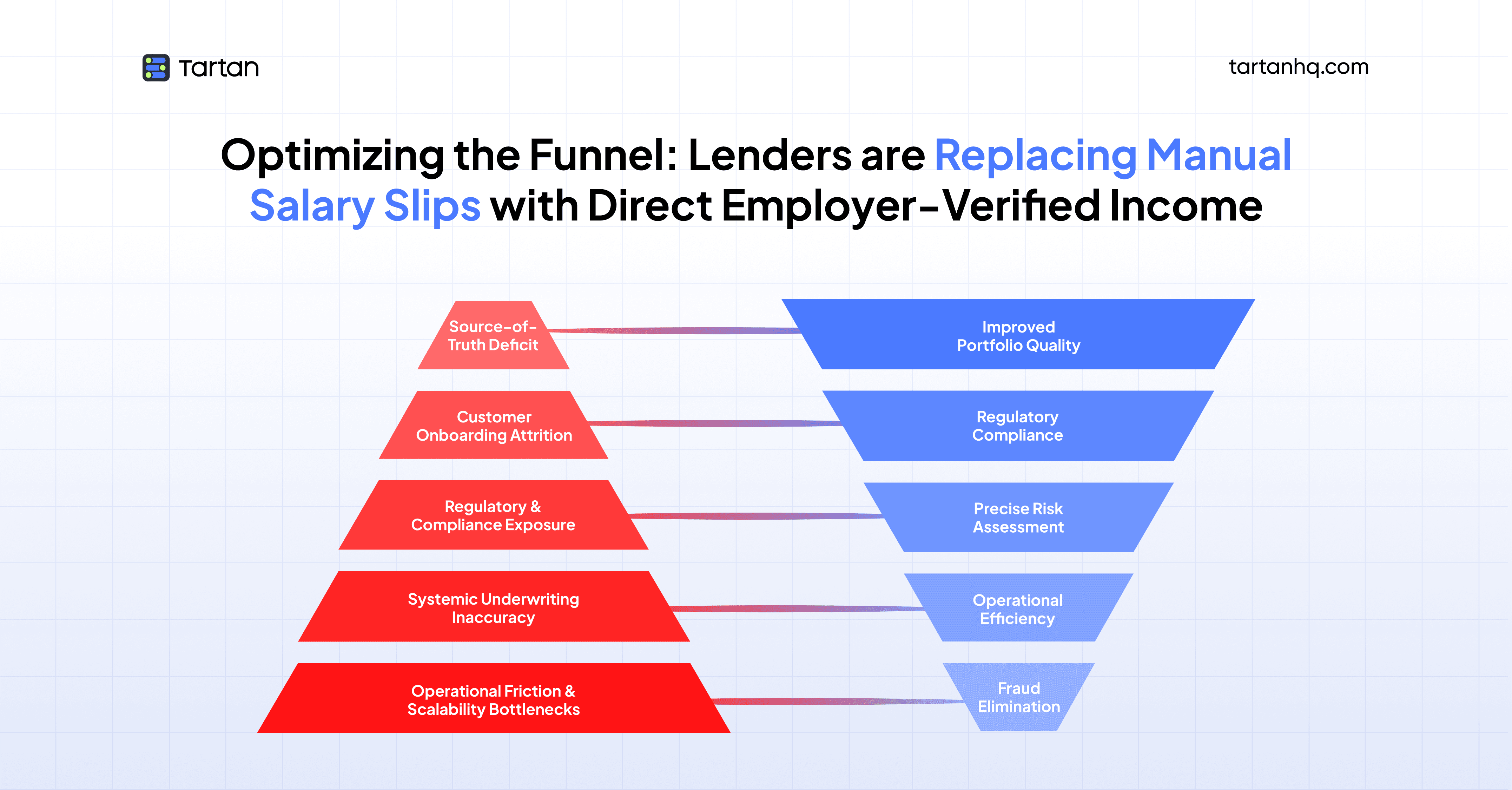
The direct loss from fraudulent loans is only part of the impact. Income misrepresentation creates cascading risks that affect credit decisioning, portfolio quality, regulatory compliance, and operational efficiency.
Credit Risk Mispricing: When a lender approves a ₹5 lakh personal loan based on a self-reported monthly income of ₹85,000, but the borrower's actual HRMS-verified income is ₹62,000, the entire credit assessment is wrong. The loan-to-income ratio isn't 5.9x - it's 8.1x. The debt service coverage isn't comfortable - it's marginal. Default probability calculations based on inflated income systematically underestimate risk.
This isn't a single bad loan. It's systematic mispricing across every loan where income is overstated. Portfolio-level risk models built on a foundation of self-reported income embed optimism bias that only becomes visible when delinquencies begin clustering.
Operational Overhead from Manual Verification: To combat fraud, many lenders require borrowers to submit multiple income proofs - salary slips, bank statements, Form 16, ITR documents. Operations teams manually cross-reference these documents, looking for consistency. They call employers to verify employment. They request additional documentation when discrepancies appear.
This verification burden creates operational drag. Each loan application requiring manual intervention slows approval cycles from minutes to days. Large-scale digital lenders processing thousands of applications daily can't manually verify every income claim, forcing them to choose between speed and accuracy.
Regulatory and Compliance Risk: The RBI's Digital Lending Directions mandate that regulated entities collect key borrower information - age, occupation, and income - as minimum standards. When lenders approve loans based on unverified self-reported income, they face potential regulatory scrutiny for inadequate due diligence. If fraud patterns emerge in their portfolio, compliance reviews may question why income verification procedures didn't catch obvious red flags.
Borrower Experience Degradation: Legitimate borrowers suffer when verification processes become onerous in response to fraud. Requests for multiple document submissions, employer verification calls, follow-up questions about income discrepancies - all of this adds friction to the borrowing experience. Customers who could prove income instantly through employer-verified data instead wait days for manual verification processes designed to catch fraudsters.
What Employer-Verified Income Actually Means
Employer-verified income shifts the verification locus from employee-submitted documents to employer-maintained payroll systems. Instead of asking borrowers to prove their income, lenders access verified income data directly from the employer's HRMS with employee consent.
The technical mechanism matters. When an employee applies for a loan, they provide consent for the lender to access their employment and income data. The lender connects to the employer's HRMS through a standardized integration layer (platforms like HyperSync provide this connectivity). The system retrieves:
Current employment status (active, on notice, terminated)
Verified base salary and allowances
Actual monthly gross and net income
Employment tenure and role details
Deduction breakdowns (PF, ESI, tax)
Historical income stability over months/quarters
This data comes directly from payroll systems - the same systems that generate statutory compliance reports, process salary transfers, and maintain official employment records. It's not mediated through employees. It's not dependent on document submission. It's the employer's authoritative record of what they actually pay the employee.
The difference from document-based verification is architectural. Documents represent a point-in-time claim about income, mediated through the borrower, subject to alteration before submission. Employer-verified data represents continuous, real-time access to the source of truth, unmediated by the borrower, tamper-proof by design.
Why Employer-Verified Income Solves Real Problems
The shift from salary slips to employer verification addresses the core limitations of document-based processes across multiple dimensions:
Fraud Elimination Through Source-of-Truth Access: When income data comes directly from employer payroll systems, the attack vectors for fraud collapse. Forged salary slips become irrelevant - the lender isn't looking at salary slips. Manipulated bank statements don't matter - the verification happens at the HRMS level, not the document level. Shell company employment schemes fail because legitimate employers won't participate in fraud, and fraudulent employers lack HRMS integrations with verification platforms.
An applicant cannot inflate their income through document manipulation when the lender sees exactly what the employer's payroll system shows. They cannot hide employment gaps or role demotions when employment history comes directly from HRMS records. The only way to commit income fraud under employer-verified systems is to manipulate the employer's own payroll records - a vastly higher bar requiring internal collusion and creating immediate audit trail risks.
Real-Time Income Visibility: Employment and income are dynamic. Employees receive promotions, take salary cuts, move between roles, go on unpaid leave, or face termination. Traditional document-based verification captures income at a point in time - typically when the borrower generates or requests salary slips.
Employer-verified systems provide current income data at the moment of loan application. If an employee received a promotion last month, the lender sees the updated salary immediately. If an employee just went on extended leave, the system reflects reduced income. If employment status changed from active to notice period, the verification shows this in real-time.
For lenders, this matters enormously for credit risk. A borrower might submit a six-month-old salary slip showing ₹95,000 monthly income, but their current income is ₹72,000 after a company-wide salary reduction. Document verification approves the loan based on outdated information. Employer verification catches the change and adjusts credit assessment accordingly.
Operational Efficiency at Scale: Manual verification processes don't scale with digital lending volumes. When a lending platform processes 50,000 loan applications monthly, assigning operations teams to call employers, cross-check documents, and investigate discrepancies becomes a bottleneck.
Employer-verified income enables automated underwriting. The moment an employee provides consent, verified income data populates the credit assessment. Loan decisions that previously required 3-5 days for manual verification complete in under 60 seconds. No operations team involvement. No document chasing. No employer calls. The system retrieves verified data and proceeds directly to credit decisioning.
Improved Credit Decisioning Accuracy: Credit models built on accurate income data perform better than models built on self-reported income. When a lender knows with certainty that a borrower earns ₹78,000 monthly (not self-reported ₹78,000, but HRMS-verified ₹78,000), debt-to-income ratios become precise. When income history shows consistent earnings over 18 months, employment stability assessment improves. When the lender can see that 22% of gross income goes to statutory deductions, net income calculations become exact.
This precision flows through to portfolio performance. Loans underwritten on verified income exhibit lower delinquency rates than loans underwritten on self-reported income, even when both groups have similar stated income levels. The difference is accuracy - fewer borrowers are over-leveraged relative to actual income, fewer credit limits exceed sustainable repayment capacity, fewer approvals happen to borrowers whose income was inflated.
The Infrastructure That Makes This Possible
Employer-verified income sounds straightforward in theory - connect to HRMS systems, retrieve payroll data, verify income. In practice, implementation complexity historically prevented adoption at scale.
India's enterprise landscape runs on dozens of HRMS platforms. Large corporations use SAP SuccessFactors or Workday. Mid-market companies deploy Darwinbox, greytHR, or Keka. Smaller businesses might use Zoho People or homegrown systems. Each platform has different data models, API architectures, authentication requirements, and field mappings.
For a lender to build direct HRMS integrations, they'd need to:
Negotiate data-sharing agreements with dozens of employers
Build custom API integrations for each HRMS platform
Handle authentication, consent management, and data security individually
Maintain these integrations as HRMS platforms update and change
Scale this across thousands of employers
The engineering burden is prohibitive. Which is why most lenders stayed with document-based verification - not because it was better, but because the alternative was operationally infeasible.
This is where unified integration platforms like HyperSync create market-level infrastructure value. Rather than each lender building point-to-point HRMS integrations, HyperSync maintains integrations across major HRMS platforms. Lenders integrate once with HyperSync and gain access to normalized, real-time employment and income data across employers using any supported HRMS.
The architecture works like this:
Employer Onboarding: Employers authorize HyperSync to access specific employee data fields (employment status, compensation, tenure) from their HRMS
Employee Consent: When applying for a loan, employees provide consent for their verified income data to be shared with the lender
Real-Time Data Sync: HyperSync retrieves current employment and income information from the employer's HRMS
Lender Access: The lender receives standardized, verified income data through HyperSync's API, regardless of which HRMS the employer uses
Continuous Updates: As employment or income changes in the HRMS, updated data flows through the system
From the lender's perspective, employer verification becomes as simple as an API call. From the employer's perspective, they authorize data sharing once and enable income verification for all employees across any lender using the platform. From the employee's perspective, income verification happens instantly without document submission.
The Regulatory Tailwind
The RBI's Digital Lending Directions mandate clear borrower information collection, including verified income data. While the regulations don't explicitly require employer-verified income, they establish principles that favor direct data access over document submission:
Lenders must maintain audit trails for all data used in credit decisions
Borrower data must be stored securely with appropriate consent mechanisms
Verification processes should minimize fraud risk and ensure data accuracy
Employer-verified income satisfies these requirements more comprehensively than document-based processes. API-based data retrieval creates automatic audit trails. Consent mechanisms are embedded in the technical integration. Fraud risk drops substantially when verification happens at the source.
More broadly, India's digital infrastructure evolution - Aadhaar for identity, Account Aggregator for financial data, UPI for payments - reflects a consistent pattern: moving from document-based proofs to API-enabled verification. Income verification is following this same trajectory.
What This Means for Lenders
The transition from salary slips to employer-verified income isn't a single decision - it's an operational transformation that touches underwriting, credit policy, technology architecture, and borrower experience.
For Digital Lenders: Platforms offering instant loans, salary advances, or consumer durables financing can fundamentally improve unit economics. When income verification compresses from days to seconds, activation rates increase. When fraud rates drop by 60-70% through verified data, portfolio quality improves. When operational costs from manual verification disappear, margins expand.
For Traditional Banks and NBFCs: Institutions with established underwriting processes can layer employer-verified income alongside existing verification methods, using it to:
Fast-track approvals for borrowers with employer-verified data
Flag high-risk applications where self-reported income diverges from HRMS data
Build credit models that differentiate based on income verification quality
Reduce operational costs by automating verification for salaried employees
For New Market Entrants: Fintechs building lending products can skip document-based verification entirely, designing underwriting flows around employer-verified income from day one. This creates competitive advantage through faster approvals, lower fraud losses, and superior borrower experiences.
The Employer Benefit
This shift isn't purely lender-centric. Employers gain tangible value from enabling verified income access for their employees:
Improved Employee Financial Access: When employees can prove income instantly through employer verification, they access credit faster with better terms. Loan approvals that previously took 5-7 days complete in under an hour. Interest rates improve because lenders have higher confidence in verified income data.
Reduced HR Burden: Companies spend significant HR time responding to employment and income verification calls from banks, landlords, and background verification agencies. Enabling automated verification through HRMS integration eliminates these ad-hoc requests.
Enhanced Corporate Banking Relationships: Employers who enable HRMS-based income verification for their employees often strengthen relationships with banking partners, creating opportunities for group insurance, corporate credit facilities, or payroll banking services.
The Implementation Reality
Adopting employer-verified income doesn't require replacing existing verification systems overnight. The practical path involves:
Phase 1 - Pilot with High-Value Segments: Start with employers where you already have corporate relationships - companies with salary accounts, group insurance, or existing lending portfolios. Enable HRMS integration through HyperSync for employees of these organizations. Measure fraud reduction, approval speed improvement, and borrower experience changes.
Phase 2 - Expand Employer Coverage: As value becomes clear, systematically onboard more employers. Prioritize large organizations with significant employee bases and companies in sectors where your lending products have strong product-market fit.
Phase 3 - Make It Default: Once employer-verified income covers a meaningful percentage of applications, shift from optional enhancement to default verification method. Applications with employer-verified data get instant decisions. Applications without it enter traditional verification workflows.
Phase 4 - Optimize Around Verified Data: Redesign credit models to leverage the precision of verified income. Develop product variants specifically for borrowers with employer-verified income - higher limits, better rates, faster approvals. Use verified income as a competitive differentiator.
Where This Goes
Five years from now, salary slip submission for income verification will seem as outdated as submitting physical bank statements for financial data analysis. The infrastructure for employer-verified income is live. The regulatory environment supports it. The fraud economics demand it. The borrower experience benefits from it.
Lenders who move early build operational advantages that compound - better credit models trained on accurate data, lower fraud losses improving portfolio returns, faster approvals winning market share, reduced verification costs expanding margins.
The question isn't whether employer-verified income replaces document-based verification. The question is whether your institution leads this transition or reacts to it.