Point-to-point integrations work brilliantly when you're serving your first few customers. Each new client gets a custom connection built specifically for their systems. The logic maps directly to their HRIS platform - whether it's Darwinbox, Keka, or Workday. Your engineering team feels productive. The integration ships on time. The customer goes live.
It feels fast. It feels "done."
Until it isn't.
As you onboard your fifth, tenth, or twentieth customer, something insidious happens. Every integration starts to drift. Different HRMS versions introduce subtle incompatibilities. Custom fields that weren't in the original spec suddenly appear. Payroll formats that were supposed to be standard turn out to have three regional variations. Edge-case workflows that "never happen" start happening weekly.
What was once a clean, simple pipe becomes a fragile web of dependencies, special cases, and technical debt. And the real killer? Each new customer makes the problem exponentially worse, not linearly.
This is the point-to-point integration trap. It's a trap that looks like progress in the early days but becomes a scaling ceiling that stops growth dead.
The Illusion of Early Velocity
When you land your first corporate client using Darwinbox, building a direct integration seems obvious. Your team reads API docs, maps employee fields, builds sync logic, and deploys. Three weeks later, the integration is live. Employee data flows smoothly. Your customer is happy.
Client two uses Keka. Your team repeats the process - another three weeks, another successful integration. By clients three and four, you've built a repeatable playbook. Engineering estimates are accurate. Onboarding timelines are predictable.
Everything looks sustainable.
When the Cracks Start Showing
Around client seven, the integration for client one stops syncing correctly. Darwinbox released a new API version and deprecated endpoints. Your integration uses the old version.
You update to the new API, but discover the new version structures data differently. Fields that were flat are now nested objects. Date formats changed. Some custom fields aren't accessible.
Two weeks of rewriting later, you realize updating client one's logic might break client four - who's also on Darwinbox but using a different version with different configurations.
You add version checks. If version X, use logic A. If version Y, use logic B. Code complexity grows. Technical debt accumulates.
Client eight wants to onboard. They use Darwinbox too, but with custom workflows requiring special handling. Onboarding slips from three weeks to five, then seven.
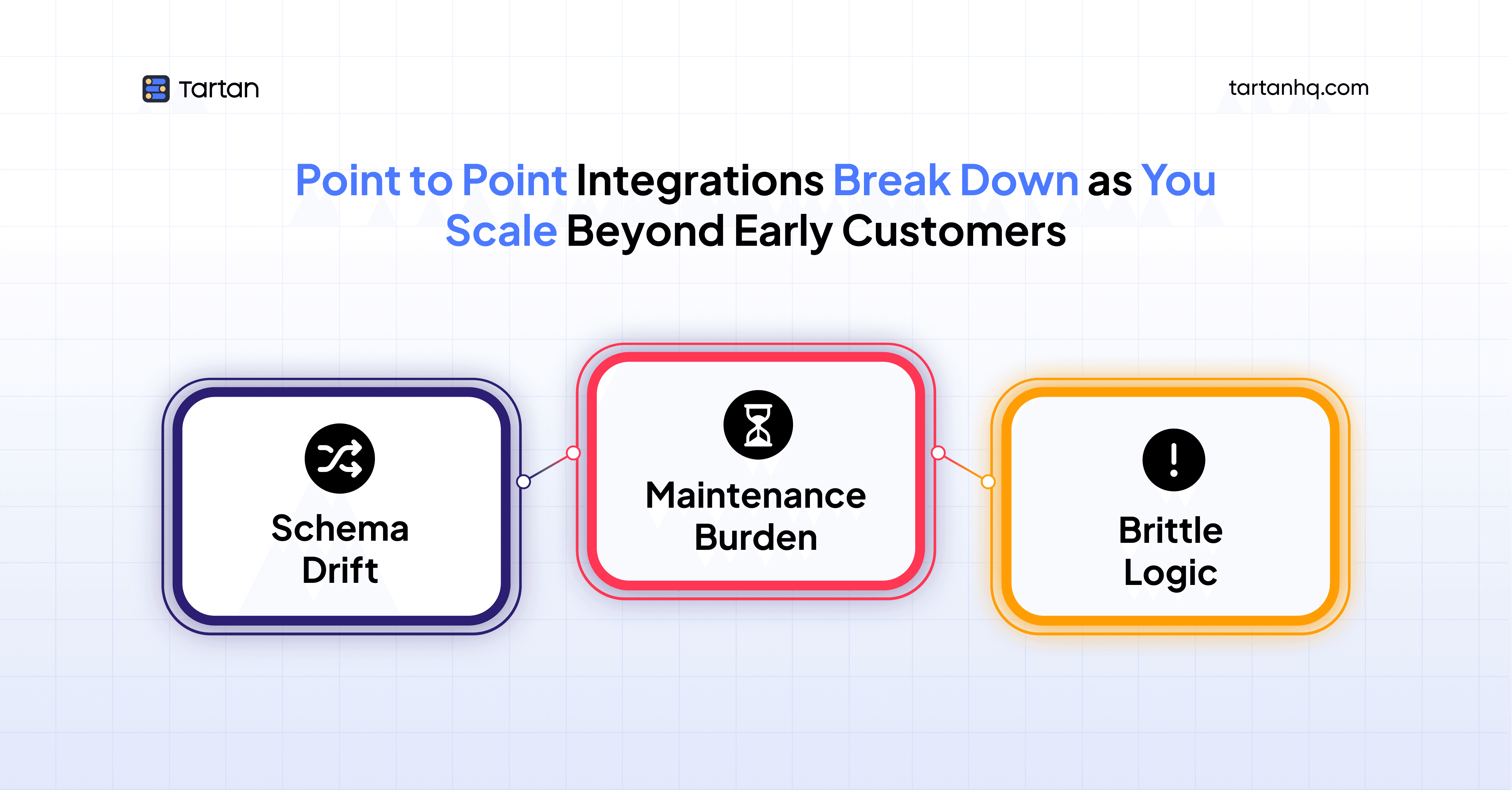
The Three Failure Modes of Point-to-Point Integration
1. Schema Drift: The Silent Killer
HRIS platforms evolve constantly. Vendors release updates. Clients enable new modules. System administrators add custom fields to track company-specific data.
In a point-to-point model, your integration has no buffer against these changes. When Darwinbox adds a new "employment_type" field that replaces the old "employee_category" field, your code breaks. When Keka restructures how they represent salary components, your payroll deduction logic fails silently - calculating incorrect amounts without throwing errors.
Schema drift is insidious because it doesn't announce itself. Your integration keeps running. Data keeps flowing. But the data is gradually degrading in quality:
New hires aren't appearing in your system because they have a new employee status value you're not checking for
Salary amounts are wrong because the HRIS moved compensation data to a different API endpoint
Department names are missing because the client renamed that field in their HRIS configuration
By the time you notice, weeks or months have passed. Data reconciliation becomes a nightmare. Customer trust erodes.
2. Brittle Logic: The Complexity Explosion
Each customer requires special handling. Client A calculates take-home pay differently than Client B. Client C has a two-tier salary structure that doesn't fit your standard data model. Client D runs payroll twice monthly instead of once.
In a point-to-point integration model, you handle these variations with conditional logic:
if client == "ClientA":
calculate_takehome_method_a()
elif client == "ClientB":
calculate_takehome_method_b()
elif client == "ClientC":
handle_tier_structure()
...
This works for five clients. It becomes unmaintainable at twenty.
The real problem emerges when you need to make a change. Fixing a bug for Client A risks breaking the logic for Client D. Adding a new feature requires testing against every client's unique configuration. A single upstream change from an HRIS vendor can cascade into failures across multiple clients - each requiring individual diagnosis and fixes.
Your engineering team spends more time debugging integration issues than building product features. Velocity grinds to a halt.
3. Maintenance Burden: The Growth Penalty
The cruelest aspect of point-to-point integrations is that growth creates operational debt instead of leverage.
In a scalable system, serving 100 customers should be only marginally more expensive than serving 10. Economies of scale kick in. Unit economics improve. Growth becomes easier.
In a point-to-point integration architecture, the opposite happens. Each new customer adds:
A new codebase to maintain (or new branches in your monolithic integration code)
A new API version to monitor for deprecations
A new set of edge cases that might conflict with existing logic
A new source of potential failures when upstream systems change
Your engineering team's cognitive load increases non-linearly. An engineer who could confidently maintain integrations for 5 clients struggles with 15. At 30 clients, no single engineer understands the full system anymore.
The operational cost per customer actually increases as you scale. New customer onboarding takes longer because engineers must carefully avoid breaking existing integrations. Bug fixes take longer because reproducing issues requires understanding client-specific configurations.
Growth becomes a liability.
The Compounding Costs
When point-to-point integrations fail to scale, costs compound across your organization:
Engineering teams spend 40-60% of time on integration maintenance instead of product development. New features take months because engineers constantly firefight broken integrations.
Integration failures damage customer trust. Payroll deductions fail. Employee rosters are outdated. Loan approvals delay because salary data is stale.
Sales cycles lengthen. When onboarding takes 8-12 weeks instead of 2-3 weeks, deals slip. Competitive opportunities are lost to faster vendors.
Innovation suffers. Every hour maintaining brittle integrations is an hour not building differentiated features. Roadmaps stall. Competitors with better architecture outpace you.
The brutal math: if each engineer maintains integrations for 10 customers before hitting capacity, you need an additional engineer for every 10 customers acquired. Engineering grows linearly with customer count - exactly the opposite of scalable SaaS.
HyperSync: A Different Architecture
HyperSync creates a normalized, continuously synced data layer between your product and the HRIS landscape. Instead of building one-off pipes, it centralizes integration logic.
Centralized Normalization: When Darwinbox changes their API, HyperSync updates their Darwinbox connector once - benefiting all customers across all applications. Your application uses HyperSync's standardized API with consistent field names. Schema drift is absorbed at the HyperSync layer, not in your code.
Version-Agnostic Connections: HyperSync maintains compatibility across HRIS versions. When a client upgrades from Darwinbox 5.2 to 6.0, your integration doesn't break. No version checking. No conditional logic.
Continuous Synchronization: Real-time sync instead of batch updates. When salary changes, it propagates immediately. Errors are detected and flagged instantly - not weeks later during reconciliation.
Leverage Through Scale: HyperSync improves with growth. When they add HRIS support, all customers benefit. When they optimize performance, every application improves. Onboarding customer 50 is easier than customer 5 - more edge cases handled, more variations covered.
What This Means for Product Velocity
When teams aren't drowning in maintenance, they focus on differentiated features:
Faster development: Build features once against HyperSync's API, they work across all HRIS platforms. A payroll deduction feature requiring testing across 20 configurations in point-to-point works universally with HyperSync.
Predictable onboarding: Sales teams commit to 1-2 week timelines instead of "8-12 weeks depending on HRIS" that kills deals.
Reliable operations: Integration failures drop dramatically. When they occur, they're fixed centrally - not requiring custom debugging per customer.
Roadmap execution: Engineering capacity isn't consumed by maintenance. Features that drive growth actually ship.
The Scaling Ceiling Removed
Point-to-point integrations create a scaling ceiling. You might manage them for 10 or 20 customers. But somewhere around 30-50 customers, complexity becomes unmaintainable. Growth stops not because of product-market fit - but because integration architecture can't scale.
HyperSync removes that ceiling. Customer 100 onboards as smoothly as customer 10. Engineering capacity scales with product complexity, not customer count.
The question isn't whether to adopt unified API architecture. It's whether you'll make the shift before point-to-point integrations strangle your growth - or after.
Once you're managing 30 brittle integrations with a burned-out team and customers experiencing sync failures, migration becomes exponentially harder.
Companies winning in corporate fintech, benefits platforms, and HR tech aren't necessarily the ones with better features. They're the ones with integration architecture that scales.
HyperSync provides that architecture. So your team spends less time maintaining fragile connections and more time building outcomes.
That's not just a technical advantage. It's a strategic moat.