There is a gap sitting inside most enterprise AI deployments that is invisible in normal operations and extremely visible the moment something goes wrong.
An AI agent makes a decision. The decision is incorrect - a credit application incorrectly declined, a claims record incorrectly updated, a customer communication sent with wrong information.
The incident escalated. The investigation begins. And the first question the compliance team, the CISO, or the regulator asks is: can you show us exactly what the agent did, what data it accessed, what it reasoned from, and why it reached that conclusion?
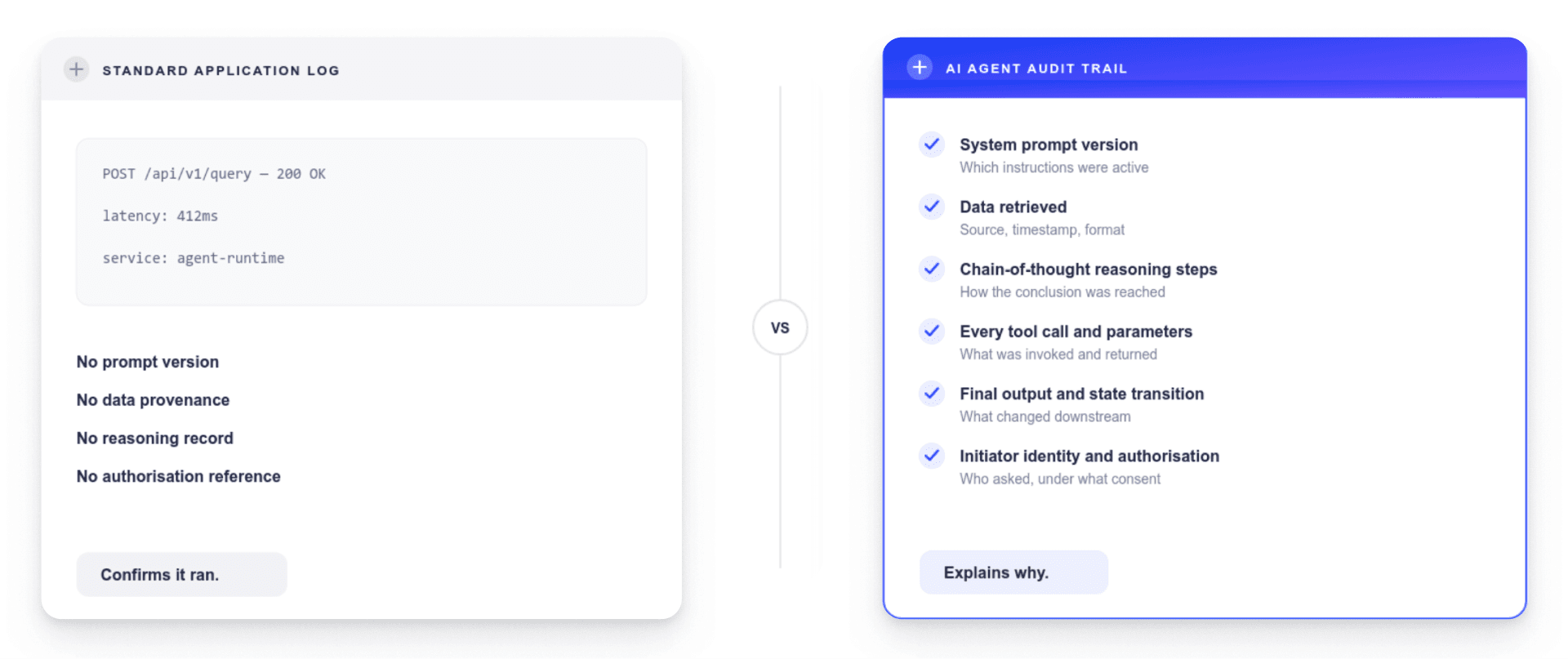
In most enterprises today, the honest answer is no. Standard application logs tell you that an API call occurred. They do not tell you which version of the system prompt the agent was running, what data it retrieved, what reasoning steps it took, or what the final state transition was that produced the output. The evidence that would allow you to reconstruct the agent’s behaviour - and defend it to an auditor - does not exist.
This is the audit trail gap. And in 2026, with the EU AI Act’s enforcement activation in August, NIST AI RMF 1.1 now the standard reference for US enterprise contexts, and procurement teams in regulated industries making audit trail capability a gating criterion, it is no longer a future problem. It is a present one.
Why standard logs are not enough
The instinct when someone says “we need better logging for AI agents“ is to point to the existing observability stack - Datadog, Splunk, CloudWatch - and say it is already covered. It is not, for a specific reason.
Standard application logs capture infrastructure events: an API endpoint was called, a response was returned, a latency was recorded. An AI agent audit trail needs to capture something fundamentally different: the cognitive and decisional sequence that produced an outcome.
For an AI agent, that means:
The system prompt version the agent was running at the time of the task
The specific data retrieved - from which sources, at what timestamp, in what format
The chain-of-thought reasoning steps the agent took before reaching its output
Every tool call made - which tool, with what parameters, what was returned
The final output and the state transition it triggered in any downstream system
The identity of the human or system that initiated the task and the authorisation under which the agent acted
Without all six of these, you cannot reconstruct what the agent did. You can confirm it ran. You cannot explain why it produced the outcome it did. That is the difference between a log and an audit trail - and it is the difference between passing an external audit and failing one.
The regulatory baseline in 2026
Before getting to best practices, it helps to understand what the regulatory environment is actually requiring - because the answer determines the minimum viable audit trail, not just the aspirational one.
Three frameworks converge on the same core requirement in 2026:
EU AI Act
High-risk AI systems must automatically generate logs sufficient to identify situations that may result in risk. For agents in financial services and HR contexts, this means a minimum of 6 months of log retention, human oversight documentation, and the ability to reconstruct every decision on request. Enforcement activation: August 2, 2026. Penalties: up to €35 million or 7% of global annual revenue.
NIST AI RMF 1.1 (March 2026)
The GOVERN, MAP, MEASURE, MANAGE framework now has a GenAI Profile that specifically addresses agentic systems. MEASURE function requirements include continuous monitoring and anomaly detection, not just periodic review. Increasingly referenced by US enterprise procurement teams as the baseline expectation.
OWASP Agentic Top 10
Specifically addresses audit trail requirements in the context of agent security - insufficient logging is identified as a primary vulnerability class. Requires that agent actions are traceable, that data access is logged per-agent rather than per-system, and that logs are tamper-evident.
The convergence point across all three: comprehensive, immutable audit logs are not a best practice recommendation. They are a baseline requirement for any AI agent operating in a regulated context.
Best practice 1: Log at the agent level, not the system level
The most common audit trail failure is logging at the wrong granularity. System-level logs tell you that the HR system was accessed at 14:32:07. An agent-level audit trail tells you that Agent ID A-4721, running system prompt version 3.2, accessed the HR system at 14:32:07 to retrieve fields [employment_status, salary_grade, tenure] for Employee ID E-0892, as part of Task ID T-5541 initiated by User ID U-2207 under consent record C-8834.
The difference between these two log entries is the difference between “something happened” and “this specific agent did this specific thing for this specific reason.” Only the second one is an audit trail. Only the second one survives an external audit.
Every log entry in an AI agent audit trail should carry: agent identity, task identity, data source, data fields accessed, timestamp, authorising user or system, and consent or authorisation reference. These are not optional fields. They are the fields that allow reconstruction.
Best practice 2: Make the trail tamper-evident, not just stored
Storing logs is not the same as building an audit trail. An audit trail has a property that stored logs do not necessarily have: tamper evidence. If a log can be modified after the fact - even by a privileged administrator - it is not an audit trail in the regulatory sense. It is a mutable record.
Tamper evidence is achieved through append-only storage with cryptographic integrity verification - a hash chain where each log entry includes a cryptographic hash of the previous entry, making any modification to historical records detectable.
For most teams, the practical implementation options are:
Object storage with WORM policies - Write Once Read Many storage on AWS S3, Azure Blob, or GCS with object lock enabled. Combined with an in-application hash chain, this is the most portable and lowest-overhead option for most teams.
Database ledger extensions - Azure SQL ledger tables provide built-in tamper evidence at the database level. Google Cloud Confidential Space is an option for higher-assurance contexts.
Third-party append-only stores - Immudb and ProvenDB provide managed tamper-evident log storage without building the cryptographic layer yourself. Higher vendor dependency, lower implementation overhead.
The key point: the tamper-evidence mechanism needs to be chosen and implemented before agents go into production, not built retroactively when an audit requires it. Historical log integrity cannot be established after the fact.
Best practice 3: Build three-tier retention, not one-size storage
Not all audit trail data has the same retention requirement or the same access frequency. Treating all logs with the same retention policy and storage tier wastes money and creates query performance problems. A three-tier approach handles the different dimensions efficiently.
Tier | Retention | Storage | Use |
Hot | 30–90 days | Queryable database or search index | Incident investigation, real-time monitoring, compliance queries |
Warm | 6–24 months | WORM object storage, queryable with latency | Regulatory audits, EU AI Act 6-month minimum, annual reviews |
Cold | 3–7 years | Archival storage, low-cost, low-access | Legal proceedings, long-tail regulatory requirements, litigation hold |
The retention period for each tier should be set by legal and compliance, not by engineering. The storage mechanism for each tier is an engineering decision. Both need to be documented before the first agent goes into production.
Best practice 4: Redact at the field level, not the record level
An audit trail that logs everything without redaction is a compliance liability in itself. Employee compensation data, personal health information, customer financial records - these are sensitive data categories with their own retention limits and access controls under GDPR, DPDP, HIPAA, and sector-specific frameworks.
The correct approach is field-level redaction - logging the fact that a specific field was accessed without logging the value of that field in the general audit log. The value is retained in a restricted access log with tighter access controls and separate retention rules.
For example: an audit log entry records that Agent A-4721 accessed field [gross_salary] for Employee E-0892 at 14:32:07. The value of gross_salary is not in the general audit log. It is in a restricted compensation data access log accessible only to authorised personnel with a specific need to know.
The general audit trail can be shared with a regulator or an external auditor without exposing the underlying personal data values.
This field-level redaction pattern is the difference between an audit trail that is shareable and defensible and one that creates a secondary data governance problem every time it is accessed.
Best practice 5: Route audiit logs into your SIEM - not a sidecar
AI agent audit logs that live in a separate, agent-specific system are audit logs that the security team will not see in real time and that will not correlate with other security events. The most operationally useful audit trail architecture routes agent events directly into the enterprise SIEM - Splunk, Datadog, Microsoft Sentinel, or equivalent.
This matters for two reasons. First, it enables real-time anomaly detection - an agent accessing data at unusual volumes, calling APIs outside its normal pattern, or accessing data sources not associated with its current task can be surfaced by SIEM correlation rules the same way other security events are.
Second, it enables incident correlation - when a security event involves an AI agent, the SIEM can correlate agent activity logs with network events, authentication events, and other security signals to build a complete picture of what happened.
The format for AI agent events in the SIEM matters. Each event should map to the SIEM’s standard event schema - agent identity as the principal, data source as the target resource, task and consent reference as context fields - so that existing SIEM queries and alerting rules work without modification.
Best practice 6: Log the data source, not just the agent action
This is the practice most specific to AI agents that access enterprise data through external APIs - which includes any agent using a unified API layer to access HRIS, CRM, or ERP data.
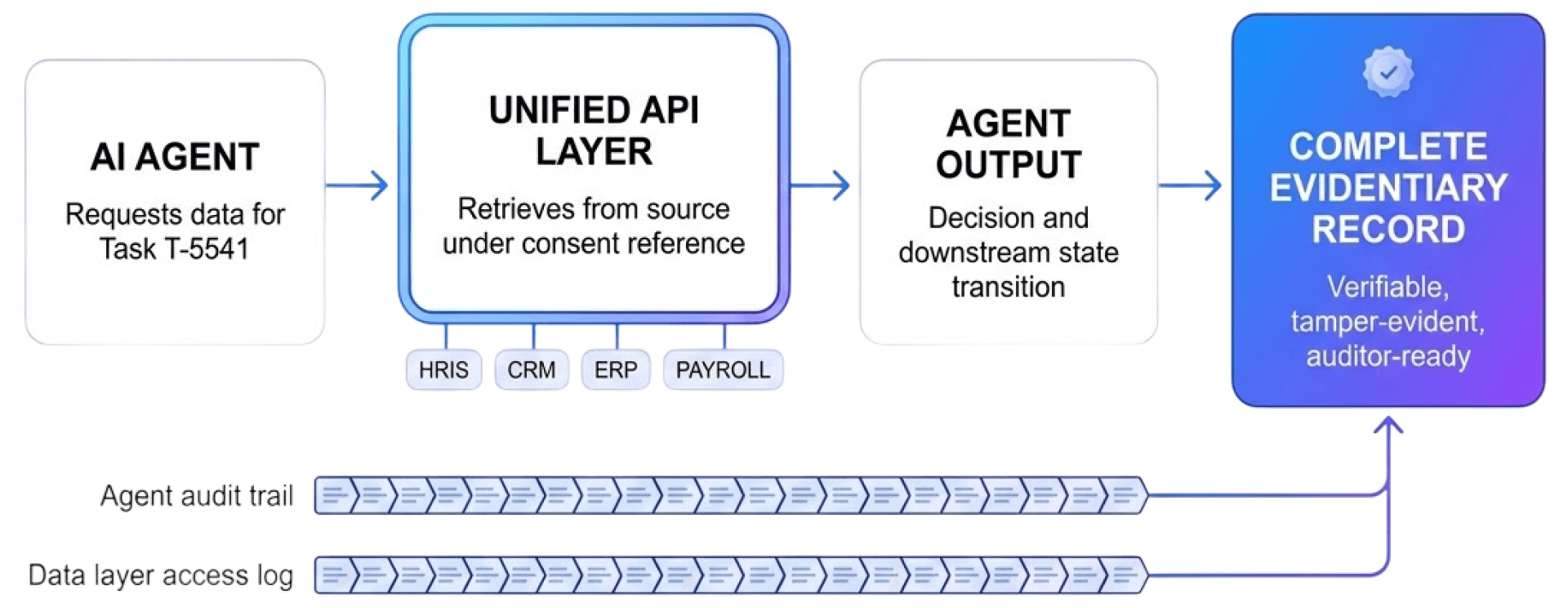
The audit trail needs to capture not just that the agent made a data retrieval call but where that data came from - specifically, which upstream system, at what point in time, under which consent record. For financial services and HR use cases, the provenance of the data is as important as the data itself from a compliance standpoint.
A unified API layer that generates its own access logs - recording every data retrieval event with source system, data fields accessed, consent reference, and timestamp - provides this provenance record as a structural feature of the architecture. The agent’s audit trail and the data layer’s access log together create a complete chain of evidence: the agent requested data, the data layer retrieved it from source X under consent Y at time Z, and the agent used it to produce output W. That is the complete evidentiary record that a regulator or auditor needs.
“Organisations with evidence-quality audit trails are 20-32 points ahead on every AI maturity metric compared to those without. The audit trail is not just a compliance requirement - it is the foundation that makes every other governance control meaningful.”
Best practice 7: Build for the auditor across the table, not for the engineer who shipped it
The final and most important best practice is a design principle rather than a technical specification: the audit trail should be designed to answer an auditor’s questions, not to satisfy an engineer’s logging checklist.
The auditor across the table is not going to query your Elasticsearch index. They are going to ask: on this date, for this customer, what did your agent do, what data did it use, and who authorised it? Your audit trail needs to answer that question in a form that a compliance professional - not a developer - can read, verify, and present as evidence.
This means the audit trail should be queryable by non-technical users. It means the output of an audit query should be a readable narrative of agent activity, not a JSON blob that requires interpretation. It means the consent and authorisation references in each log entry should be resolvable to human-readable records without additional investigation.
The practical test: if you had to respond to a regulatory inquiry tomorrow about a specific agent decision made three months ago, could your compliance team - without engineering support - pull the complete audit record, verify its integrity, and present it as evidence? If the answer is no, the audit trail is not finished, regardless of how technically sophisticated the logging infrastructure is.
Audit trail infrastructure for AI agents is not a compliance project. It is a production infrastructure requirement. Every day an agent operates in production without a complete, tamper-evident, queryable audit trail is a day during which the organisation is accumulating liability it cannot see and cannot quantify until an incident or an audit makes it suddenly, expensively visible.