For fraud heads, risk operations leads, and product teams at any business that onboards customers digitally - and is discovering that the verification stack has a gap at the most basic layer of all.
Contact Point Verification has a positioning problem. It is most commonly discussed in the context of lending - specifically, as a collections and KYC tool for NBFCs and banks managing borrower reachability. The conversations happen in credit risk circles. The articles are written for loan operations teams. The buyer is assumed to be a lending institution.
This framing is understandable and not wrong. CPV is genuinely critical in lending. But it has produced a blind spot: every other customer-facing business that has a fraud problem rooted in unverified contact data is either not using CPV at all, or has built inadequate manual equivalents that cannot scale.
The fraud problem is not lending-specific. It is universal. Any business that onboards customers digitally, operates a marketplace, processes claims, verifies candidates, or maintains a customer record over time has an exposure to contact data fraud - and most of them are addressing it with document checks, biometrics, and device fingerprinting while leaving the most basic verification layer entirely unaddressed.
Is this person reachable at the contact details they have provided? Is the phone number active? Does it belong to a real person? Is the address an actual deliverable location, not a freight forwarder or a vacant lot? These are the questions CPV answers. For a full breakdown of what this layer actually does, see the complete guide to digital contact-point verification. And across the sectors where fraud is rising fastest, they are the questions that most verification stacks are not asking.
The Universal Fraud Entry Point
Every digital fraud attack - identity fraud, account takeover, synthetic identity, marketplace fraud, claims fraud - involves a contact point. The fraudster needs a phone number to receive OTPs. A delivery address to receive goods. An email address to receive account communications. In many cases, the fraudulent contact point is the most easily detectable signal in the entire transaction - if it is checked.
A phone number associated with a high-velocity fraud pattern. An address that is a known freight forwarder used by refund fraud networks. An email domain that was registered two days ago and has no digital footprint. These signals are available at the contact point layer - but only if the contact point is being actively verified against live telco, address, and digital identity databases, not just captured and stored.
The FTC reported that consumers lost $3.5 billion to imposter scams in 2025, with imposter scams representing the leading fraud category. The common thread across nearly all imposter scams is a fraudulent contact point - a spoofed number, a fake address, an email that mimics a legitimate sender. Catching the fraudulent contact point before the transaction proceeds is the intervention that costs the least and prevents the most. This is also why the method of verification matters - see how physical verification, video KYC, and digital CPV compare at scale.
“As digital onboarding becomes the default across lending, fintech, and insurance, contact point verification is shifting from a manual compliance formality to an automated, real-time fraud-prevention layer. Businesses that adopt API-based CPV early aren’t just cutting costs - they’re closing off one of the most common entry points for fraud before it ever reaches the underwriting stage.”
The Use Cases Beyond Lending
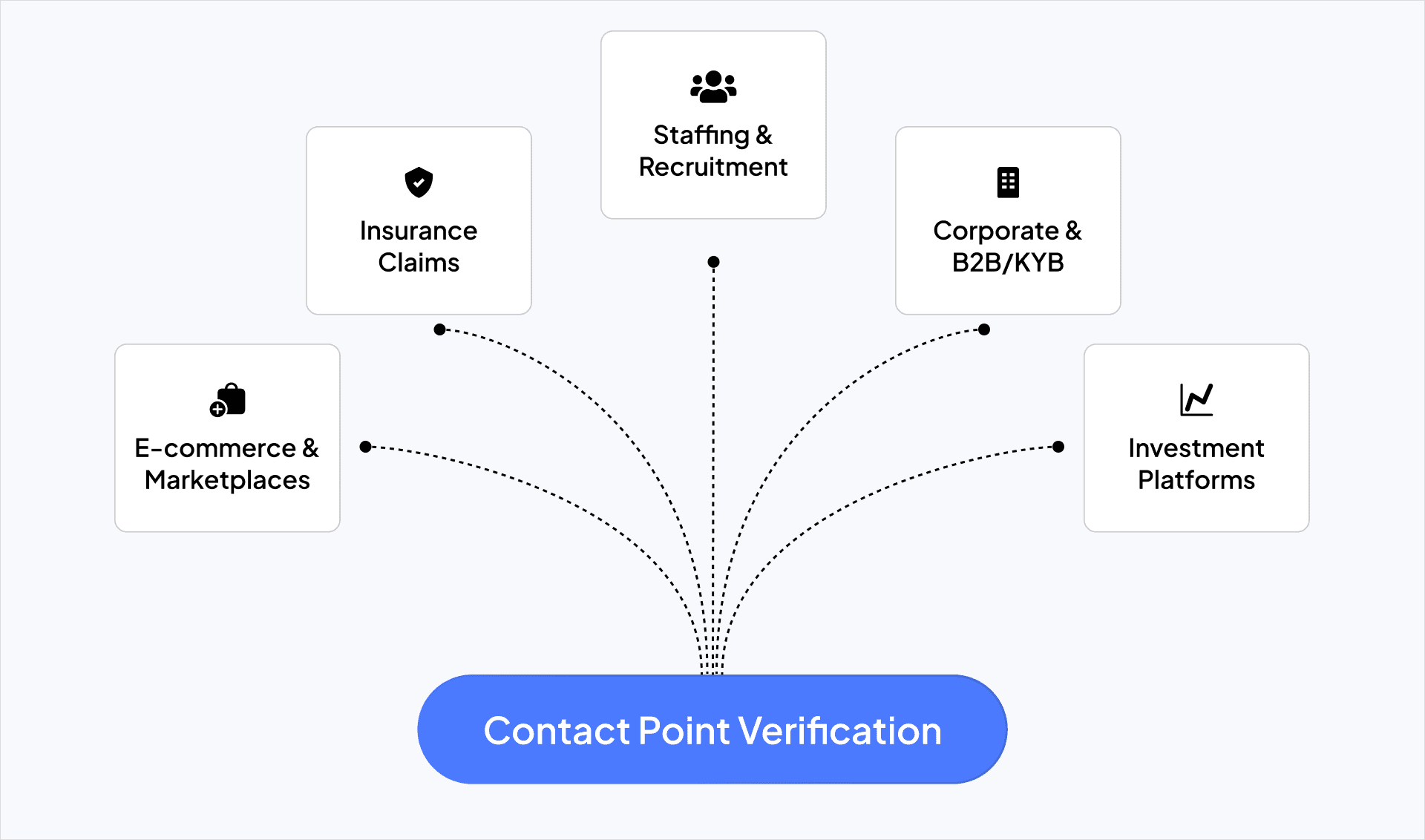
The sectors where CPV is being deployed most effectively outside of lending share a common characteristic: they have high-value transactions or relationships that attract fraud, and their current verification stacks are strong on identity documents and biometrics but weak on contact data validation.
E-commerce and marketplace platforms. Seller fraud and refund fraud are the two highest-cost fraud categories for e-commerce platforms. Both depend on fraudulent contact data - a seller account with a fake address that processes refund requests against legitimate buyers, or a buyer account that uses a freight forwarder address to claim non-delivery on successfully delivered orders.
CPV at seller onboarding catches the freight forwarder addresses and the virtual mailbox addresses that are the infrastructure of seller fraud networks. CPV at buyer account creation catches the high-velocity phone numbers that fraud rings cycle through. Neither check is expensive. Both are invisible in most e-commerce verification stacks because the assumption is that document and biometric checks are sufficient - and they are, for identity fraud. They do not catch the fraudster who has a legitimate identity but fraudulent contact details for a specific transaction.
Insurance claim investigation. Claims fraud costs the global insurance industry tens of billions annually. A significant proportion of it involves fraudulent claimants - people who file claims using false contact details, either to obscure their identity during investigation or to prevent the insurer from reaching the policyholder whose identity they are using.
CPV at the claim filing stage validates that the claimant’s phone number and address are active and reachable before the claim is processed. A claimant who cannot be reached at the contact details they have provided is a claim that warrants investigation before payout, not after. This is not a new insight in insurance fraud investigation - but it is a check that is still performed manually in most insurers’ operations teams, at high cost and with significant delay, when it could be automated and instantaneous. The same automation logic applies directly to lending: see how reducing loan disbursal TAT for NBFCs depends on closing this exact verification gap earlier in the funnel.
Staffing, recruitment, and background verification. The hiring fraud problem is growing rapidly in volume and sophistication. Candidates provide false contact details to prevent background verification results from reaching them, to obscure prior employment gaps, or to use contact information belonging to a different person whose background they are attempting to claim.
CPV in the recruitment workflow validates that the candidate’s phone number and email address are active and belong to a real individual before the background check process begins. Catching a fictitious or borrowed contact point at this stage is significantly less expensive than completing a full background verification on a candidate whose contact data was fraudulent from the start.
Corporate and B2B onboarding. Business verification - Know Your Business - involves verifying that a company is real, operating at the declared address, and contactable through its registered details. Address CPV as part of KYB workflow confirms that the declared business address is an actual operating location, not a registered agent address used by shell companies, not a residential address misrepresented as commercial premises, and not an address flagged in fraud databases as associated with fraudulent business registrations. This overlaps closely with address fraud patterns in lending - see how to detect address fraud in loan applications.
Trading platforms and investment services. Retail investment platforms onboarding new customers face specific regulatory obligations to verify that the investor’s contact details are genuine - including requirements to confirm the address against which KYC has been completed. The RBI’s KYC Master Direction, most recently amended in August 2025, explicitly lists contact point verification as an accepted method for address confirmation in several specific KYC refresh scenarios. This makes CPV not just a fraud tool in financial services but a specific regulatory compliance mechanism.
What CPV Actually Checks - and Why It Is Different From Document Verification
The most common misconception about CPV is that it duplicates document verification - that if you have verified the customer’s identity document, you have verified their contact details. This is wrong in a specific and important way.
Document verification confirms that the identity document is genuine and belongs to a real person. It does not confirm that the contact details the customer has provided in the onboarding form are the same as those associated with the verified identity. A genuine identity document can be used to onboard with fraudulent contact details. The document check passes. The contact point is false. The fraud proceeds.
CPV addresses a different question entirely. It checks the contact details themselves - not the document that was presented alongside them. Is this phone number active in a live telco database? Is it associated with a real individual? Has it been flagged in fraud intelligence databases? Is this address a real deliverable location? Has it appeared in patterns associated with known fraud types?
These checks are complementary to document verification, not redundant with it. The strongest onboarding verification stack runs both - document verification to confirm identity, CPV to confirm reachability and contact data integrity. Each covers a fraud vector that the other does not.
The Implementation Case: Why API-Based CPV Is the Only Scalable Approach
Manual contact point verification - the field investigator who visits an address, the call centre agent who rings a number and asks verification questions - has been the standard approach in insurance, lending, and banking for decades. It is also, at any meaningful scale, inadequate.
Manual CPV is slow: a field visit takes days. It is expensive: the cost per verification at scale runs into hundreds of rupees per check. It is inconsistent: the quality of the verification depends on the individual conducting it. And it creates a window - the period between onboarding and verification completion - during which a fraudulent customer is already active in the system.
API-based digital CPV eliminates all four problems simultaneously. A phone number verification against a live telco database takes milliseconds and costs a fraction of a manual check. An address verification against a postal database and fraud intelligence layer is instant and consistent. The verification happens before the customer is onboarded, not after - closing the fraud entry window entirely.
For any business currently running manual CPV at scale, the ROI case for API-based digital CPV is straightforward: faster verification, lower cost per check, higher consistency, and an earlier fraud detection point in the customer journey. The investment pays back quickly, and the fraud reduction benefit compounds over time as the intelligence layer improves with every verified contact point. Platforms like HyperVerify run this exact verification stack - identity, address, income, and business credential checks - through a single unified API.
The Fraud Layer Most Stacks Are Missing
Modern fraud prevention stacks in 2026 are sophisticated on many dimensions. Document liveness detection. Biometric facial matching. Device fingerprinting. Behavioural analytics. Session metadata analysis. The investment in these layers is real and the fraud detection capability they provide is genuine.
What most stacks are still missing is the layer that sits before all of them: verification that the contact data being used to build the customer relationship is real, active, and not associated with fraud patterns. CPV is not a replacement for any of the checks listed above. It is the check that should happen first - because it is the cheapest, the fastest, and the one that catches the fraud signal that every subsequent layer takes for granted.
A synthetic identity will defeat a document check. It will defeat a biometric check. It will not produce a phone number that is active, in good standing, and associated with a real person’s usage patterns - because a real contact point is the one thing a synthetic identity cannot fabricate convincingly at scale.
CPV is not a lending tool. It is the foundational fraud layer that every customer-facing business should be running - and most are not.