Address fraud rarely shows up as a rejected application. It shows up months later, as a defaulted loan with no working contact point and no way to trace the borrower. By the time a lender notices, the loss is already booked.
Most lending workflows are not built to catch this at the point of application. They are built to collect a document, confirm it looks valid, and move on. That gap between collecting proof and actually verifying it is where address fraud lives.
This is not a hypothetical risk. In 2025, a fraud ring operating out of Bengaluru built more than 200 synthetic identities using AI-generated PAN and Aadhaar details, passed e-KYC checks, and defaulted across five fintech lenders on a combined ₹4 crore before the pattern was caught. Cases like this share a common thread: individual documents looked valid, and no lender cross-checked the address or identity signals shared across applications until after disbursal.
Why Address Fraud Goes Undetected in Loan Applications
Static documents are easy to manipulate
A utility bill or bank statement used as proof of address is a static file. It can be edited, reused, or borrowed from someone else's name with minimal effort. Once a document passes a visual check, most systems treat the address as confirmed. Nothing about the process re-tests whether the applicant actually lives there.
Read more: Profile fraud in Lending
Binary pass/fail checks give no risk nuance
Conventional address verification produces one of two outcomes: pass or fail. This tells a credit team nothing about how confident that outcome is. A borderline case and a clean case get treated the same way, which means genuine applicants get delayed by manual review while risky ones pass through without a second look.
Address reuse is invisible until it's too late
The same address can appear across dozens of unrelated applications without triggering any flag, because most systems verify addresses in isolation, one application at a time. Reuse patterns, a common signal of coordinated fraud, only become visible when someone manually cross-checks records, which rarely happens at scale.
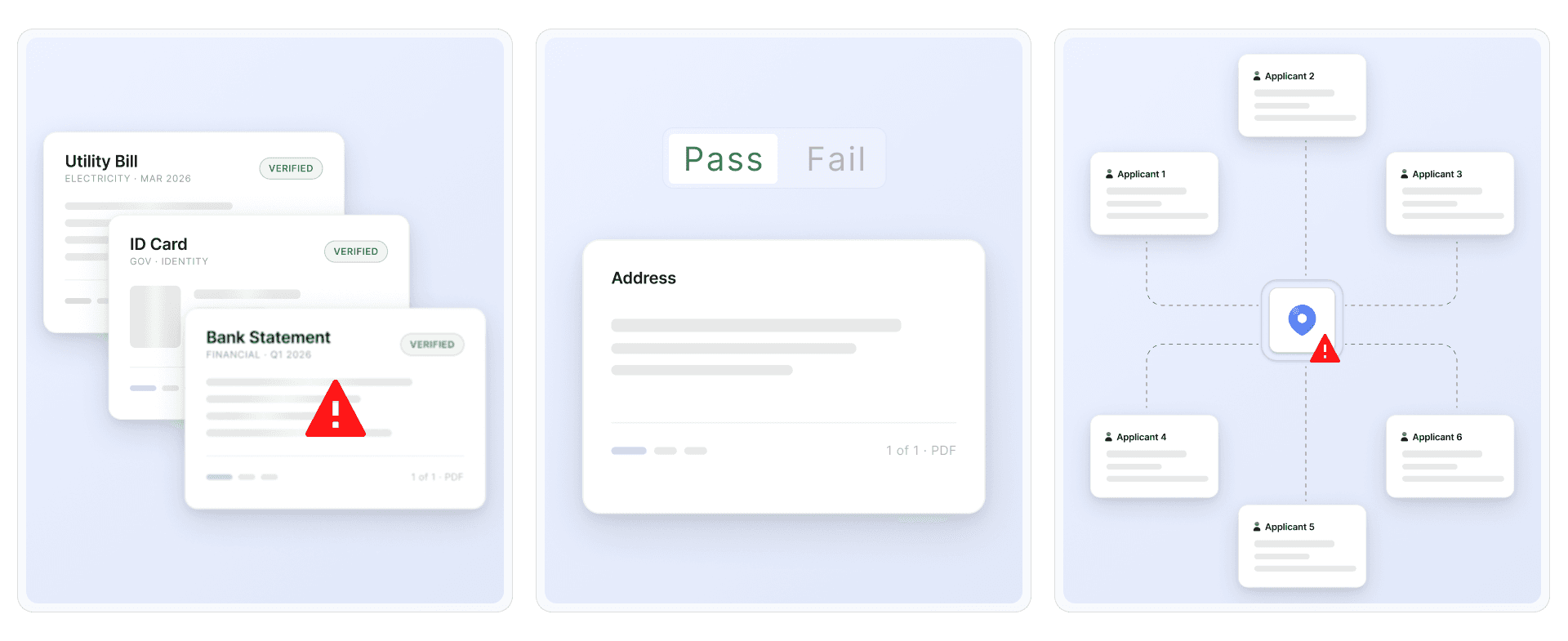
Common Address Fraud Patterns in Lending
Reused addresses across multiple applications
Fraud rings and repeat defaulters often route multiple applications through the same physical address, sometimes with different applicant names. Without system-level cross-referencing, this pattern stays hidden until a lending team investigates a cluster of defaults after the fact.
Mismatched or fabricated proof-of-address documents
Forged or altered documents can pass a basic OCR scan if the verification stops at "does this look like a valid document" rather than "does this address exist and match the applicant." Document authenticity and address accuracy are two different checks, and most workflows only run the first one.
Address collected but never independently verified
Many onboarding flows accept whatever address the applicant types into a form, backed by a document upload, with no independent signal confirming the applicant is actually present at that location. The address exists on paper. It was never checked against anything real.
What Detection Actually Requires
Live signal verification, not static uploads
Detecting address fraud requires evidence generated at the point of verification, not a document the applicant already had on hand. Live location data, address evidence photos, and OCR-verified documents captured together create a signal that is far harder to fabricate than a single uploaded file.
Confidence scoring instead of pass/fail
A risk score, rather than a binary outcome, lets credit teams apply proportionate decisioning. Low-risk cases can move straight to approval. High-risk cases get flagged with the specific evidence that raised the concern, instead of a blanket rejection or an unexplained pass.
Address-level context through affluence data
Neighborhood and property-level data adds a layer of context that a single document cannot provide. This helps underwriting teams calibrate credit limits and offers based on where an applicant actually lives, without requesting additional documentation from the applicant.
A timestamped, explainable audit trail
Every verification step needs a timestamp and a linked piece of evidence. When a compliance team needs to defend a lending decision during an audit, "the document looked fine" is not a defensible answer. A logged, evidence-backed trail is.
How This Comes Together in Practice
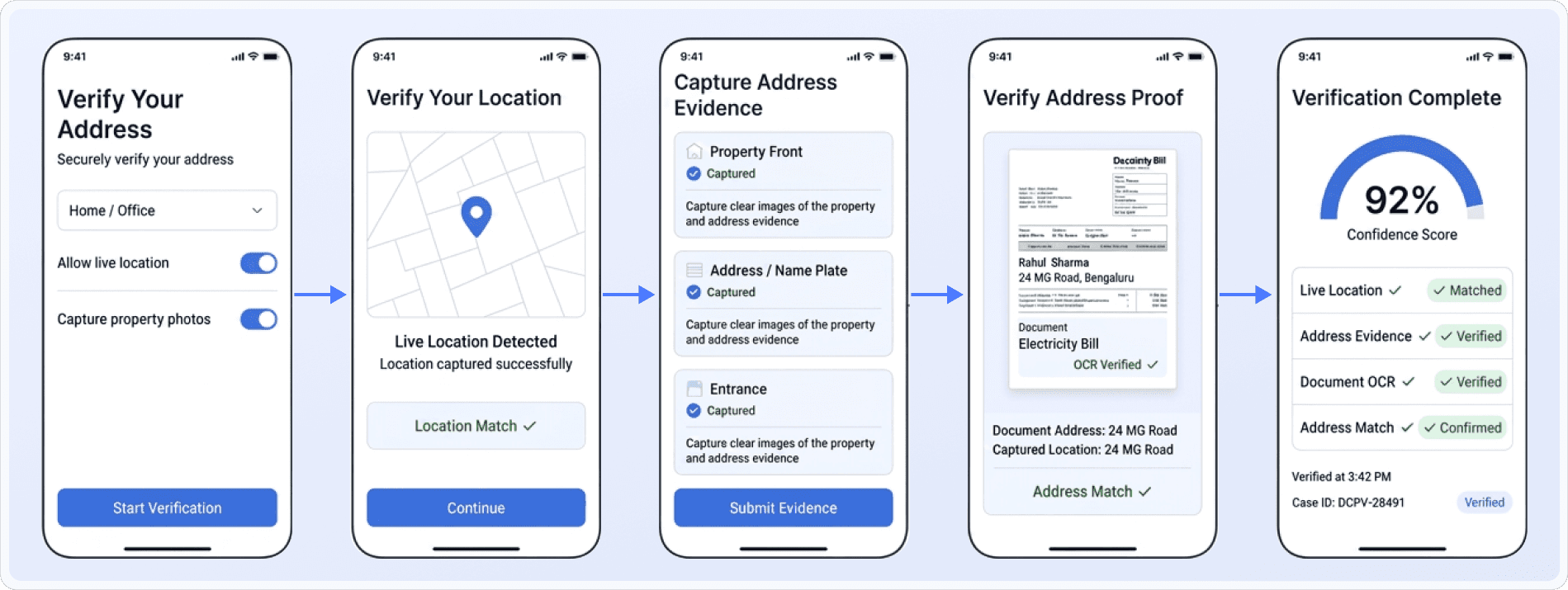
TartanHQ's Digital Contact-Point Verification is built around this exact gap between collecting proof and verifying it. Instead of accepting a static document, DCPV runs a guided verification journey that captures live location, address evidence photos, and OCR-verified documents in one flow, then generates a confidence score rather than a pass or fail.
The affluence score adds address-level context for underwriting without extra data requests from the applicant. Every step is logged with a timestamp, giving compliance teams an explainable trail instead of a black-box decision. The result is verification that runs in minutes to hours, asynchronously, without the scheduling delays and inconsistent reporting that come with field agent visits.
What Lending Teams See After Implementation
Fewer false rejections, because risk scoring replaces binary outcomes
Address reuse and misuse caught at the point of application, not after default
Faster disbursal cycles, since verification no longer depends on field agent scheduling
Audit-ready documentation for every verification decision, without manual note-taking
Talk to TartanHQ About Address Fraud Detection
If address fraud is showing up in your default rates rather than at the point of application, the fix starts with how addresses get verified, not just collected. Connect with the TartanHQ team to see how Digital Contact Point Verification fits into your existing credit decisioning workflow.