Most enterprise policies do not fail because they are poorly written. They fail because no one can find the current version, no one can prove when it was approved, and no one can trace who signed off on the exceptions.
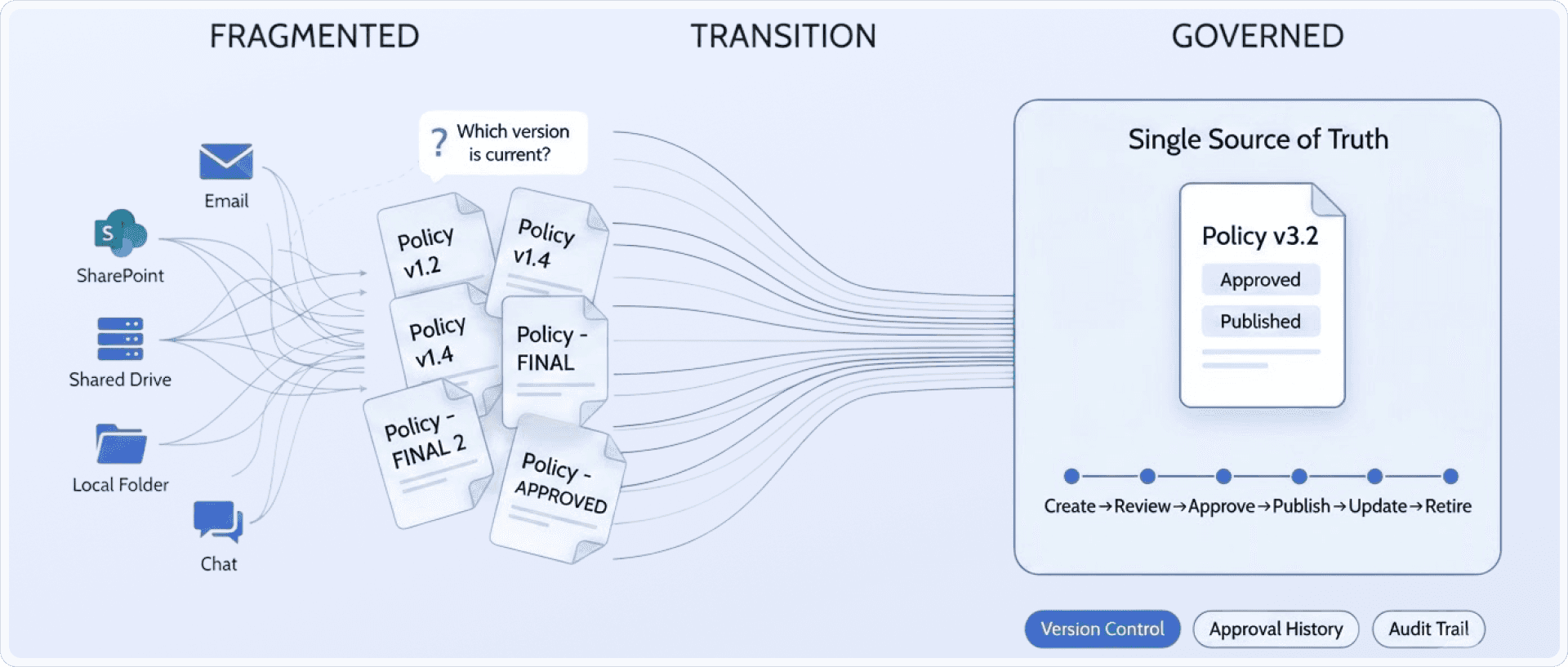
Documents sit scattered across SharePoint, email threads, shared drives, and local folders. Approvals happen over email with no structured trail. Compliance teams spend hours reconstructing audit history instead of managing risk. Business users wait on IT tickets to answer questions that should take seconds.
This is a policy lifecycle management problem, and it compounds with every undocumented decision.
Who This Is For
This is written for the people accountable for policy governance inside regulated, high-growth organizations, typically across BFSI, insurance, lending, and corporate travel infrastructure:
Compliance and GRC leaders who need to produce audit-ready trails on demand, and who absorb the risk when a policy gap surfaces during a regulatory review.
Operations and lending heads managing SOPs across underwriting, disbursal, and collections, where the procedure documented needs to match the procedure actually followed.
HR and policy owners maintain employee-facing policies across distributed teams, where version confusion creates inconsistent experiences at scale.
CXOs and business heads who need direct, self-serve answers on policy status and compliance posture, without routing every question through compliance or IT.
If your organization operates under RBI, IRDAI, or SEBI-mandated frameworks, or manages SOPs across multiple functions with regular audit touchpoints, this is a system-level problem worth solving deliberately rather than patching function by function.
Where Lifecycle Gaps Show Up in Practice
These are not hypothetical risks. They are recurring scenarios across regulated organizations that skip structured lifecycle management.
Lending: Underwriting Policy Drift
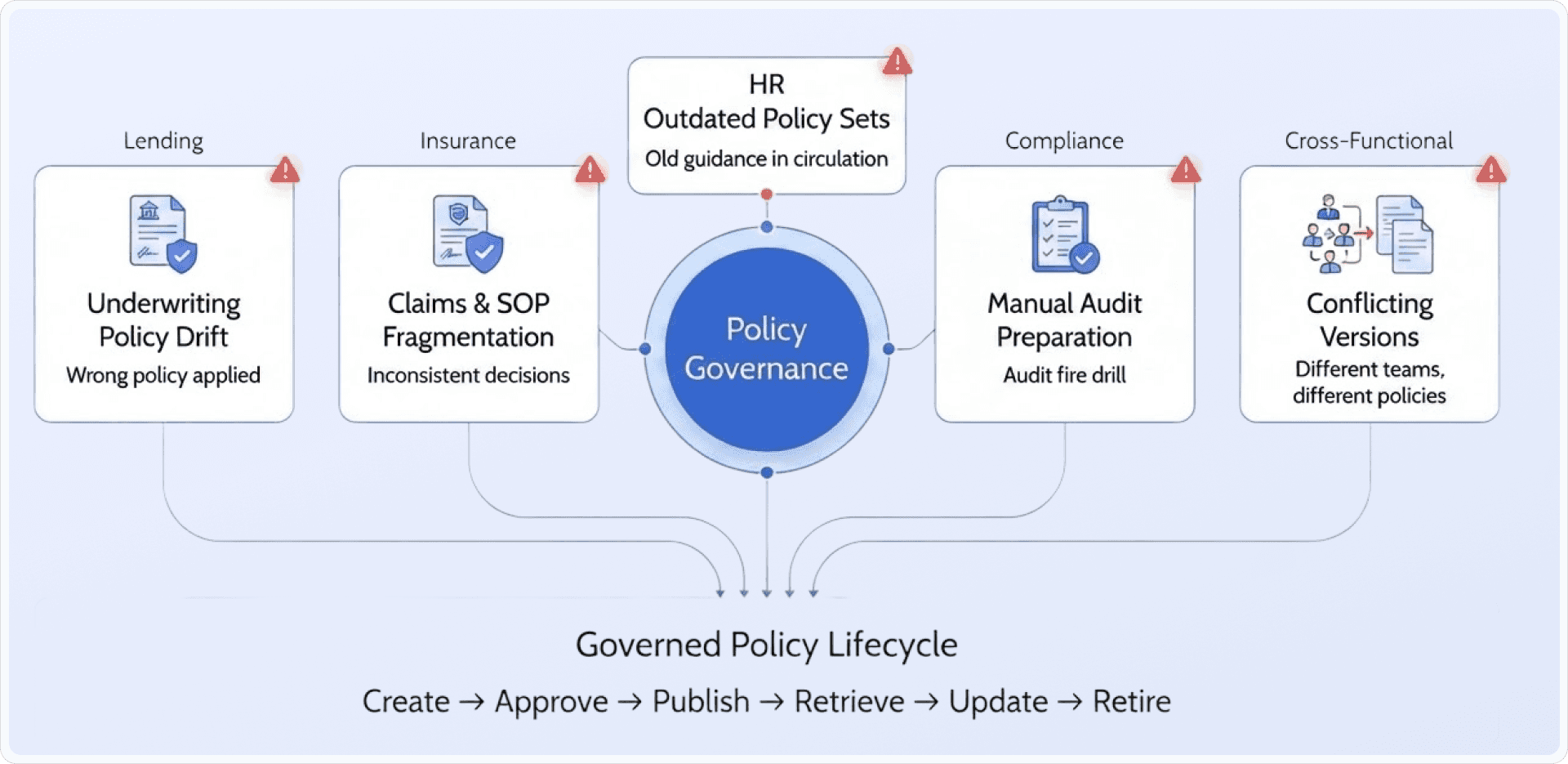
When credit or eligibility criteria change, lending teams that lack a governed approval workflow often keep operating on the prior policy for weeks after the update, simply because the new version has not reached every underwriter. A structured lifecycle closes that gap the moment approval is granted.
Insurance: Claims and Underwriting SOP Fragmentation
Claims processing SOPs frequently live in multiple versions across regional teams. Without centralized governance, two claims handlers can apply different criteria to comparable cases, creating both customer inconsistency and audit exposure.
HR: Onboarding on Outdated Policy Sets
New hires typically absorb policy information from whatever document a manager happens to share, not necessarily the current version. Governed retrieval ensures onboarding always pulls from the single published source, not from an inherited folder of old attachments.
Compliance: Audit Preparation as a Recurring Fire Drill
Without automatic audit trails, compliance teams reconstruct approval history manually before every regulatory review, pulling emails, chat logs, and file version timestamps together under deadline pressure. A governed lifecycle produces that trail continuously, so audit prep stops being a special project.
Cross-Functional: Conflicting Policy Versions in Circulation
When document creation, approval, and retrieval are not enforced through one system, it becomes common for two departments to reference different versions of what should be the same policy. This is one of the most frequent findings in internal and external audits alike.
Why This Matters More for BFSI, Insurance, and Lending Teams
Regulated industries carry a heavier compliance load than most. Lending operations, underwriting teams, and HR functions each maintain their own layer of SOPs, and regulatory bodies expect documented proof of governance on demand.
Fragmented systems make this proof expensive to produce. A single unified layer for policy and SOP management removes that friction. Compliance teams centralize RBI, IRDAI, and SEBI-mandated policies, enforce version control at the platform level, and generate audit-ready trails without manual reconstruction.
What Policy Lifecycle Management Actually Covers
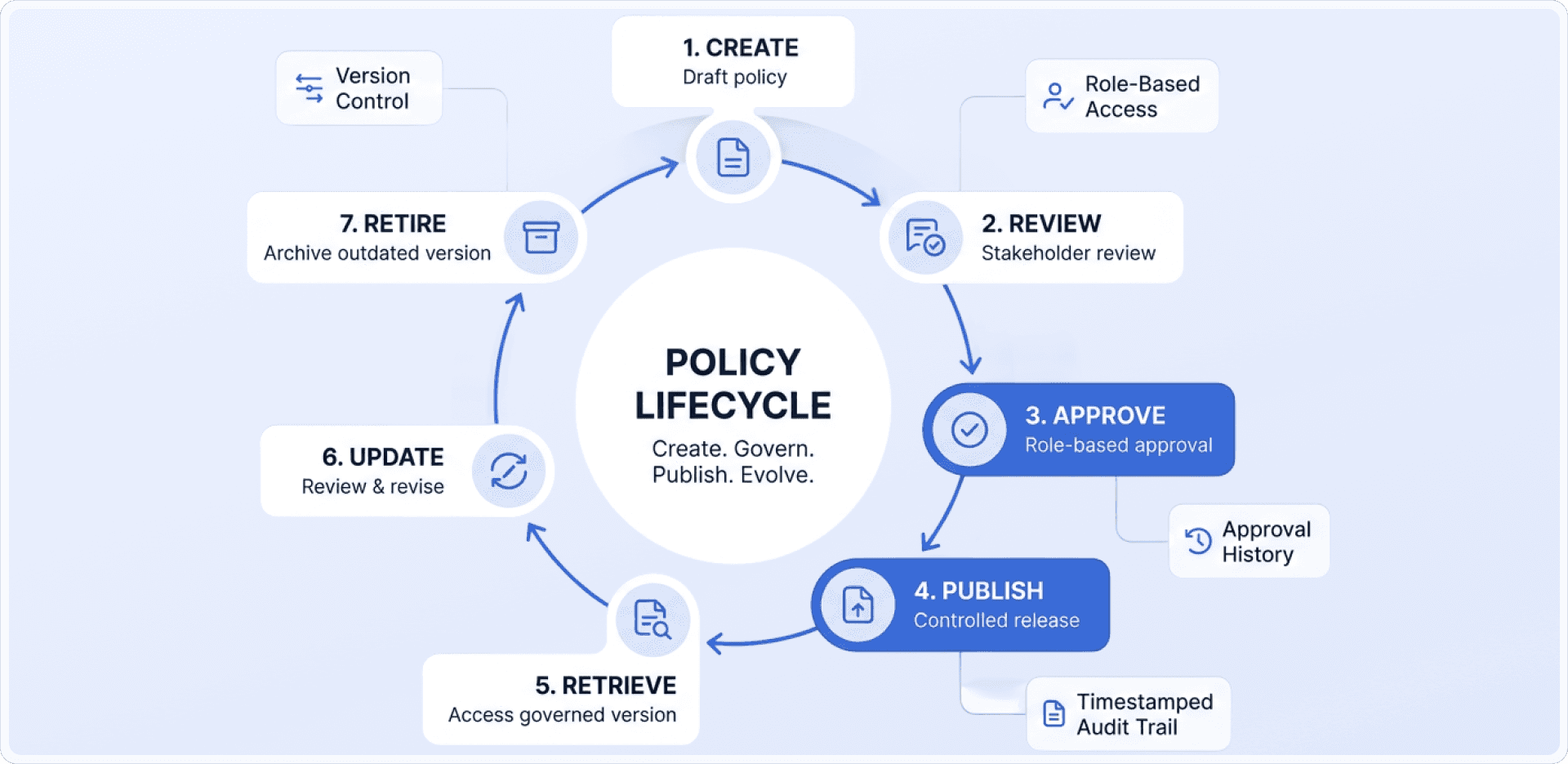
Policy lifecycle management is the structured process of creating, approving, publishing, updating, and retiring organizational policies and SOPs. A complete policy lifecycle includes:
Document Creation and Version Control
Every policy has an owner, a version history, and a single source of truth. Draft, review, and published states stay clearly separated so teams never act on outdated guidance.
Structured Approval Workflows
Policies move through defined approval chains based on role and authority level. Each step is logged, timestamped, and attributable to a specific approver.
Governed Access and Retrieval
Employees can find and query the exact policy they need without depending on the document owner or IT for support.
Audit Readiness
Every change, approval, and access event is recorded automatically, producing a complete trail that stands up to regulatory scrutiny at any point in time.
When any one of these stages is missing, the entire lifecycle breaks down. Fragmented documents lead to compliance gaps. Ungoverned approvals lead to regulatory exposure. Poor retrieval leads to slow, IT-dependent decision-making.
Benefits of Policy Lifecycle Management
Faster Policy Retrieval
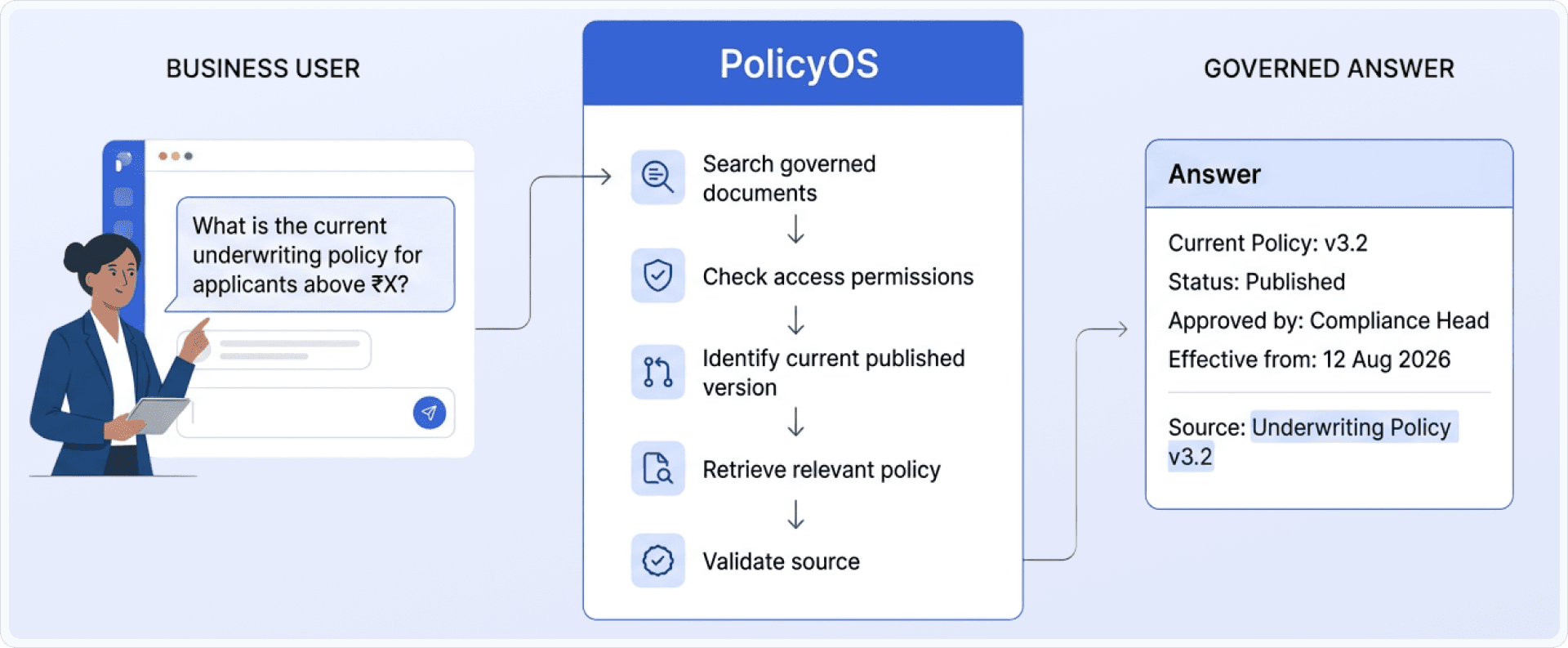
Manual search across drives and inboxes can take hours for a single policy lookup. A governed document layer with natural language retrieval reduces this to seconds, with source references attached to every answer.
Shorter Approval Cycles
Email-based approval chains stall easily and leave no reliable trail. Structured workflow orchestration enforces role-based routing, so approvals move on a predictable timeline instead of sitting in someone’s inbox.
Cleaner Compliance Posture
Regulatory frameworks like RBI, IRDAI, and SEBI require organizations to prove version control, approval history, and access restrictions. A centralized, governed system keeps audit trails complete and current by default, rather than reconstructed under deadline pressure.
Reduced IT Dependency for Insights
Business users and CXOs often need answers from policy or operational data without waiting on a technical team. Conversational access to governed documents lets teams query directly in plain language, with the underlying data staying accurate and access-controlled.
How PolicyOS by TartanHQ Closes the Gap
PolicyOS is built as the governed document and intelligent decision support layer for enterprise policy management. It addresses each stage of the lifecycle directly:
Centralized document management: A single governed repository for all enterprise policies, SOPs, and operational documents, replacing scattered drives and inboxes with version control and role-based access.
Role-based approval orchestration: Governance workflows enforced at the platform level instead of over email, with structured approval chains and complete audit trails built into every document’s lifecycle.
Conversational policy retrieval: Natural language queries return precise answers with source references, removing the need for manual search or IT dependency.
Natural language business analytics: Business users query documents, structured data, and operational reports directly, without SQL or an analyst queue.
Policy Governance Should Not Be a Quarterly Scramble
Effective policy lifecycle management is not a one-time project. It is an ongoing operating layer that determines how fast your organization can retrieve information, how defensible your audit trail is, and how much your business teams depend on IT for answers they should be able to find themselves.
Organizations that centralize this layer see the difference immediately: fewer compliance gaps, faster approvals, and teams that can act on policy information without waiting in a queue.
See PolicyOS in Action
If your compliance, lending, or operations team is still managing policies across scattered drives and email chains, it is worth seeing what a governed alternative looks like in practice.
Connect with the TartanHQ team → to walk through how PolicyOS fits into your existing document and approval workflows.