Corporate travel is a product category that looks deceptively well-solved from the outside. Booking engines exist. Expense management tools exist. Policy configuration modules exist. The enterprise sales deck checks every box a corporate client asks about.
And yet the product teams building these platforms know that three problems resurface on almost every large enterprise account - problems that don’t show up in the demo but consistently show up in production.
Employees booking outside policy. New joiners who aren’t in the system yet. Travel entitlements based on grade data that is weeks or months out of date.
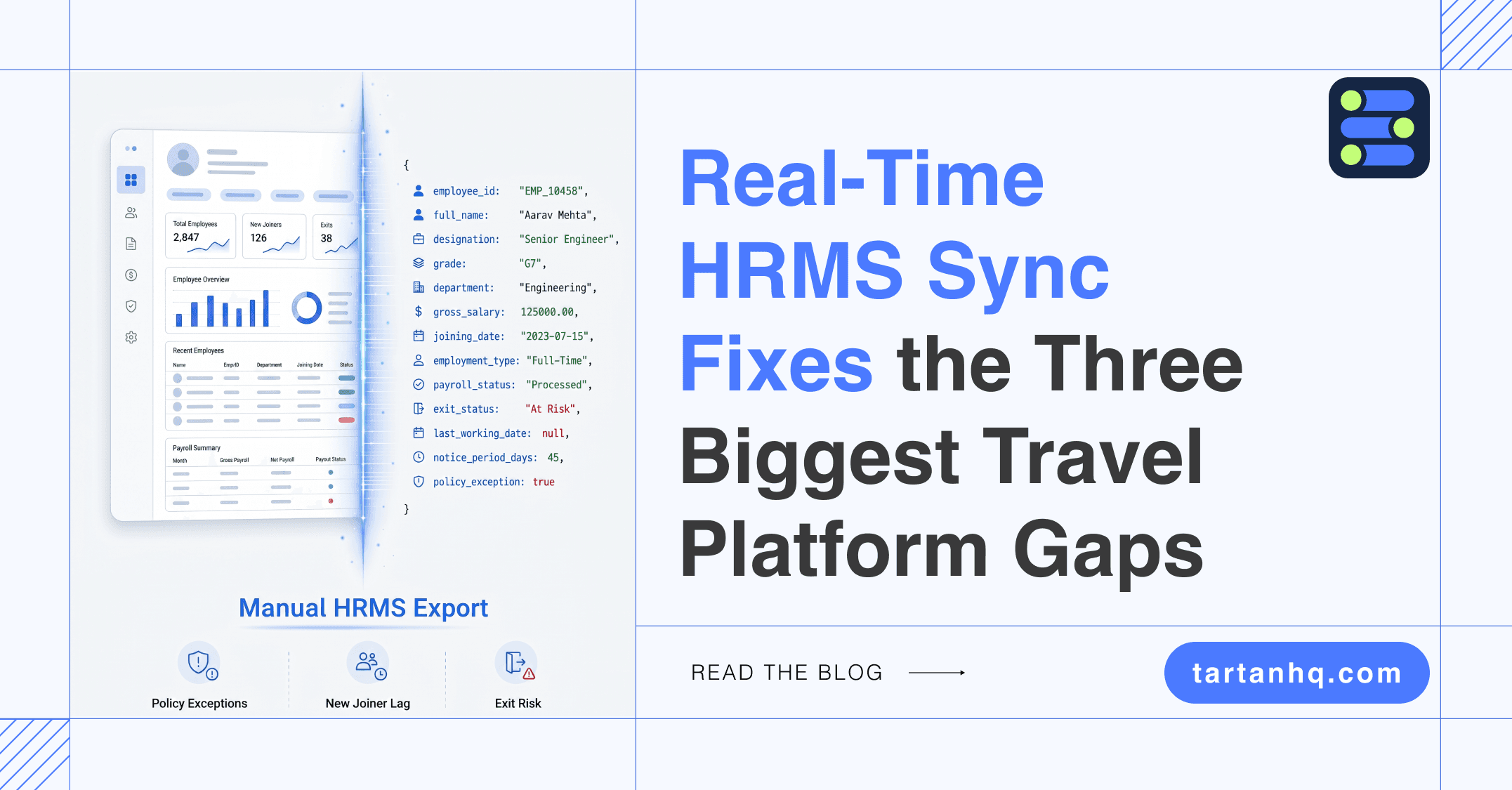
Each of these looks like a separate bug. A policy configuration issue, an onboarding lag, a data freshness problem. They get ticketed, escalated, and addressed individually. But they share a single root cause: the corporate travel platform is not connected to the one system that knows everything it needs - the employer’s HRMS.
This is the pipe that is broken. And until it is fixed properly, the same three problems will keep coming back.
Problem one: policy enforcement that runs on stale grade data
Every corporate travel policy is grade-based. A VP flies business class on routes above four hours. A manager books economy. A senior manager gets a hotel cap of ₹8,000 per night in metro cities. An associate’s per diem is fixed at a lower rate. The logic is consistent and the client has signed off on it.
The problem is what happens between the moment a client’s HR team exports an employee roster for the platform and the moment an employee actually books a trip. In that window - which, for manually maintained platforms, can be anywhere from a few weeks to several months - people get promoted. Roles change. An employee moves from manager to senior manager and their
entitlements change with it. A lateral hire joins at a higher grade than most of their peers.
The travel platform doesn’t know any of this. It knows what the last data file said. So when the newly promoted senior manager books a hotel at the rate she is now entitled to, the system flags it as a policy violation. She has to raise a manual exception. Someone approves it. The approval takes a day.
She books anyway out of frustration, or she calls the travel desk, or she escalates to HR. None of this should have happened. The policy was correct. The data was wrong.
Multiply this across a 5,000-person enterprise client with regular promotion cycles and the exception queue becomes a permanent part of the product’s operational overhead - not because the policy engine is broken, but because the employee data feeding it is perpetually behind reality.
“A travel policy exception is almost never a policy problem. It is a data freshness problem - the system applying the right rule to the wrong version of the employee.”
Problem two: new employees who don’t exist in the platform yet
A new employee joins a company on Monday. By Wednesday, their manager has asked them to travel to Bangalore for a client meeting on Friday. The employee opens the corporate travel platform.
They are not in the system.
What happens next varies by platform and by client, but none of the options are good. The employee books outside the platform on their personal card and claims reimbursement - which bypasses policy entirely. Or the travel desk manually creates their profile and sets their entitlements by hand - which is ops overhead that compounds with every new joiner. Or the trip gets delayed, which is a business impact that the travel platform is now implicitly responsible for.
This onboarding lag is a direct function of how employee data reaches the platform. In most implementations, it arrives via periodic HR data exports - monthly, or at best weekly. A new employee who joins mid-cycle simply doesn’t exist in the travel platform until the next export runs.
The gap between joining and being bookable can be days. For large enterprises with high-velocity hiring, it is a constant drip of the same problem.
The client’s travel manager feels this acutely. They are the person fielding the “I can’t book” messages. They are the one raising support tickets. Over time, this erodes confidence in the platform - not because the booking engine is broken, but because the platform doesn’t know who works at the company at any given moment.
Problem three: exits that keep booking
The mirror image of the new joiner problem is the exit problem - and it carries more financial risk.
An employee leaves the company. Their last day is the 15th. The next HR data export is scheduled for the 1st of the following month. In the two weeks between their exit and the data update, their travel platform account remains active.
If they have a trip already booked that falls after their exit date, the booking processes without issue.
If a rogue actor - or simply an oversight - triggers a booking in that window, the corporate client is on the hook for travel spend on behalf of someone who no longer works for them.
For most platforms this is a known edge case that gets handled through manual escalations and periodic reconciliation. It is tolerated because the alternative - maintaining a real-time view of employee status - has historically required a level of HRMS connectivity that most travel platforms have not built.
The financial exposure from this varies by client size and employee turnover rate. For a 10,000-person enterprise with 15% annual attrition, the window of active accounts for departed employees - multiplied across every exit in the year - represents a non-trivial risk surface. One that is entirely eliminable with a live data connection.
Why solving these one at a time doesn’t work
The instinct for most product teams is to address each of these problems with a product solution. Build a faster onboarding flow. Create a better exception management module. Add an account deactivation trigger. These are reasonable responses and they improve things at the margin.
But they don’t fix the root cause, which is that the travel platform’s understanding of who works at a company, at what grade, with what entitlements, is always a lagged, approximate, human-maintained copy of the truth - rather than the truth itself.
As long as the platform’s employee data comes from periodic exports, the three problems will recur. You can make the exception queue easier to manage. You cannot eliminate it without changing where the data comes from and how frequently it arrives.
What live HRMS connectivity changes
When a corporate travel platform connects directly to an employer’s HRMS via API - with the employer’s consent - the data relationship inverts. Instead of the platform maintaining a stale copy of the employee roster, it reads from the live system the employer maintains as their operational truth.
New joiners appear in the travel platform the moment they appear in the HRMS - which is typically before or on day one of employment. The profile is auto-created, entitlements are set based on the grade and designation in the HRMS, and the employee is bookable from the first day they might need to travel. The manual onboarding step disappears.
Promotions and role changes propagate immediately. When an employee’s grade updates in the HRMS, their travel entitlements update in the platform. The policy exception queue shrinks because the data is no longer behind the reality it is supposed to reflect. The system applies the right rule to the right version of the employee, consistently.
Exits trigger account deactivation automatically. When an employee’s status changes to inactive or terminated in the HRMS, the travel platform knows. The risk window between exit and data update closes to near-zero.
The operational overhead that currently sits between the travel platform and its enterprise clients - the travel desk calls, the manual exceptions, the support tickets from new joiners who can’t book - shrinks substantially. Not because the product got better at handling exceptions, but because the data quality that generates the exceptions improved at the source.
Day 1 new joiners bookable with live HRMS sync | Real-time grade and entitlement updates - no export cycle | Zero lag between employee exit and account deactivation |
The enterprise sales argument
There is a commercial dimension to this that product teams should factor into how they prioritise the investment.
Enterprise travel RFPs increasingly include questions about HRMS integration capability. Procurement teams at large Indian corporates - the accounts that represent the highest contract value - have experienced the data lag problems firsthand on previous platforms and are actively evaluating whether a new vendor has solved them.
A travel platform that can demonstrate live, bidirectional HRMS connectivity is answering a question that matters to the buyers who matter most.
The retention argument is equally strong. The three problems described in this piece - stale grade data, new joiner lags, active exit accounts - are the most common reasons enterprise travel clients raise escalations and, eventually, evaluate switching. They are operational friction that compounds over time and erodes the client relationship even when the core booking product is performing well.
Eliminating them through HRMS connectivity is a retention investment as much as a product investment.
The HRMS diversity challenge
The practical barrier most travel platform product teams hit when they try to solve this is the same one that stops every B2B SaaS team that needs HRMS data at scale: Indian enterprises use 50+ different HRMS platforms.
Building a direct integration with Darwinbox covers some clients. Adding GreytHR and Keka covers more. But maintaining five, ten, or fifteen integrations - each with its own authentication model, data schema, and update cadence - is a significant ongoing engineering commitment that competes with every other item on the product roadmap.
A unified HRMS API layer eliminates this trade-off. One integration, one data model, coverage across 80+ platforms. The travel platform connects once and gets real-time employee data from whatever HRMS each enterprise client happens to run.
New clients onboard without requiring a new integration project. The HRMS diversity problem - which has historically made live connectivity feel too expensive to build - becomes a solved infrastructure problem rather than an ongoing engineering tax.
This is what Tartan’s HyperSync provides specifically for B2B platforms that need live employee data from enterprise clients.
Travel platforms integrating HyperSync get real-time roster sync, grade and designation updates, and exit event triggers across the full diversity of HRMS platforms their clients use - through a single API, with consent management built in, deployable in days rather than sprints.
The three problems are fixable. They require one architectural decision - connecting to the HRMS directly rather than waiting for it to be exported - and one integration that covers every client regardless of which HR system they run.
The question for every corporate travel platform product team is straightforward: how much of your current support queue, exception backlog, and client escalation log traces back to employee data that was already correct in the client’s HRMS - it just never arrived in time?