There is a moment in every salaried employee’s working life that is, from a banking perspective, extraordinarily valuable - and almost entirely wasted by the institutions best positioned to capture it.
The moment is day zero of a new job.
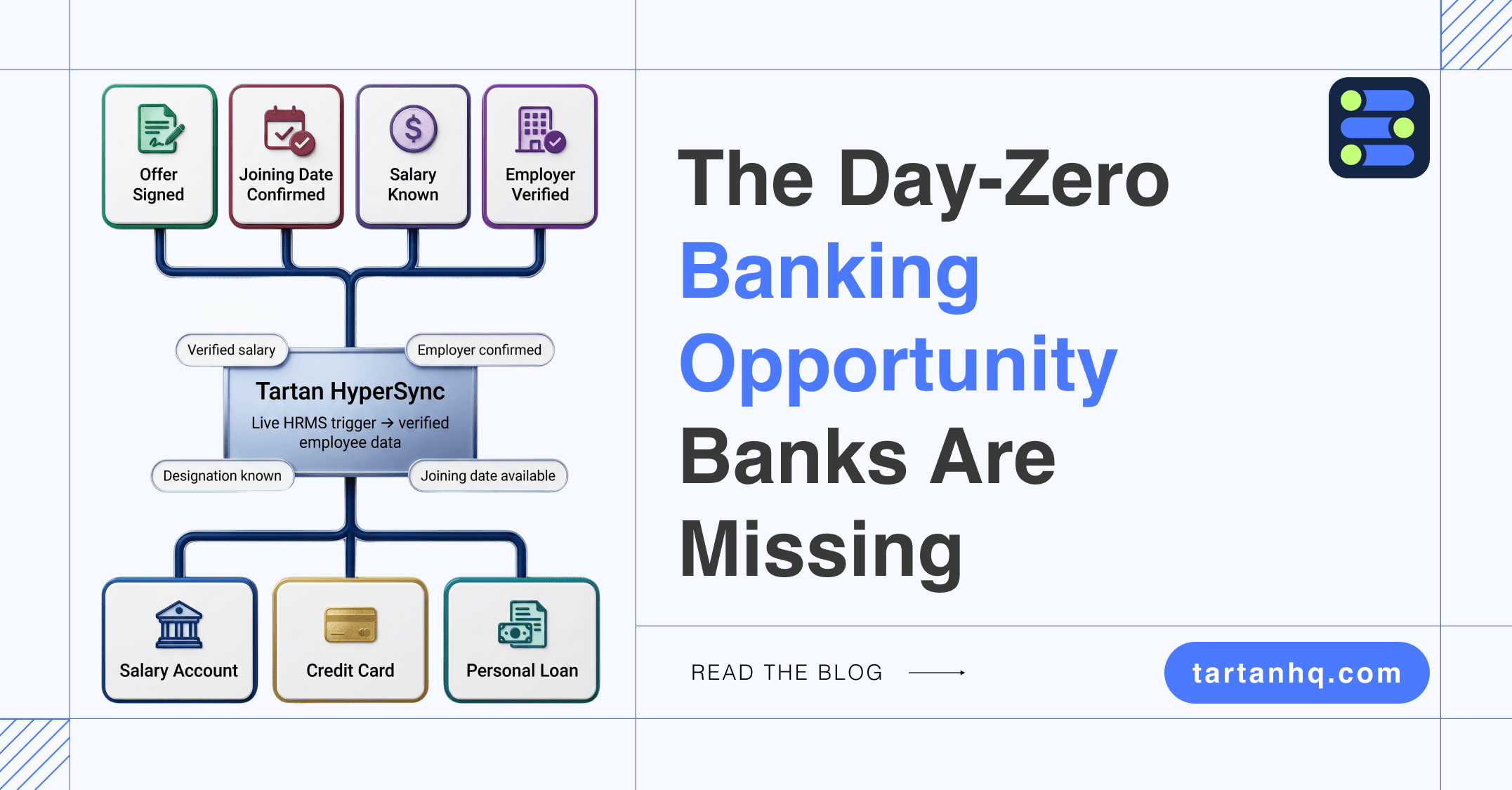
The offer letter has been signed. The joining date is confirmed. The employee knows exactly what their salary will be, who their employer is, and when their first paycheck will arrive. Their financial intent at this moment is at its peak - they are thinking about where to open a salary account, whether to consolidate banking relationships, what new financial products they might now qualify for. They are, in the language of acquisition, maximally warm.
And what does the bank do? It waits. It waits for the employer’s HR team to initiate a salary account tie-up. It waits for the employee to walk into a branch or download an app. It waits for three months of salary credits before calculating a pre-approved loan offer.
By the time the bank makes its move, the employee has already made their decisions - often for a bank that moved faster, or defaulted to whichever institution their employer’s corporate relationship happens to route payroll through.
The acquisition opportunity at joining is real, time-bound, and enormous. Most banks are currently arriving three months late.
Why joining day is the highest-intent financial moment
To understand why day zero matters so much, it helps to think about what a new employee is actually experiencing in the two weeks before and after joining.
They have just made a significant life decision. For many - especially first-jobbers and mid-career switchers - a new role represents a step-change in income.
A candidate moving from ₹8 lakh to ₹14 lakh annually is not just earning more. They are re-evaluating their entire financial position.
What can they afford now that they couldn’t before? What credit products do they newly qualify for? Where should their salary land?
This is also a moment of maximum data clarity. At the point of joining, the employee’s current employer, current salary, designation, and start date are all known facts - not estimates, not approximations from a bureau score or a bank statement.
The offer letter and the HRMS record are the cleanest statement of financial capacity a bank will ever have about this person. It is more current than their last salary slip. It is more verified than their self-reported income on a loan application. It is ground truth, available right now.
The window is narrow. Within a few weeks of joining, the employee has typically opened an account somewhere, set up their investment SIPs, and settled into financial routines that are sticky and hard to shift. The bank that reaches them before this window closes acquires a customer at the beginning of what could be a decades-long relationship. The bank that arrives after has to dislodge entrenched behaviour - a much harder and more expensive proposition.
“Day zero of employment is the only moment in a salaried person’s financial life where their income, employer, and intent are all simultaneously verifiable and maximally active. Banks that treat it as a passive event are ceding their best acquisition window to whoever moves first.”
What pre-approved credit at joining actually looks like
The use case is more concrete than it might first appear. Here is how it works when built on live HRMS data.
When a new employee’s record is created in the employer’s HRMS - typically when HR processes the offer acceptance or confirms the joining date - that event can trigger an outreach from the bank. Not a generic welcome message.
A personalised, pre-approved financial offer built on verified data: the employee’s exact salary, their employer’s credit profile, their designation, and their start date.
The salary account offer arrives before day one. The employee is invited to open an account digitally - pre-filled with their employment details, requiring minimal documentation because the bank already has what it needs from the HRMS. The account is live before the first payroll cycle. No branch visit. No form-filling exercise. A three-minute digital journey that lands at the exact moment the employee is thinking about exactly this.
The personal loan pre-approval follows from the same data. The bank knows the gross salary. It knows the employer’s category and stability. It can calculate a pre-approved limit, price it appropriately, and present it as an offer the employee can accept in a single tap - again, before they have received a single paycheck.
For an employee joining at ₹15 lakh per annum who has immediate needs - relocation costs, a new vehicle, home setup expenses - this offer lands at precisely the right moment.
The credit card offer completes the picture. A card pre-approved based on confirmed joining salary and employer profile, offered as part of the onboarding journey, converts at rates that generic campaign-based card acquisition cannot match. The employee is primed, the data is clean, and the offer is relevant.
The lifetime value argument
Acquiring a salaried customer at joining versus acquiring them eighteen months into their tenure at the same company is not an equivalent outcome - even if the immediate product uptake looks similar.
The customer acquired at joining has their salary account, their first credit card, and possibly their first personal loan all with the same bank, established in the first weeks of their employment. That is three products, three data streams, and three relationship anchors from day one.
The cross-sell surface over the subsequent five years - home loan, vehicle loan, mutual funds, insurance, wealth products - is built on a primary banking relationship that has been compounding since before they received their first salary.
The customer acquired eighteen months later has already distributed their financial relationships. Their salary comes in, but a portion leaves immediately to a different bank’s credit card. Their investment accounts are elsewhere.
The bank has a salary account, but not a banking relationship. Cross-selling into this customer is harder, and the products that represent the highest lifetime value - home loans, wealth management - have often already been placed with someone else.
The acquisition cost differential matters too. Reaching a new employee through their employer’s HRMS data - with a targeted, pre-approved offer at a known moment of intent - is fundamentally cheaper than acquiring the same customer through performance marketing six months later. The conversion rate on a pre-approved offer built on verified data, delivered at the right moment, is in a different category to an inbound loan application from a customer who is comparison shopping after receiving three other offers.
Day 0 when financial intent and data clarity peak simultaneously | 3 products activatable before first salary - account, card, personal loan | Weeks before most banks even know the employee exists |
The segment this changes most
Not every new employee represents the same opportunity - and the banks that execute this well will prioritise accordingly.
First-time salaried employees - campus hires, early-career professionals entering the formal workforce - are the most valuable cohort for this motion. They are new-to-credit or thin-file customers whose creditworthiness cannot be assessed from bureau data alone, but whose employer and salary data at joining tells a much cleaner story.
A candidate joining a Tier-1 IT company or a large BFSI institution at ₹6-8 lakh per annum, on a permanent contract, with a confirmed start date, is a better credit risk than their bureau profile suggests. HRMS data makes this visible at the right moment.
Mid-career switchers moving to significantly higher-paying roles are the second high-value cohort. A professional moving from ₹12 lakh to ₹22 lakh annually is undergoing a financial step-change that will express itself across multiple products over the next twelve to eighteen months.
The bank that captures them at joining - before their prior bank has noticed the income change - is positioning itself for every subsequent financial decision at the new income level.
Senior hires and leadership roles represent the wealth management opportunity.
An executive joining at ₹50 lakh or above, confirmed by HRMS data, is a wealth management lead - not just a salary account.
The bank that converts this person at joining with a premium account and an immediate wealth conversation is starting the relationship from a fundamentally different position than the one that sends a generic pre-approved loan SMS six months later.
What makes this possible now
The reason this use case has not been fully exploited yet by Indian banks is not lack of intent - most acquisition heads would immediately see the value. It is data access. Banks historically have had no mechanism to know about a new employee until the employer initiates a salary account relationship or the employee walks through the door.
Live HRMS connectivity changes this. When a bank has a consent-driven API connection to an employer’s HR system, new employee records are visible the moment they are created. The joining event becomes a real-time trigger.
The bank does not wait for the employee to come to it. It reaches the employee at the moment the HRMS reflects that they exist - which is before day one, and weeks before any competing bank has the same information.
This is exactly what Tartan’s HyperSync enables for banks managing corporate salary account relationships. HyperSync maintains a live, consent-based connection to 80+ HRMS platforms - meaning that regardless of which system the employer uses, new joiners are surfaced to the bank in real time. The acquisition trigger is the HRMS event, not the payroll credit. The bank moves first, every time, at the moment of highest intent.
The best salaried customer acquisition motion in Indian retail banking is not a better campaign. It is not a lower interest rate or a higher card limit. It is showing up before anyone else does, with a relevant offer built on verified data, at the one moment when the customer is most ready to make financial decisions.
That moment is before the first day of work. The data to reach it already exists. The only question is whether the bank has a live connection to it.