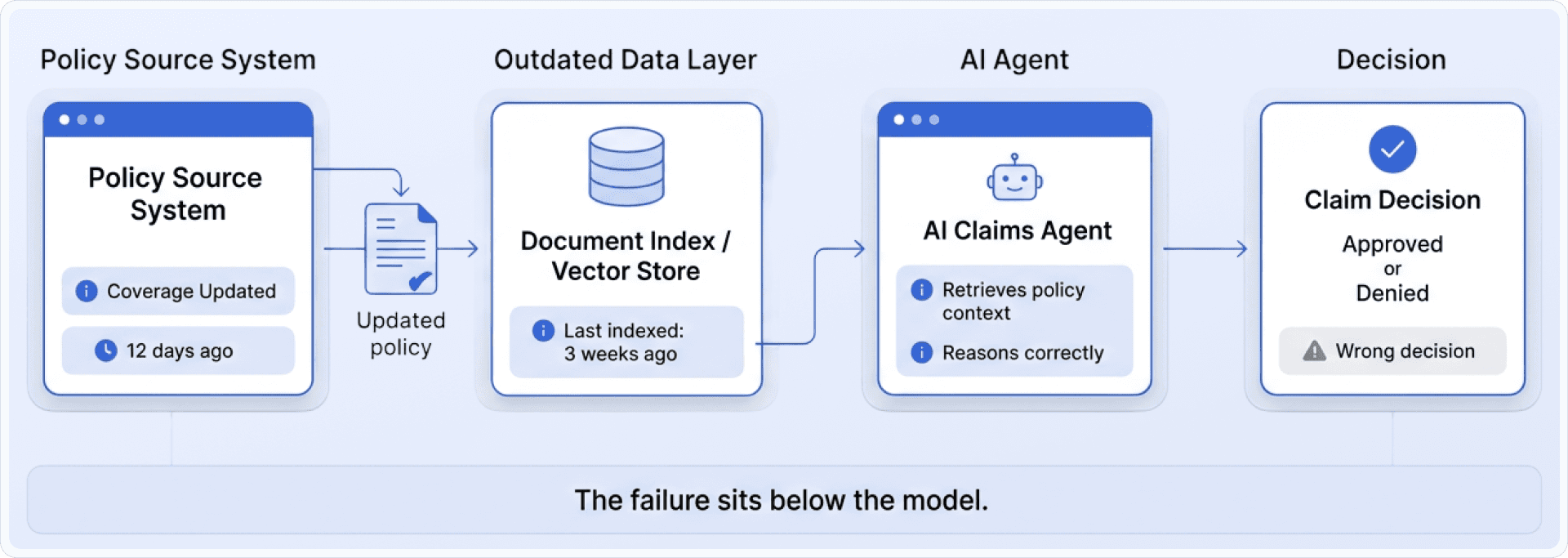
An AI agent processing an insurance claim pulls policy terms from a document indexed three weeks ago. The policyholder’s coverage changed twelve days ago. The agent approves a claim that should have been flagged, or denies one that should have been paid. No one notices until the customer calls, or worse, until an auditor does.
This is not a model problem. The agent reasoned correctly given what it had. The failure sits one layer below the model, in the systems responsible for keeping policy data current and accessible at the moment of decision.
The Gap Between Policy Updates and Policy Data
Insurance and lending organizations update policy terms constantly. Underwriting guidelines shift. Coverage riders get added or dropped. Regulatory changes force mid-cycle amendments. Each update typically lands in a source system: a policy administration platform, a document management tool, a compliance database.
AI agents do not read source systems directly in most deployments. They read from an intermediate layer, often a vector store or a cached document index, that was populated at some point in the past. The interval between a policy update and the agent’s index catching up creates a window. Any decision made inside that window is made on stale information, and the agent has no way to know it.
This is a data synchronization problem wearing the costume of an AI reliability problem. Teams debug it by tuning the model, adjusting the retrieval prompt, or fine-tuning on more examples. None of these fixes the actual issue: the agent is confidently reasoning over data that no longer describes reality.
Three Ways Outdated Policy Data Breaks Downstream Decisions
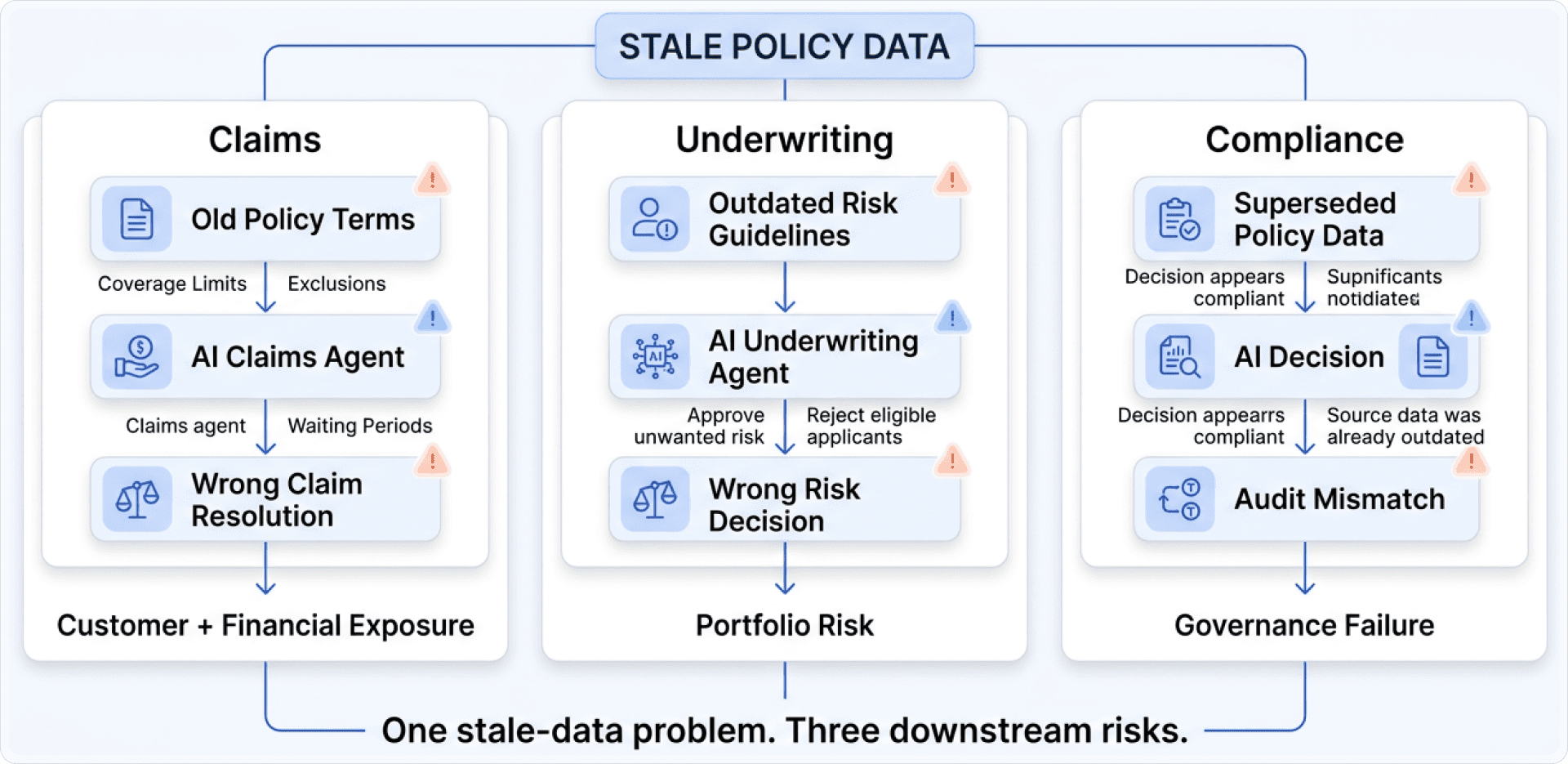
Claims get resolved against the wrong terms. A claims agent references coverage limits, exclusions, or waiting periods from a superseded policy version. The resolution is internally consistent and completely wrong. The customer experience damage is immediate. The financial exposure compounds if the error repeats across a batch of similar claims processed the same week.
Underwriting decisions drift from current risk appetite. Lending and insurance underwriting guidelines change in response to portfolio performance, regulatory guidance, or market conditions. An agent working from a three-month-old guideline document approves risk the business no longer wants, or rejects applicants who now qualify. Neither error shows up in the agent’s output. Both show up in the portfolio metrics weeks later, disconnected from their root cause.
Compliance exposure accumulates silently. Regulated industries operate under documentation requirements that assume decisions were made against current rules at the time of decision. An agent acting on outdated policy data creates a record that looks compliant on its face but was generated from information the organization had already superseded. When an auditor traces the decision back to its source data, the mismatch surfaces as a governance failure, not a technical bug.
Why This Is a Context Layer Problem, Not a Model Problem
Retraining or swapping the underlying model does not fix any of the three failures above. The model performed its function correctly: it retrieved the most relevant information available to it and reasoned over that information. The defect is upstream, in what the agent was given to reason over.
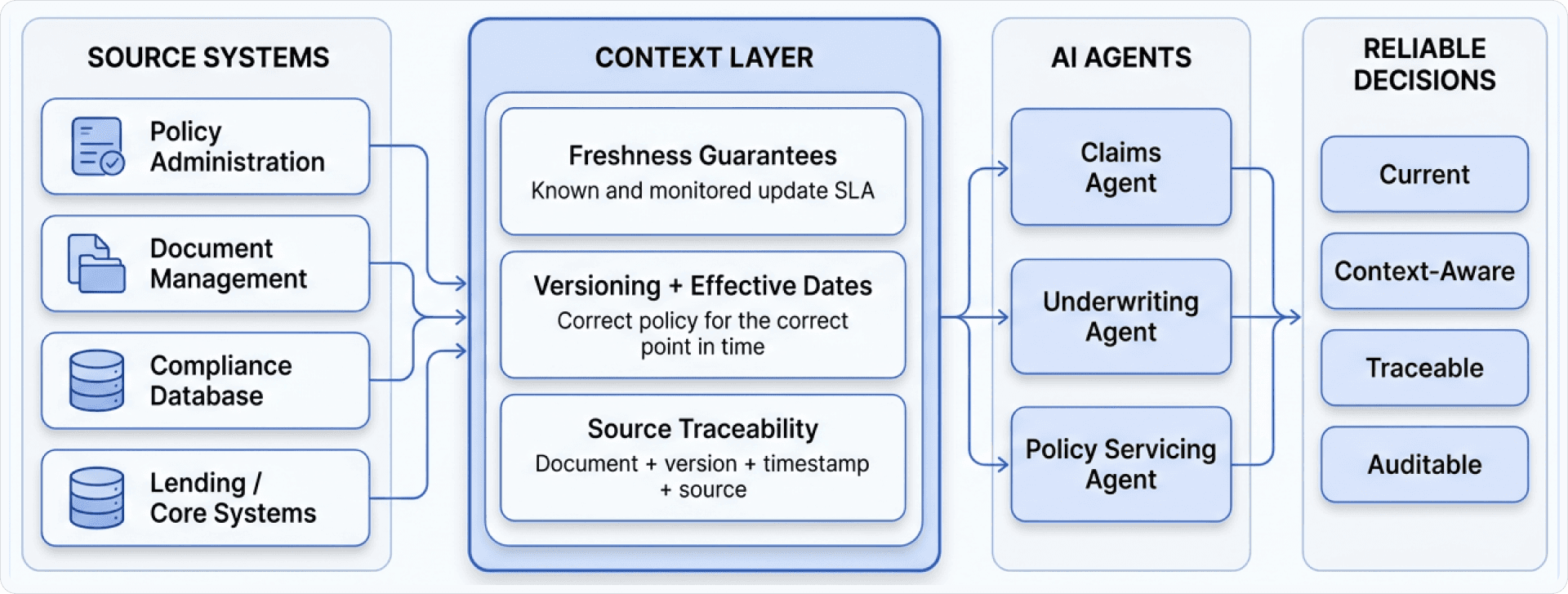
A context layer is the infrastructure responsible for that upstream work. It governs what data an agent can access, how current that data is, and what happens when source systems change. Three properties determine whether it prevents the failure modes above or reproduces them.
Freshness guarantees. The context layer needs a defined, monitored interval between a change in the source system and that change becoming available to the agent. “Eventually consistent” is not a sufficient standard for policy data feeding claims or underwriting decisions. The interval needs to be known, bounded, and short enough that the business can tolerate the worst case.
Versioning and effective dates. Policy terms are not simply current or outdated. Insurance and lending policies routinely have effective dates, grace periods, and terms that apply differently depending on when a policy was issued or last renewed. A context layer built for regulated industries needs to serve the correct version for the correct point in time, not just the most recent version.
Traceability back to source. When an agent makes a decision, the context layer should be able to show exactly which document version, timestamp, and source system record informed that decision. This closes the audit gap described above. It turns “the agent said so” into a reconstructable chain from source data to decision.
What This Looks Like in Practice
Consider a claims workflow built on a context layer with these properties. A policy amendment lands in the source system. The context layer picks up the change within a defined SLA, versions it correctly against the policy’s effective date, and makes it available to any agent querying that policy going forward. A claim submitted the next day pulls the amended terms. A claim submitted before the amendment took effect pulls the prior version, correctly, because the context layer understands effective dating rather than treating “most recent” as “correct.”
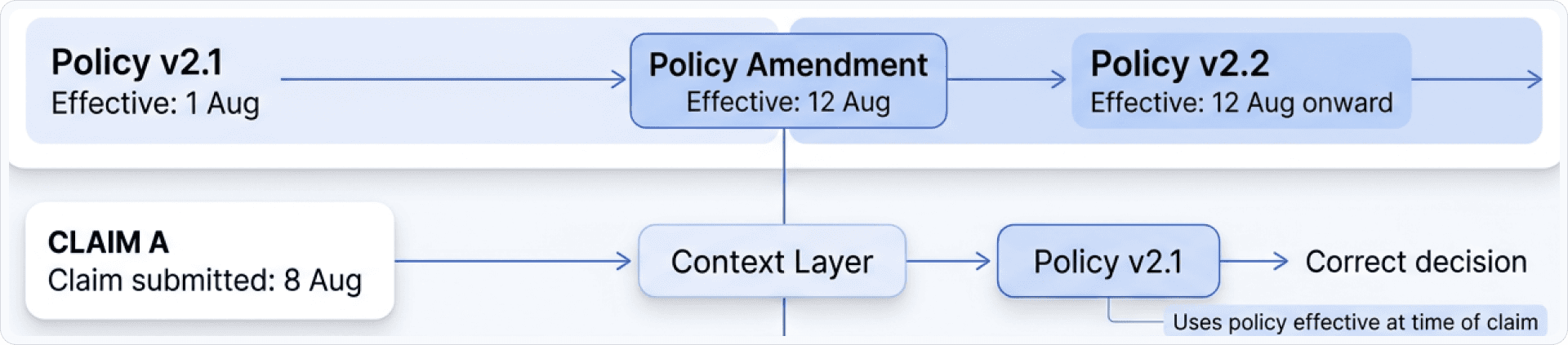
If a dispute arises later, the organization can reconstruct exactly which policy version the agent used and when that version became available, satisfying both internal governance and external audit requirements.
None of this requires a different model. It requires infrastructure between the source systems and the agent that treats data currency and provenance as first-class concerns rather than implementation details.
The Real Question for BFSI Teams Deploying AI Agents
Most organizations evaluating AI agents for claims, underwriting, or policy servicing ask how accurate the model is. The more useful question is how current and traceable the data feeding that model is at the moment of every decision.
A highly capable model reasoning over stale policy data will produce confident, well-articulated, wrong answers. Failure is invisible at the point of generation and expensive at the point of discovery. Fixing it means investing in the context layer, not just the model sitting on top of it.
Organizations deploying AI agents in regulated financial services should treat context infrastructure as a governance requirement, not an optional optimization. The cost of getting it wrong shows up in customer trust, portfolio performance, and audit findings, all after the decision has already been made.
TartanHQ’s Take on the Context Layer
Tartan builds the context layer underneath AI agents in insurance and lending through a unified API model. Agents cite information directly from the source system instead of ungoverned sources, with freshness, effective dating, and traceability handled at the infrastructure level. This is what separates an agent that reasons well from an agent that reasons well on the right data.
Talk to Tartan about what a context layer means for your AI deployments.