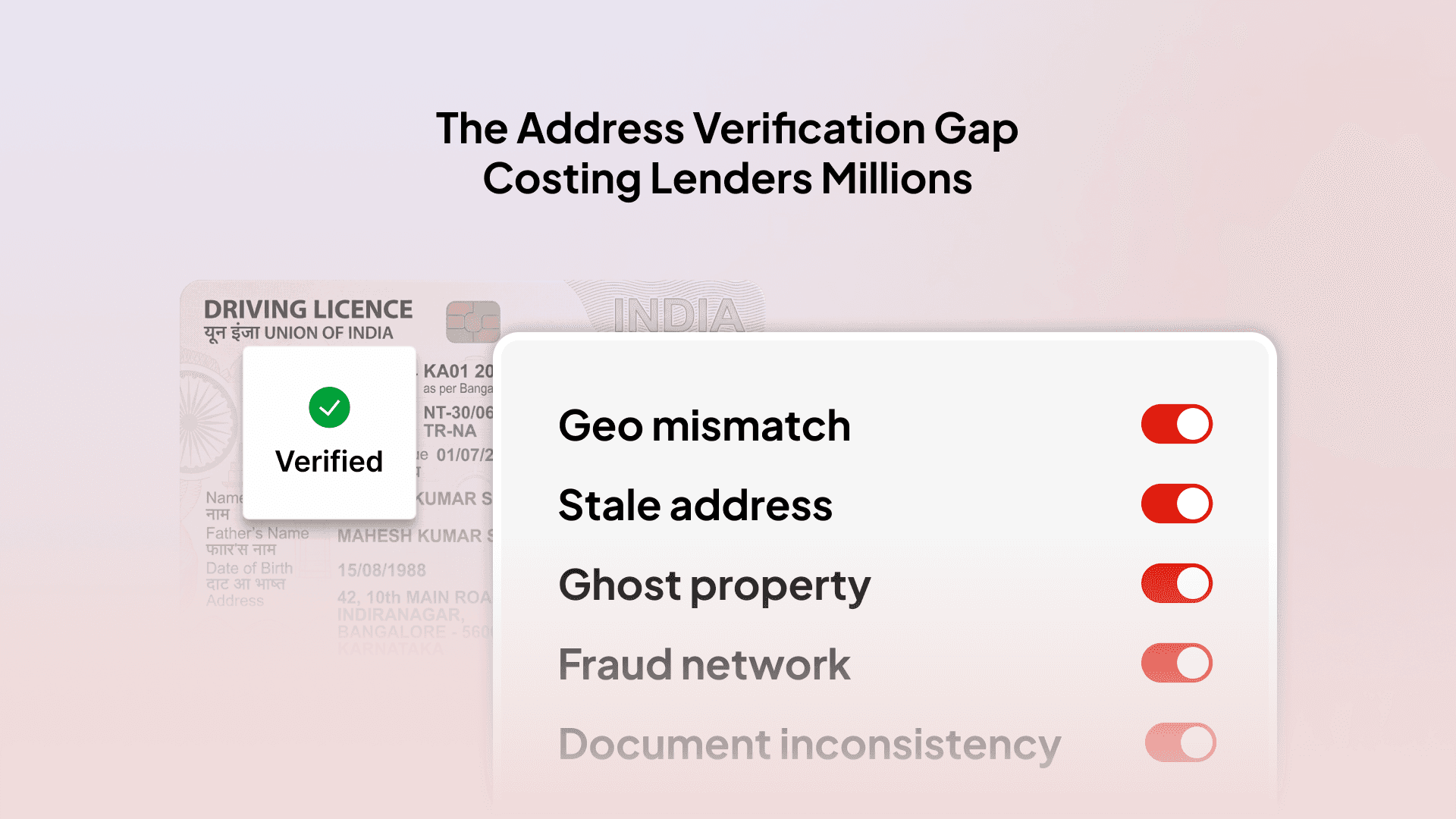
A borrower who doesn't live where they say they do isn't always a fraudster. But they're always a risk you haven't correctly priced.
Lenders and insurers spend significant effort verifying identity. Address verification gets a fraction of that attention, usually a document check, a validity window, and a pass/fail outcome. That's enough to satisfy a checklist. It isn't enough to establish that the address is real, current, or connected to the person who submitted it.
The result shows up later: borrowers who can't be located at default, policyholders with incorrect risk zone classifications, claims that don't match the onboarding profile. By then, the verification window had long closed.
Here are the five red flags that survive document review, and what goes undetected when they do.
1. Geo-Location Mismatch
The declared address and the borrower's actual location point to different cities. The document is clean, the format is correct, and nothing in the file indicates a problem.
Geo-mismatches carry no visible marker on the document itself. They pass manual review because manual review only reads what's on the page. For insurers, a policyholder declaring a low-risk residential address while operating from a commercial or high-risk zone distorts risk classification at the point of underwriting, a mispricing that holds until a claim surfaces.
What the lender or insurer loses: Credit decisions made on an unverified location. Collections teams chasing a borrower at an address they vacated months ago. Insurers paying out claims on policies priced against the wrong risk profile.
Know how lending teams can identify and solve profile fraud with digital CPV
2. Micro-Inconsistencies Across Documents
The address reads differently across documents - a flat number written one way on the Aadhaar, another on the utility bill, a PIN code off by a digit on the application form. Each inconsistency seems explainable in isolation. The pattern across a file often isn't.
Manufactured addresses are assembled from real components. They're designed to look slightly imperfect because uniformity is itself a flag. Under volume pressure, reviewers rationalize these inconsistencies away rather than escalate them. Address reuse - the same address submitted by different borrowers across institutions is invisible to a static document check entirely.
What the lender or insurer loses: Files that should have triggered enhanced review are approved at standard terms. Organized fraud patterns that span multiple applications go undetected until the NPA count climbs.
3. Stale Proof of Address
The document is within the acceptable validity window. It's genuine. The address on it is where the borrower lived before they moved.
Address churn runs high in the borrower segments that drive the most credit volume, salaried professionals and gig workers in the 24-to-35 bracket relocate frequently. A document dated 60 days ago can reflect an address that no longer applies. The verification passes. The address doesn't.
What the lender or insurer loses: In lending, a defaulting borrower at an address that's no longer theirs means collections start cold. For insurers, stale onboarding addresses mean risk zone misclassification and policy communications that reach no one, exposure that compounds across a group enrollment portfolio.
4. Residence Evidence That Can't Be Independently Verified
The address proof is present and correctly formatted. The address itself, when checked against civic and postal databases, doesn't resolve to a verifiable structure.
Synthetic and ghost addresses are built specifically to pass document-level KYC. A notary stamp confirms that signatures are genuine. It says nothing about whether the address exists or whether the applicant has any connection to it. Rental agreements - submitted as primary address proof across a significant share of retail loan files, carry no institutional verification at all.
What the lender or insurer loses: Disbursals made against borrowers who cannot be physically located. For insurers without field verification at group enrollment, unverifiable member addresses create policy leakage that shows up at claims, not at onboarding.
5. Divergent Signals Across the Full File
Every document in the file clears individually. The declared residence, the bank account city, the employer location, and the emergency contact address all point in different directions with no coherent explanation connecting them.
Document-centric review evaluates each proof in isolation. The pattern across the file goes unexamined. No individual check fails, so no flag is raised. The aggregated picture, fragmented address identity across a single application, is the most reliable indicator of orchestrated fraud in BFSI lending, and it's the one that survives every standard verification step.
What the lender or insurer loses: High-value fraud cases that clear underwriting without friction. A verification record that shows a clean pass, leaving no basis to defend the decision when the case surfaces in collections or regulatory review.
What Document Checks Miss - And What Digital CPV Sees
Each of these five flags shares the same root cause: document verification confirms that a document exists. It says nothing about whether the address on it is real, current, or connected to the borrower who submitted it. This is also why many NBFCs are moving beyond traditional field visits toward digital verification models that improve speed, consistency, and fraud detection
Tartan’s Digital contact point verification provides:
Live location at the point of application. Geo-mismatches surface before the file reaches an underwriter, captured from where the applicant actually is, not from a document submitted days earlier.
OCR-verified documents cross-referenced in real time. Micro-inconsistencies within a file are flagged automatically. Address reuse across prior applications, invisible to manual review surfaces at intake, not at collections.
Physical address evidence captured at verification. Photographs of the location, a live location pin, visual confirmation of the property. Verifying an address, not a document.
Confidence scores in place of pass/fail. Multi-signal risk scoring means low-risk files auto-clear and high-risk files arrive with the evidence trail attached. Address-level affluence signals add a calibration layer for limit-setting in lending and risk zone classification in insurance.
Audit-ready, timestamped logs across every case. Consistent policy enforcement, explainable outcomes, and documentation that holds up when a regulator asks why a specific file was approved, at any volume, without adding headcount.
The red flags in this piece don't disappear when they go undetected. They accumulate until they surface in collections queues and claims investigations, at which point the address on file leads nowhere and the verification record shows a clean pass on a document that confirmed nothing.
Tartan's Digital CPV is built for exactly this gap, across lending, insurance, and regulated onboarding workflows. If your team is re-evaluating its address verification process, speak to us.