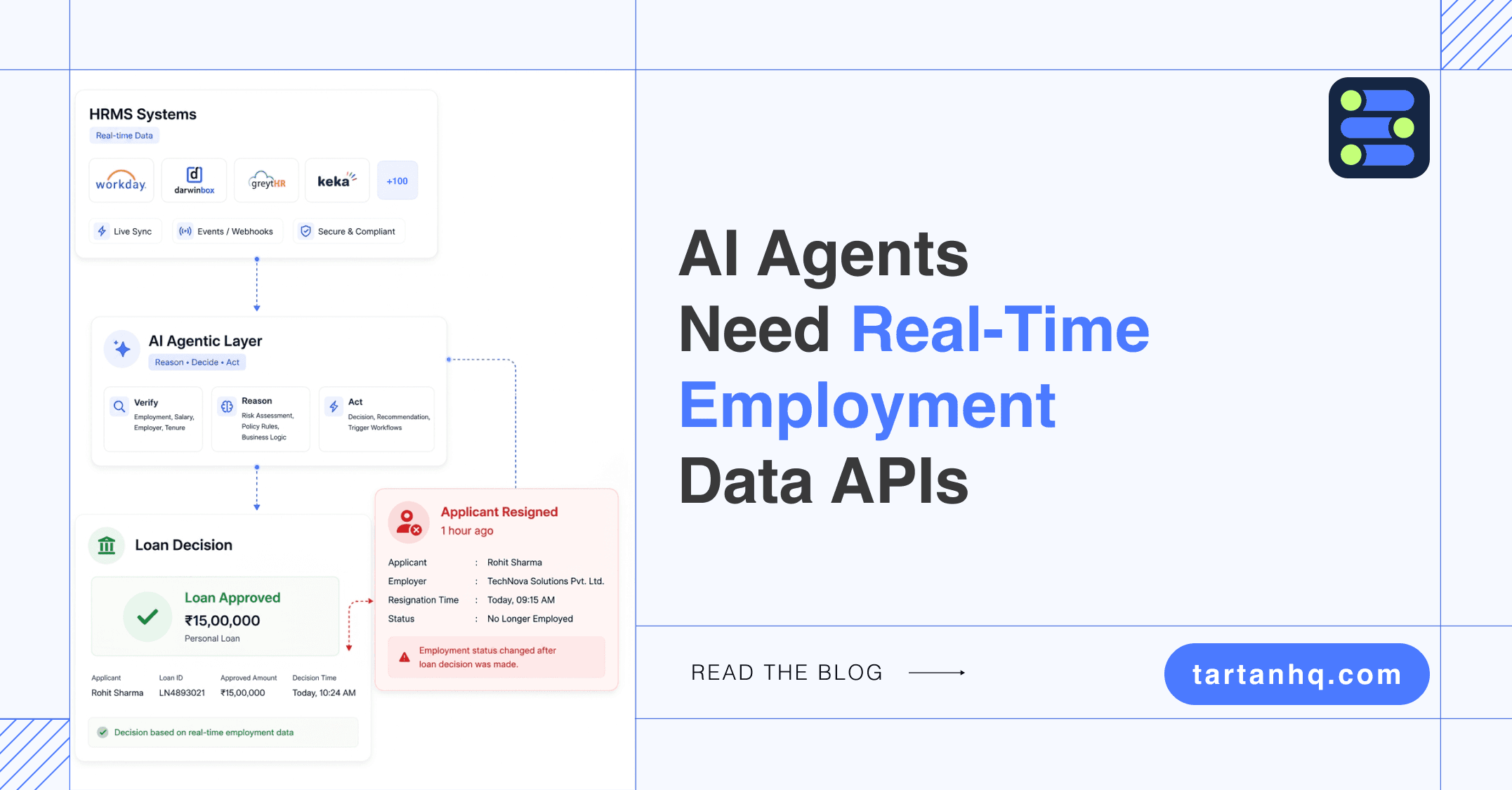
The shift from AI models to AI agents changes the requirements on the data layer in ways that most teams underestimate until they hit production.
A model makes a prediction. You feed it data, it returns a score or a classification, and you act on that output. The data pipeline can be asynchronous, batch-processed, and imperfect - the model is averaging across patterns, not making a specific real-time claim about a specific person.
An agent reasons and acts. It receives a task, breaks it into steps, calls external systems to gather information, synthesises what it finds, and takes an action - or hands off a structured recommendation to a human with full context. Every external system call the agent makes is a data retrieval event, and the quality of the agent’s reasoning is directly bounded by the quality of the data those calls return.
In financial services - where agents are being deployed for underwriting, claims processing, customer service, and compliance - the most important external data the agent needs to call is employment data. Current employment status. Verified income. Tenure. Employer identity. The signals that determine whether a loan should be approved, a claim should be paid, or a product offer should be made.
Getting this data right - in real time, at the moment the agent needs it, from a source the agent can trust - is the infrastructure problem that determines whether AI agents in financial services work as promised or quietly underperform.
How agents use employment data: the specific call patterns
Understanding what AI agents actually need from an employment data API requires understanding how they use it in the flow of a task. The call patterns are specific and consistent across the financial services use cases where agents are being deployed.
Verification at task initiation.
When an underwriting agent begins processing a loan application, its first substantive action is typically verification - confirming that the applicant is who they say they are, working where they say they work, earning what they say they earn.
The employment data API call happens here: current employment status, current salary, employer identity, start date. The agent ingests the response and either proceeds with confidence or flags the application for human review if the data conflicts with the application details.
The requirement at this step is freshness. The agent needs to know the applicant’s current employment status, not their status as of yesterday’s cache sync. An applicant who resigned this morning looks identical to an employed applicant in any batch-synced data source.
Conditional reasoning mid-task.
As the agent works through a complex task - a claims assessment, a credit limit review, an eligibility determination - it may need to make additional employment data calls based on what it discovers in earlier steps.
If the initial income verification raises a question about a recent salary change, the agent calls back to retrieve historical compensation data. If the claims assessment surfaces a question about the claimant’s employment status at the date of the incident, the agent queries for point-in-time employment records.
The requirement at this step is depth. The API needs to return not just current status but historical employment records, salary history, and change events - the data that allows the agent to reason about employment continuity over time, not just at a single point.
Event-triggered action.
Some agentic workflows are not initiated by a user request but by an employment event. When a new employee appears in an employer’s HRMS, that event triggers the agent to create a salary account, pre-approve a credit offer, or initiate an insurance enrollment. When an exit is recorded, the agent triggers coverage deactivation, account transition, or risk reassessment.
The requirement at this step is event streaming. The agent needs to receive employment change events as they happen - not query for changes on a schedule. A webhook architecture that pushes events from the employment data layer to the agent in real time is the enabling infrastructure for event-driven agentic workflows.
Why traditional unified APIs fall short for agentic workflows
The unified API platforms that have served HR tech and benefits products well over the past several years were built for a different use case: syncing employee records between systems on a scheduled basis. The architecture is optimised for reliability and breadth of coverage, not for real-time data retrieval or event-driven triggering.
This creates three specific limitations when these platforms are used as the data layer for AI agents in financial services.
Batch sync creates reasoning errors. When an agent calls a cached employment data API, it receives data that is accurate as of the last sync - which may be 24 hours old.
The agent reasons correctly from the data it receives. If the data is stale, the reasoning produces a confident but incorrect output. The agent doesn’t know the data is stale. Nothing in the response signals that the information may no longer be current. The error is invisible until the outcome surfaces it.
No event streaming means no event-driven agents. Most traditional unified APIs support polling - you query for current state, you get current state. They do not support event streaming - you subscribe to change events, you receive a push notification when something changes.
For event-triggered agentic workflows, polling is an inadequate mechanism. An agent that has to poll an employment data API every minute to detect a new joiner event is burning API calls and introducing latency into a workflow that could be instantaneous with webhook delivery.
Data model depth varies.
Agents need richer data models than HR tech workflows typically require. An HR tool that syncs employee names and job titles functions adequately with a shallow data model.
An underwriting agent that needs to assess employment stability needs tenure, salary history, employment type, notice period status, and organisational context. Many unified APIs provide the former but not the latter - or provide deep data for some HRMS platforms and shallow data for others.
“An AI agent is only as trustworthy as the data it retrieves. In financial services, ‘trustworthy’ means current, verified, and sourced from the system of record - not a cached copy of it.”
What the right API layer for agentic financial services looks like
Building AI agents that work reliably in financial services production requires an employment data API layer with specific characteristics that go beyond what most unified API vendors currently provide.
Real-time pass-through, not cached sync. When the agent calls the API, the request should return data from the employer’s HRMS as it exists at the moment of the call. Not from a cache. Not from yesterday’s sync. Current state. This is the foundational requirement for any use case where employment status at the time of a financial decision is material - which, in lending, insurance, and AI-powered credit products, is every use case.
Webhook delivery for employment events. New joiners, exits, salary changes, designation updates - these events should push to the agent’s system as they occur in the HRMS, not be discovered through periodic polling. The webhook infrastructure should be reliable, include retry logic, and carry enough context in the event payload that the agent can act without making additional API calls for the common cases.
Consistent data model across providers. The agent should receive employment data in the same structure regardless of which HRMS the employer uses. Current employment status should be represented the same way whether it comes from Workday, ADP, Darwinbox, or GreytHR. Salary should be expressed in the same format. Tenure should be calculated consistently. Data model inconsistency forces the agent to handle provider-specific edge cases that should be abstracted by the API layer.
Consent and audit trail as infrastructure. In financial services, the provenance of data used in a decision is a compliance requirement. An AI agent making a credit decision needs to be able to demonstrate - if audited - that the employment data it used was obtained with the subject’s consent, from a verified source, at a specific point in time. The API layer should generate this audit trail automatically, not require the agent or the product team to build it.
HRMS coverage breadth. The agent’s ability to serve users depends entirely on whether their employer’s HRMS is covered by the API. A unified employment data API that covers 80+ HRMS platforms - including the regional and enterprise-specific systems that a diverse user base will present - means the agent can serve the full applicant or customer population rather than a subset of those whose employers happen to use covered platforms.
The compounding effect in production
The data infrastructure decisions made when deploying an AI agent in financial services compound over time in both directions.
An agent built on a real-time, consent-first employment data layer makes decisions on current information, generates a clean audit trail, and handles employment change events as they occur. Its outputs are trustworthy.
Over time, the decisions it makes train better models, generate better training data, and produce a portfolio of outcomes that are measurably better than document-based alternatives.
The agent’s value compounds.
An agent built on a batch-sync employment data layer makes decisions that are occasionally wrong in ways that are hard to diagnose - the data looked right at the time, but the data was stale. The errors are silent until they surface as defaults, incorrect claims payouts, or compliance findings.
The team spends cycles diagnosing issues that trace back to data architecture rather than model quality. The agent’s value is capped by the data quality ceiling it was built on.
Tartan’s HyperSync provides the employment data infrastructure layer specifically built for these requirements - real-time pass-through access across 80+ HRMS platforms, webhook delivery for employment events, normalised data models, and consent management with full audit trail. It is the API layer that makes AI agents in financial services reliably trustworthy, not just technically impressive.
The agents being built today in financial services will either compound in value or plateau based on one decision made early: whether the data layer they call at runtime is current or cached. That decision is available to make correctly, right now, before the agent goes live.