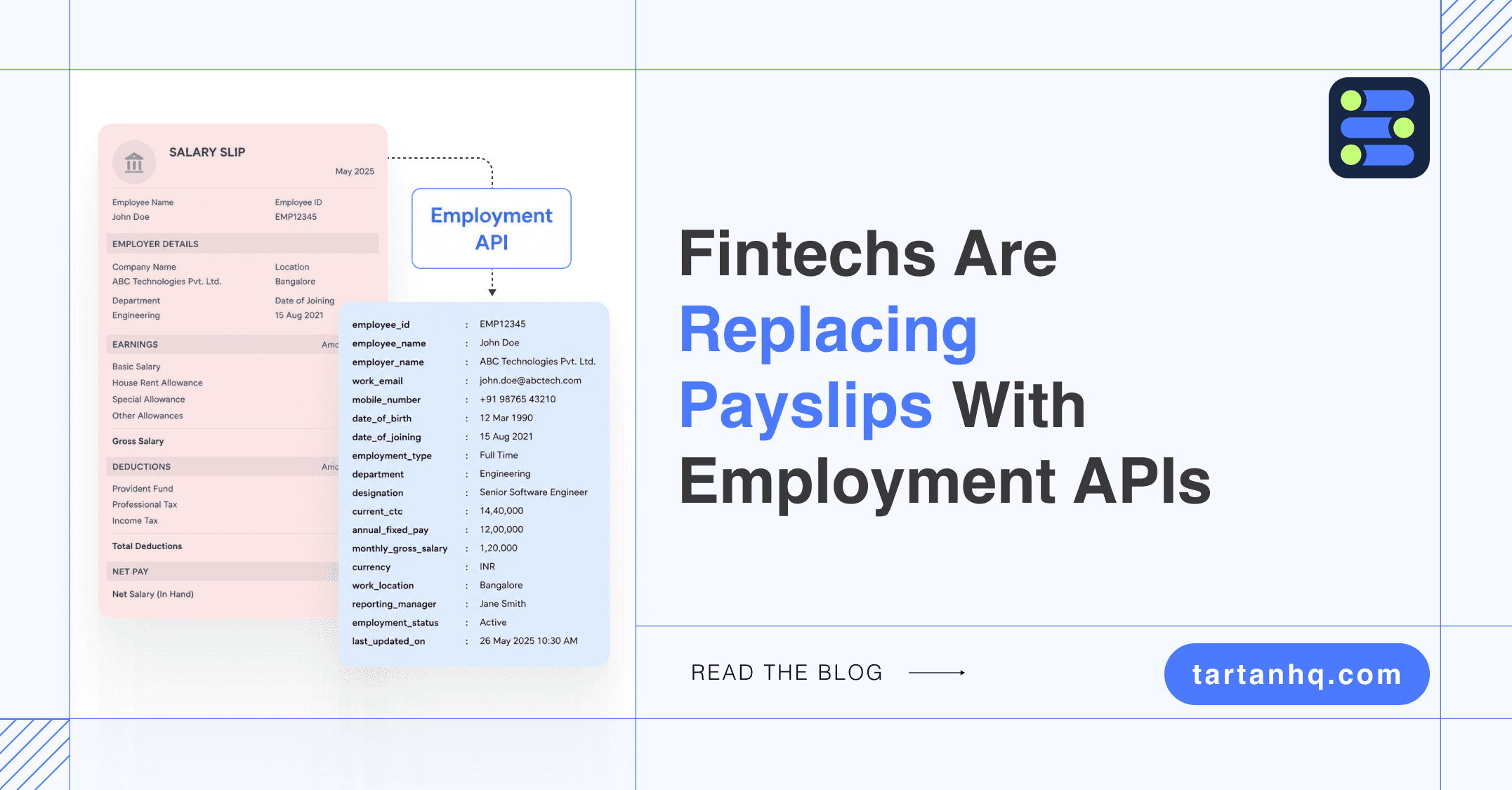
Credit bureaus tell you what a borrower has done in the past. Bank statements tell you what has moved through their account. Employment data tells you something more fundamental: whether they are currently earning, how much, from whom, and how stable that relationship is.
For financial services - lending, insurance, embedded finance, benefits - employment data is arguably the single most predictive signal available at the point of a financial decision. And yet it remains the most awkwardly accessed data category in the fintech stack.
Most products either skip it entirely, rely on documents the applicant provides, or build a fragile point-to-point integration with a single payroll provider and call it done.
This guide is for the product and engineering teams who want to do it properly.
What employment data actually includes
Employment data is broader than most teams initially assume. At its core it covers four distinct layers, each with different uses for financial services products.
Identity and employment status.
Is this person currently employed? Who is their employer? What is their employment type - permanent, contract, part-time? When did they join? This layer is the foundation. It answers the most basic question a lender or insurer asks: does this person have a stable income relationship with an employer?
Compensation data.
What is the person’s gross salary? What are their deductions? What does their net take-home look like? Are there variable components - bonuses, commissions, allowances?
Compensation data is what drives credit limit calculations, premium pricing, and benefits eligibility decisions. It is also the layer most commonly faked in document-based verification workflows.
Tenure and stability signals.
How long has this person been at their current employer? Have they changed jobs frequently? Are they still in a probationary period?
Tenure is one of the strongest predictors of repayment behaviour in salaried lending - a signal that is invisible in a bank statement and only partially visible in a bureau report, but directly available from HRMS data.
Organisational context.
What is the person’s designation? Which department are they in? What is the employer’s size and type?
Organisational context tells you things about future income trajectory that compensation data alone cannot - a junior engineer at a high-growth company is a different credit profile to a junior engineer at a declining one, even at identical current salaries.
Why document-based verification is breaking down
The standard approach to employment verification in financial services - ask the applicant to submit salary slips, employment letters, or bank statements showing salary credits - has served the industry for decades. It is also, increasingly, the weakest link in the underwriting chain.
The fraud exposure is well-documented. Salary slips are among the most commonly forged documents in retail lending. OCR tools catch obvious forgeries but miss sophisticated ones. The fundamental vulnerability is structural: a document the applicant provides is a document the applicant controls. Any verification process that depends on applicant-provided documents has an integrity ceiling that cannot be raised by improving the OCR.
The staleness problem is less discussed but equally significant. A salary slip issued on the 1st of last month accurately reflects employment status as of that date. It tells you nothing about what happened on the 2nd. For an applicant who resigned last week, submitted a salary slip from three weeks ago, and is currently serving notice, the document passes every check a lender runs. The employment reality does not.
The operational cost is the third problem. Document collection - chasing applicants for uploads, validating formats, following up on incomplete submissions - represents a meaningful share of ops overhead in any high-volume lending or insurance workflow.
It is also the primary driver of application drop-off. Every friction point between application and decision is a conversion loss, and document collection is the most friction-laden step in most financial product journeys.
“A salary slip tells you what someone earned on the date it was issued. An employment data API tells you what they earn now, whether they are still employed, and whether anything material has changed. These are not two versions of the same thing.”
The use cases that employment data APIs unlock
Salaried lending and credit underwriting.
This is the primary use case globally. A lender integrating an employment data API can pull current employment status, verified salary, and tenure at the point of application - without the applicant lifting a finger beyond a one-time consent step.
The credit decision is made on ground truth, not documents. TAT compresses from days to minutes. Fraud exposure drops because the data comes from the employer’s system, not the applicant’s file manager.
Group insurance enrollment and premium calculation.
Insurers pricing and managing group health, life, or income protection products need current, accurate employee roster data from corporate clients. An employment data API replaces the monthly spreadsheet exchange - new joiners are added automatically, exits trigger deactivation, salary revisions update sum assured without manual endorsement requests.
The premium calculation is always based on the current covered population, not last month’s snapshot.
Earned Wage Access.
EWA products - letting employees access wages they have already earned before payday - require continuous visibility into how much an employee has worked and earned in the current pay cycle.
This data lives in the employer’s payroll and HRMS system. An employment data API is the mechanism that makes EWA products possible without requiring the employer to build custom integrations or the employee to manually upload anything.
Embedded finance and salary-linked products.
Banks and fintechs building salary-linked credit cards, overdrafts, or savings products for employer cohorts need live employment and compensation data to manage limits, eligibility, and risk dynamically.
A static credit limit set at account opening based on salary at the time of application is already outdated if the account holder changes jobs or receives a salary revision. Live employment data enables dynamic product management that a static onboarding data snapshot cannot.
Benefits administration.
Benefits platforms managing retirement contributions, health insurance, and other employee benefits need authoritative, current employment data to calculate eligibility, contributions, and plan changes.
The employment data API is the connection between the HRMS system of record and the benefits platform - replacing manual exports, reducing errors, and ensuring that benefits reflect actual current employment status.
How employment data APIs work
An employment data API sits between your product and the employer’s HRMS or payroll system.
When an applicant or employee initiates a flow that requires employment verification, they authenticate a consent-based connection - typically a one-time authorisation that takes under a minute - which grants your product permission to read specific employment data fields from their employer’s system.
The API returns structured, normalised employment data: current status, salary, start date, designation, department. The data is current as of the moment of the request, not as of the last time someone exported a file. Your product ingests it, makes its decision, and the connection persists for ongoing updates if the use case requires them.
The consent architecture matters both for user experience and compliance. Under GDPR, DPDP, and evolving global privacy frameworks, accessing employee data requires documented, purposeful, revocable consent. A well-built employment data API handles this as a structural feature rather than an afterthought - the consent is captured in the authentication flow, scoped to the data fields required, and revocable by the employee at any time.
The integration challenge: HRMS fragmentation
The practical barrier most fintech and financial services teams hit when trying to access employment data directly is the fragmentation of the HRMS market. There is no single payroll or HR system that covers the employer market.
Globally, the landscape includes ADP, Gusto, Rippling, Workday, SAP SuccessFactors, BambooHR, and hundreds of regional and enterprise-specific platforms. In India specifically, Darwinbox, GreytHR, Keka, and Oracle HCM together cover a majority of the enterprise market - but none of them individually covers it all.
Building a direct integration with any one of these platforms gets you partial coverage. Building and maintaining integrations with all of them is an ongoing engineering programme that most fintech product teams cannot sustain alongside their core product roadmap.
A unified employment data API solves this by abstracting the fragmentation. Your product integrates once with the unified layer. The layer handles connectivity, authentication, and data normalisation across every HRMS platform your users’ employers might run. The employment data your product receives is consistent in structure regardless of the underlying source.
What to look for in an employment data API
Not all employment data APIs are equivalent. The dimensions that matter most for financial services use cases are data freshness, coverage breadth, consent architecture, and compliance posture.
Data freshness.
For lending and insurance decisions, current data is not a nice-to-have. A platform that syncs daily is fundamentally different from one that returns live data at the moment of the API call. For underwriting, claims processing, and dynamic product management, daily sync creates a risk window that real-time access eliminates.
Coverage breadth. How many HRMS and payroll platforms does the API cover? For a global fintech or a regional financial services player with a diverse corporate client base, coverage depth determines what proportion of your applicants or policyholders you can actually serve through the API rather than falling back to manual document collection.
Consent architecture. Is consent handled as a first-class feature, or is it bolted on? The consent flow should be seamless for the end user, explicitly scoped to the data required, and auditable.
For regulated financial services environments, the audit trail on consent and data access is not optional.
Compliance posture. SOC 2, ISO 27001, GDPR readiness, and sector-specific regulatory alignment vary significantly across providers. Financial services deployments require a provider whose compliance posture matches the regulatory environment the financial product operates in.
Employment data is not a new category. But accessing it properly - in real time, with consent, across the full diversity of HRMS platforms, in a format financial services decisioning systems can actually use - is newer than most teams realise.
The products that build this capability into their data stack now are building a structural advantage that compounds with every underwriting decision, every policy enrollment, and every credit offer they make from a position of verified, current information rather than documents of uncertain age and provenance.