When a unified API vendor says their platform provides “employment data,” they are describing the output. The question that actually determines whether that data is useful for your specific use case is: how old is it when you receive it?
The answer varies more than most buyers realise when evaluating employment data APIs. Finch - one of the most widely used unified employment APIs - syncs data daily for automated integrations and weekly for assisted ones.
Merge, across its HRIS category, operates on a similar polling-and-cache architecture. Meaning: when your product calls the API, it is not retrieving current data from the employer’s HRMS. It is retrieving the most recent cached copy, which may be anywhere from a few hours to several days old depending on when the last sync ran.
For some use cases, this is acceptable. For others - specifically in financial services, insurance, and AI-powered workflows - it is a fundamental constraint that limits what the product can reliably do.
Understanding the two architectures
Employment data APIs are built on one of two underlying architectures, and the difference matters significantly at the point of use.
Cached sync (batch) architecture. The API provider periodically polls the underlying HRMS, retrieves updated data, stores it in their own database, and serves your API calls from that stored copy.
Your product calls the API and gets back data that was accurate at the time of the last sync - which, depending on the provider and plan, may be 24 hours ago or a week ago. The advantages are consistent response times, resilience to upstream HRMS outages, and simpler integration patterns.
The disadvantage is that the data has a freshness ceiling that cannot be improved beyond the sync frequency.
Pass-through (real-time) architecture. When your product calls the API, the request passes through to the underlying HRMS in real time. The response reflects the current state of the data at the moment of the call.
There is no intermediate cache. If an employee’s status changed an hour ago, your API call reflects that change. The tradeoff is dependency on the upstream HRMS’s availability and response time - but for use cases where data currency is critical, this is the only architecture that actually delivers current information.
Batch / Cached | Real-time / Pass-through |
Data age: 24hrs to 7 days | Data age: seconds |
Response time: fast (from cache) | Response time: varies with source |
Freshness ceiling: sync frequency | Freshness ceiling: none |
Risk window: always open | Risk window: effectively zero |
Best for: static HR workflows | Best for: financial decisioning, AI agents |
Where batch sync breaks - specifically
The cases where daily batch sync creates real problems are not edge cases. They are the core use cases for employment data in financial services.
Credit underwriting at point of application.
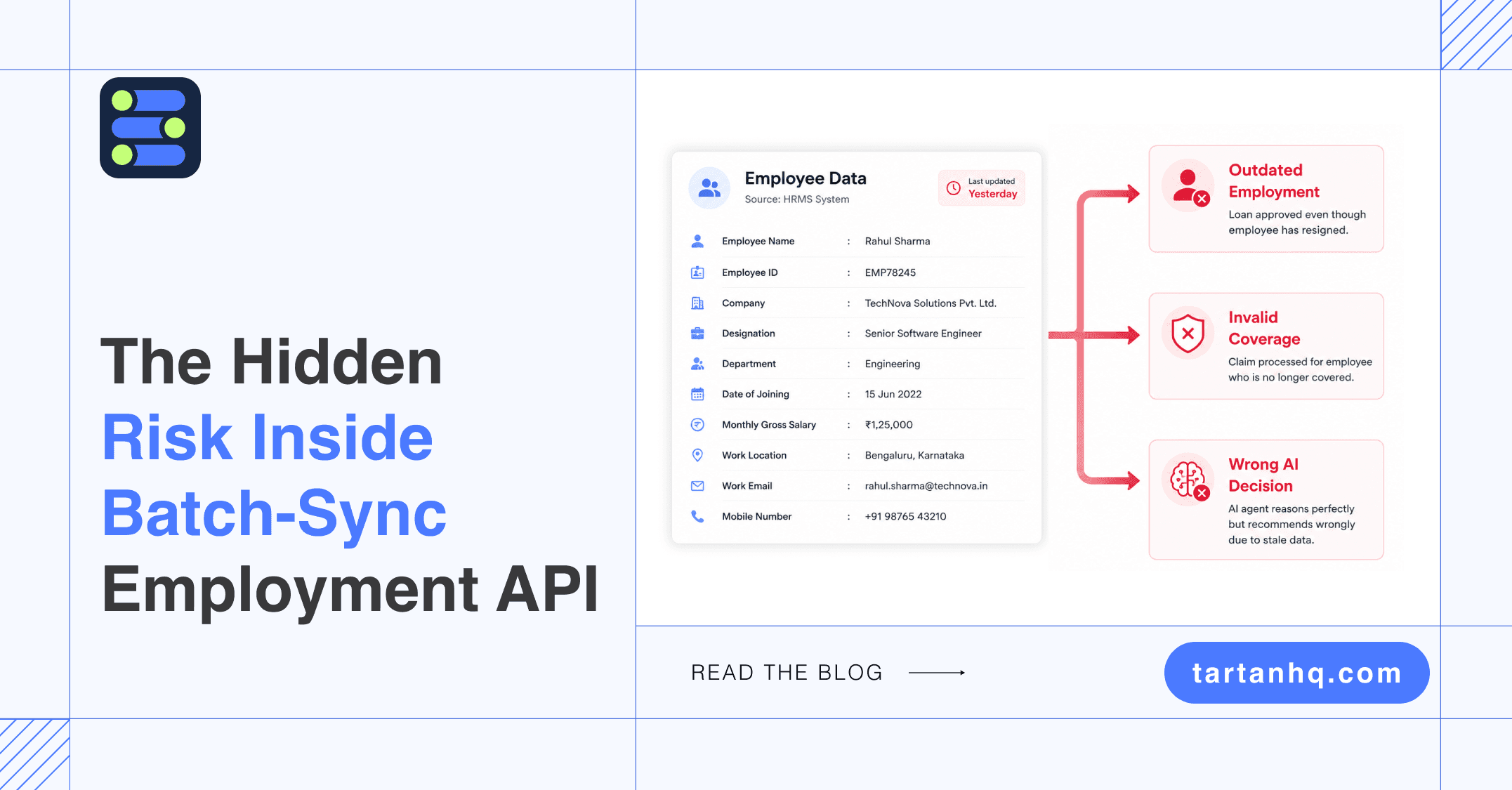
A lender uses an employment data API to verify an applicant’s current employment status and salary before approving a personal loan. The applicant applies on Tuesday. The last sync ran Monday night. The data the lender receives reflects Monday’s employment status. The applicant resigned on Monday afternoon.
The lender approves a loan to someone who is no longer employed, based on data that was technically correct at the time of the sync but is factually wrong at the time of the decision. The batch architecture performed exactly as designed. The outcome is a credit decision made on stale information.
In a real-time architecture, the API call at the moment of application would have returned the current status - resigned, with a termination date of Monday - and the lender’s decision logic would have handled it correctly.
Insurance coverage and claims processing.
An insurer manages a group health portfolio. An employee covered under a corporate policy is hospitalised on Wednesday. The insurer’s system checks coverage status. The last sync ran Tuesday. The employee’s exit - processed by HR on Tuesday afternoon - has not propagated yet.
The coverage check confirms active status. The claim proceeds. The insurer pays out a claim for an employee who was not covered at the time of the incident.
Again: the batch architecture worked as designed. The outcome is incorrect. The 24-hour gap between the sync and the event is the source of the error, and no amount of improving the sync logic eliminates it - because the gap is inherent to the architecture.
AI agent workflows.
An AI underwriting agent calls an employment data API as part of its reasoning process for a credit decision. The agent receives data from a cache synced 18 hours ago. It reasons correctly from that data.
It produces a recommendation that is internally consistent but based on a stale premise. The recommendation is wrong not because the agent reasoned poorly but because the data it reasoned from did not reflect current reality.
This is the specific failure mode that makes batch sync architecturally incompatible with agentic AI in financial services. AI agents are built for real-time reasoning and real-time action.
An agent that calls a batch API is not a real-time system - it is a delayed system with a sophisticated reasoning layer on top of a stale data foundation.
The risk window concept
A useful way to think about the cost of batch sync is the risk window - the period between when a material employment change occurs and when that change is reflected in the data your product is using to make decisions.
In a daily sync architecture, the risk window is up to 24 hours. During that window, your product is operating on data that may not reflect a resignation, a termination, a salary change, or a status revision that has already happened at the employer. Every financial decision made during that window is a decision made on potentially incorrect information.
For a high-volume lender processing thousands of applications a day, the number of decisions that fall within a risk window - where an employment change occurred between the last sync and the application - is not trivial. It scales directly with application volume and with the natural rate of employment changes in the applicant pool.
In a real-time architecture, the risk window is effectively zero. The API call retrieves current data at the moment of the decision. There is no gap between the event and its reflection in the data your product uses.
When batch sync is actually fine
It is worth being clear that batch sync is not categorically wrong. There are use cases where daily sync is entirely adequate and the real-time architecture’s tradeoffs - dependency on upstream availability, more complex error handling - are not worth accepting.
HR workflow automation - syncing employee records between an HRIS and a benefits administration platform, provisioning user accounts, updating directory information - typically does not require real-time data. A 24-hour lag in reflecting a new hire’s profile in an internal directory is operationally acceptable for most organisations.
Analytics and reporting use cases - workforce composition dashboards, headcount tracking, compensation benchmarking - operate on data that is inherently historical. Daily or weekly sync is more than adequate.
The use cases where batch sync is insufficient are specifically the ones where a decision is being made on the basis of current employment status and where the cost of that decision being wrong is material. In financial services, that describes almost every use case employment data is being applied to.
What to ask when evaluating employment data APIs
Most unified API vendors describe their sync capabilities in ways that obscure the architectural distinction. “Near real-time,” “frequent syncs,” and “live data” are used with varying degrees of accuracy across the market. The questions that cut through the marketing language are specific.
When your product calls the API endpoint for an employee’s current status, is that request hitting a cache or making a live call to the underlying HRMS?
If the employee’s status changed 30 minutes ago, would that change be reflected in an API call made now?
What is the maximum possible age of data returned by the API on any given call?
Is real-time access available on the current pricing tier, or is it a premium feature?
The answers reveal the architecture.
And the architecture determines whether the employment data API can actually support the use cases you are building - or whether you are building financial services decisions on a foundation that is, by design, always operating a day behind.
For lending, insurance, and AI-powered financial workflows, the difference between real-time and daily sync is not a feature comparison. It is an architectural decision that determines what your product can reliably do and what risk it is silently accepting every day it operates on stale data.