Here’s a conversation happening in enterprise boardrooms right now.
The growth team wants to launch a new product line. The RevOps lead says the CRM data isn’t clean enough to target the right accounts. The data team says the CRM data isn’t clean because it doesn’t sync properly with the ERP. The engineering team says fixing the ERP-CRM sync will take three months because the last person who built that integration left eight months ago and nobody fully understands it. The CIO knows all of this is true and has seventeen other integration problems queued behind this one.
The product launch slips by a quarter. The growth team blames the tech stack. The tech team blames the growth team’s timelines. The real culprit is integration debt - and it’s quietly becoming one of the most significant velocity killers in enterprise organisations today.
What Integration Debt Actually Is
Integration debt is the accumulated cost of every point-to-point integration your organisation has built, inherited, or bodged together over time - and never properly maintained.
Most enterprise organisations have dozens of them. A connector between the HRMS and the payroll system built in 2019 that breaks every time either vendor pushes an update. A Salesforce-to-ERP sync that runs nightly and is perpetually 18 hours behind. A customer data pipeline that three different teams have patched independently, producing three different versions of the same metric depending on which dashboard you look at. A vendor API integration that was built for a product that has since been deprecated but still runs somewhere in production because nobody is confident enough to turn it off.
Each of these integrations was built to solve a specific problem at a specific moment. None of them were built to scale. None of them were designed with the assumption that the systems on either side would keep changing. And all of them require ongoing maintenance - engineering time that isn’t going toward product, isn’t going toward growth infrastructure, and isn’t going toward anything on any roadmap.
This is the debt. And like financial debt, it compounds. Every new integration added to a point-to-point architecture increases the surface area of potential failure. Every system upgrade from a vendor risks breaking three integrations downstream. Every new data consumer - a new analytics tool, a new growth platform, a new reporting layer - requires a new custom connection to every relevant data source.
At a certain scale, the organisation stops moving. Not because of a lack of ambition or budget. Because the integration architecture has become a structural constraint on velocity.
Where Growth Teams Feel It First
CIOs and CDOs feel integration debt as a technical governance problem. Growth teams feel it as a business problem - and they feel it constantly.
Account targeting breaks down. Enterprise growth increasingly runs on ABM - account-based motion, precision targeting, high-quality outreach. ABM requires clean, unified account and contact data across CRM, intent platforms, and enrichment tools. When the underlying data infrastructure is fragmented, ABM targeting is built on incomplete or conflicting data. The wrong contacts get prioritised. The best accounts fall through gaps between systems. Campaign performance suffers and nobody can diagnose why because the data trail fractures across four different platforms with four different sync states.
Revenue forecasting becomes guesswork. Reliable forecasting requires clean data flow between pipeline, product usage, billing, and finance systems. When those systems are connected through ageing point-to-point integrations - or not meaningfully connected at all - the forecast is assembled manually, usually in a spreadsheet, usually by a RevOps analyst who has learned which numbers to trust and which to sanity-check by experience. This is not scalable and it is not fast. Deals slip between quarters because the data infrastructure can’t support real-time pipeline visibility.
Customer onboarding slows. In enterprise SaaS and financial services, customer onboarding is a growth metric. Every day of onboarding delay is a day of delayed revenue recognition and a higher churn risk. Onboarding speed is largely a function of how well internal systems - identity verification, CRM, billing, provisioning, compliance - pass data to each other. When that data flow is interrupted by integration failures or sync delays, onboarding stalls. The customer experience suffers. The growth number suffers. The integration debt is the root cause, but it shows up in the CX report, not the engineering backlog.
Why This Is Now a GTM Infrastructure Problem, Not Just a Tech Problem
For a long time, integration debt lived in the technology organisation’s problem set. It was an engineering concern, a systems architecture concern, a cost-of-maintenance concern. Growth teams complained about data quality. CIOs managed the backlog. The conversation rarely connected the two directly.
That is changing - and the shift is being driven by how enterprise GTM has evolved.
Modern enterprise GTM is data-intensive in a way it simply wasn’t five years ago. Growth teams are running intent-based prospecting, real-time personalisation, multi-touch attribution, product-led growth loops, and AI-assisted outreach - all of which require clean, unified, real-time data flowing between systems. The GTM stack has grown more sophisticated faster than the underlying data infrastructure has kept pace.
When a growth team’s ABM motion requires data from six systems and those six systems are connected through brittle point-to-point integrations, the sophistication of the GTM strategy is capped by the reliability of the worst integration in the chain. The strategy is only as good as the infrastructure it runs on.
This is why CIOs and CDOs are increasingly being asked to weigh in on GTM infrastructure decisions - not just security, governance, and cost, but velocity. Can this data architecture support the growth motion we’re trying to run? If not, what does fixing it actually cost in terms of time, engineering capacity, and opportunity?
What a Unified Data Layer Changes
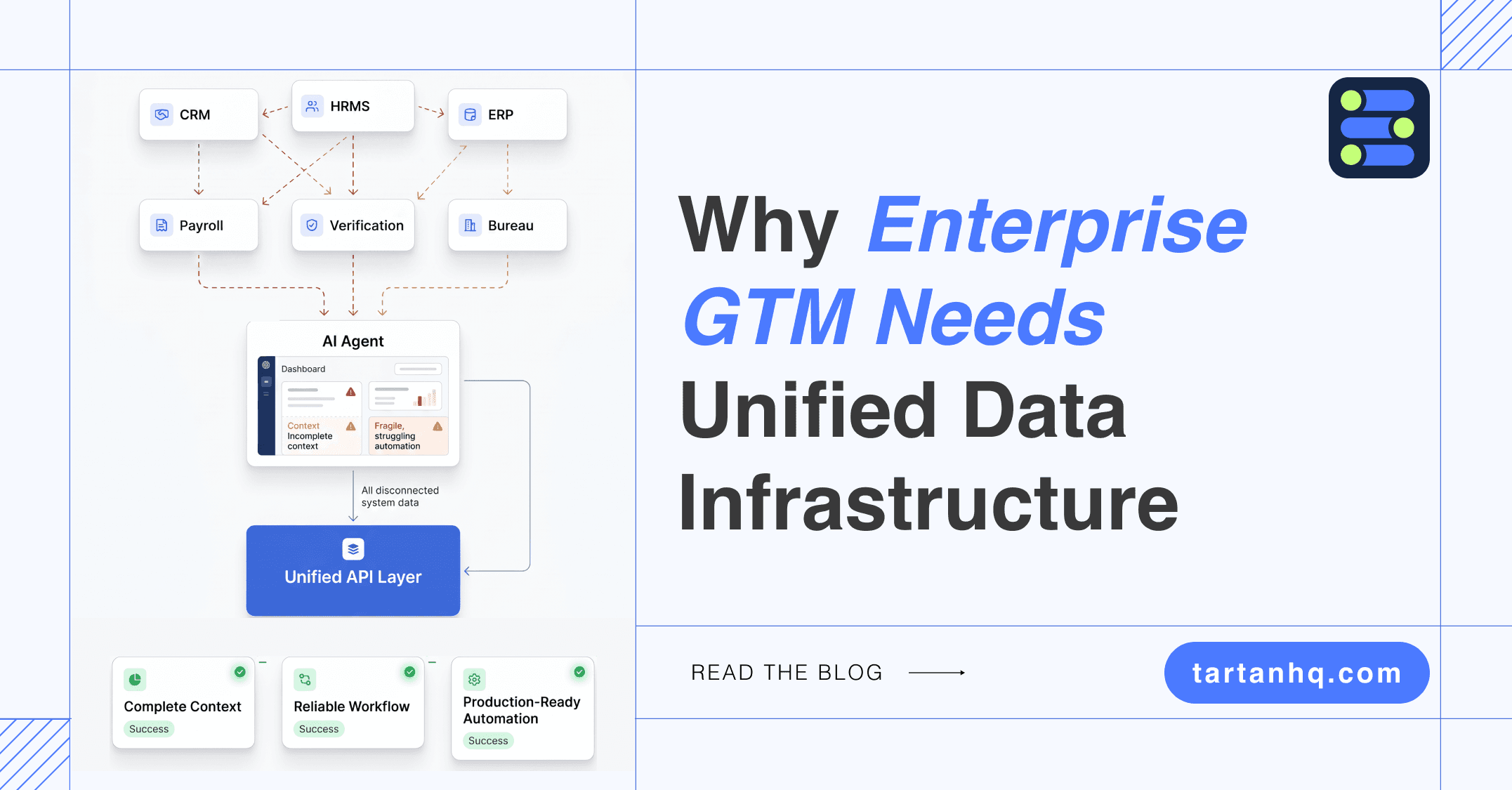
A unified data layer doesn’t eliminate integrations. It changes their architecture - from a web of point-to-point connections to a hub model where data from multiple source systems flows into a single normalized layer that every consumer - CRM, analytics platform, growth tool, finance system - accesses through one consistent interface.
The practical implications for enterprise growth teams are significant.
Single source of truth for GTM data. Account data, contact data, product usage data, billing data - normalized and unified in one layer. ABM targeting runs on clean data. Forecasting runs on the same numbers everyone is looking at. Attribution doesn’t fracture across systems. The growth team stops spending 30% of its bandwidth reconciling data from different sources and starts spending that time on actual growth work.
Faster time-to-data for new GTM motions. When a new growth initiative requires a new data source - a new intent platform, a new enrichment vendor, a new product analytics tool - integration into a unified layer is a one-time connection, not a custom build for every downstream consumer. The time between “we want to run this motion” and “the data infrastructure supports this motion” compresses from months to weeks.
Resilience against vendor changes. When a source system updates its API or changes its data schema, the impact is contained to one connection point in the unified layer - not propagated across every downstream integration. The engineering overhead of maintenance drops substantially.
AI and automation readiness. Enterprise growth teams are increasingly building AI-assisted workflows - lead scoring, churn prediction, outreach personalisation, revenue forecasting. All of these require clean, normalized, unified data as inputs. A fragmented point-to-point architecture is not AI-ready. A unified data layer is the prerequisite infrastructure for any serious AI-powered GTM motion.
The Infrastructure Decision That Is Hiding in Plain Sight
For CIOs and CDOs reading this: the unified data layer question is already on your desk. It’s just arriving as a series of separate complaints - growth team asking for better data, RevOps team asking for cleaner CRM sync, finance team asking why the numbers don’t match, engineering team asking for capacity to fix integration failures nobody planned for.
These are not separate problems. They are the same problem expressed by different functions at different points in the same broken data chain.
The organisations that treat a unified data layer as a strategic infrastructure investment - not a technical hygiene project - will have a structural GTM advantage over those that continue managing integration debt one patch at a time.
Velocity is a data infrastructure problem. The growth teams that are moving fastest are the ones whose CIOs decided that first.