

The sequence is predictable enough that it has become routine in BFSI institutions of meaningful scale. A regulatory circular lands. The compliance team reads it carefully, produces an impact assessment, and recommends specific changes to four policies and two product guidelines.
The product team reviews the recommendations, agrees on three of the four, pushes back on one pending a legal opinion, and issues updated product specifications. Engineering receives the specs, logs the work, and picks it up in the next sprint. Three weeks later, the changes are live in the rule engine. Six weeks after the circular landed, the system is compliant.
This is a well-run process by most institutional standards. And it still means six weeks of regulatory exposure - six weeks during which the institution is operating under a framework the regulator has already superseded, making decisions on the basis of rules that no longer represent the current regulatory position.
If two circulars arrived in those six weeks - which is not unusual during active regulatory periods - the institution is now managing two overlapping implementation cycles simultaneously, each with its own interpretation, its own sign-off chain, and its own engineering queue position. The exposure compounds. The rule engine is now not one version behind but two or three, with the gaps distributed across different policy areas and different product lines.
This is not a process failure. This is the structural consequence of a policy implementation chain that was designed for a lower velocity of regulatory change than the one BFSI institutions are currently operating in.
Mapping the version lag - precisely
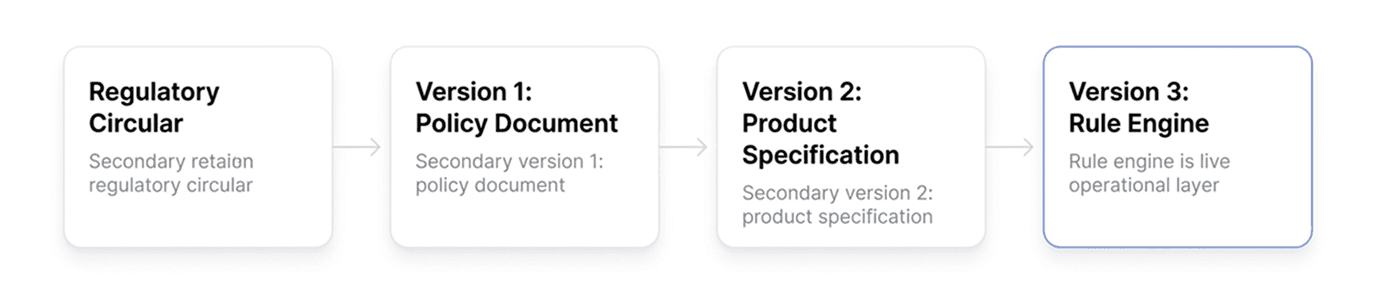
The "three versions behind" framing is not arbitrary. It reflects the actual number of translation steps that exist between a regulatory change and its live implementation in most BFSI institutions - and each step is a version divergence point.
Version 1: The policy document. This is what the compliance team produces. It is the institutional response to the regulatory change - the internal policy or guideline that operationalises what the circular requires. It is reviewed, approved, and filed. For most institutions, this is where the compliance team's responsibility formally ends. The policy document is the output of compliance. Everything else is implementation.
Version 2: The product specification. The product team reads the policy document and translates it into functional terms - what the product must do, what the rule logic must enforce, what the customer-facing behaviour must be. This translation is necessary because policy documents are written in compliance language and product specifications need to be written in language that engineering can act on. The translation is a judgment call. It introduces interpretation. It is version two.
Version 3: The rule engine implementation. Engineering reads the product specification and implements it in the rule engine - the system that actually enforces the policy in live operations. This translation is technical. The developer is converting natural language into code. Every ambiguity in the specification becomes a decision point in the implementation. Every edge case not covered by the spec is resolved by the developer's best judgment. It is version three - and it is the version that actually governs what the institution does.
Three versions. Three translation steps. Three opportunities for drift between the regulatory intent and the operational reality. And the gap between them is invisible until something surfaces it - a regulatory audit, a customer complaint, an internal quality review that happens to compare the rule engine output against the policy document.
"The compliance risk in BFSI is rarely about intent. It is almost always about velocity - the gap between when the regulator moves and when the institution's rule engine catches up. In 2026, that gap is being measured and penalised with increasing precision."
The three places version lag creates live exposure
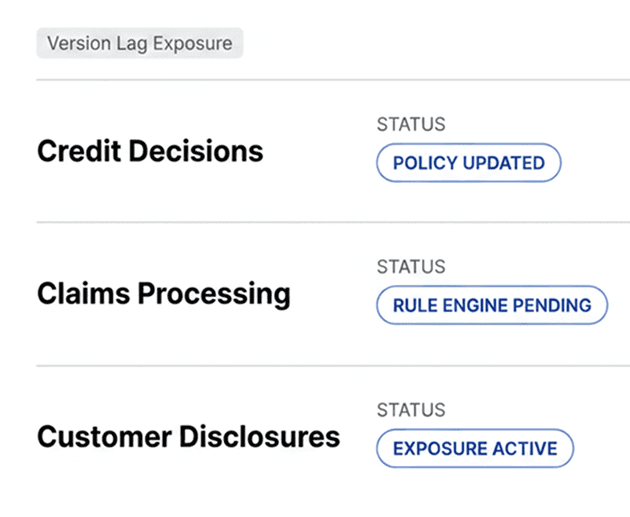
Understanding where version lag creates actual risk - as opposed to theoretical risk - requires mapping the specific decision types that the lagging rule engine governs during the implementation window.
Credit and underwriting decisions. When a credit policy is updated - tightened eligibility criteria, revised income verification requirements, new bureau score thresholds - every loan processed between the policy update and the rule engine implementation is processed under the old criteria.
If the policy was tightened, the institution is approving applications it should have declined. If the policy was loosened, it may be declining applications it should have approved. In either direction, the decision quality during the implementation window diverges from the current policy intent.
The financial exposure from this divergence depends on the volume of decisions made during the window and the magnitude of the policy change. For high-volume consumer lending operations processing thousands of applications per day, even a two-week implementation lag can represent a meaningful number of incorrectly processed applications. The correction - identifying and reviewing affected applications - is expensive in both ops time and customer relationship terms.
Claims processing decisions. When an insurer updates its claims policy - revising exclusion criteria, changing documentation requirements, updating settlement timelines, claims processed during the implementation window are adjudicated under the old rules.
If the new policy has expanded coverage, some claimants receive lower settlements than they are entitled to. If the new policy has introduced a new exclusion, some claims are settled that should have been reviewed more carefully. Both create financial exposure and, in the first case, regulatory exposure for treating claimants unfairly.
Customer communication and disclosure. Product terms, fee structures, and customer rights disclosures are policy-governed. When these are updated, every customer communication sent during the implementation window may not reflect the current version - creating potential for mis-statement and, where the communication is a regulated disclosure, a compliance failure even if the mis-statement is inadvertent.
Why the lag is structural and not fixable by process alone
The instinct when confronted with a version lag problem is to tighten the process - faster sign-offs, faster engineering cycles, expedited reviews for regulatory-driven changes. These interventions help at the margin. They do not change the structural character of the problem.
The implementation chain - circular to compliance team to product team to engineering - is not slow because the people in it are slow. It is slow because each step requires human reading, human interpretation, human decision-making, and human communication.
The fastest this chain can run is bounded by how quickly a human can read a regulatory document carefully enough to produce a reliable impact assessment, how quickly a product team can review that assessment and produce a reliable specification, and how quickly an engineering team can implement that specification correctly without introducing new errors.
Compressing each step to its minimum - emergency review protocols, dedicated regulatory sprint capacity, expedited sign-off authorities - might halve the implementation timeline. In a high-velocity regulatory environment, halving the lag from six weeks to three still means three weeks of exposure. For an institution processing high volumes of credit or claims decisions, three weeks of exposure is not meaningfully different from six weeks in terms of the number of affected decisions.
The structural fix requires collapsing the translation chain - reducing the number of human interpretation steps between the regulatory document and the live rule - not accelerating the steps that already exist.
The version tracking problem - knowing what was live when
The version lag problem has a companion problem that is equally consequential and even less visible: the institution often cannot accurately reconstruct what version of the policy was live at any given historical point.
This matters enormously during regulatory examinations and dispute resolution. A regulator reviewing a credit decision made eight months ago needs to know what the credit policy said at the time that decision was made. If the policy document has been through three revisions since then - the current version, a previous version from five months ago, and the version that was live eight months ago - the institution needs to produce the version that was actually in force at the date in question.
In most BFSI institutions, this reconstruction is possible in principle and painful in practice. The policy document is version-controlled - there is a document history. But the document history does not necessarily reflect what was live in the rule engine at the same time.
The rule engine may have been running a version that lagged the policy document, or a version that reflected a different interpretation of the policy, or a version that predated a change that was implemented in stages. Reconstructing the complete picture of what was actually in force - policy document version, rule engine version, and any intervening operational guidance - from the records that exist requires significant investigative effort and frequently produces uncertainty rather than certainty.
This uncertainty is a compliance finding in its own right. Regulators do not just ask whether the institution was compliant. They ask whether the institution can demonstrate it was compliant - and if it cannot, the presumption is not favourable.
The regulatory acceleration that makes this urgent now
The version lag problem is not new. What is new is the pace at which it compounds.
IRDAI issued a new insurance products regulation framework effective April 2024, requiring immediate implementation of new governance structures. The RBI's KYC Master Direction was amended in August 2025. The DPDP Act's enforcement provisions are being operationalised in 2026.
Each of these is a significant policy management event - requiring impact assessment, policy updates, product specification changes, and rule engine implementation, all on timelines set by the regulator rather than the institution's implementation capacity.
In this environment, an institution that takes six weeks per regulatory change and receives six significant regulatory changes per year is operating with an average of three changes in various stages of implementation at any given time. The gap between the current regulatory position and the live rule engine is not occasional - it is the normal operating state. The institution is, structurally, always three versions behind.
The question is not whether to close the version lag - every institution wants to. The question is whether to close it by continuing to optimise a process chain that is inherently bounded by human translation speed, or to change the architecture so that the distance between regulatory language and live rule logic is structurally shorter.

What shorter distance actually requires
Closing the version lag structurally requires addressing the translation chain at its most expensive steps - the human-to-human handoffs where interpretation, time, and error are introduced.
The step from policy document to product specification is a translation from compliance language to functional specification. This is a structured transformation - it follows rules, it can be guided by templates, and much of it involves mapping regulatory language to a defined set of functional parameters. It is not a step that requires the full bandwidth of a senior product manager's judgment.
The step from product specification to rule engine logic is a translation from functional language to executable code. For much of the rule logic involved in BFSI policy - eligibility criteria, documentation requirements, process standards - this translation is mechanical rather than creative. It applies defined logic patterns to defined parameter values. It is not a step that requires the full bandwidth of an engineering sprint when the parameters are well-specified.
Compressing these steps - through AI-assisted policy conversion that reads the regulatory language and produces draft rule logic for human review and approval, rather than requiring human-to-human translation at each step - does not eliminate human judgment from the chain.
It redirects human judgment to the decisions that actually require it: reviewing the AI-produced output, approving the final implementation, catching edge cases that the structured approach missed. The version lag does not disappear. But it compresses from weeks to days - which, in a high-velocity regulatory environment, is the difference between acceptable and unacceptable exposure.
Your policy is three versions behind reality. The gap is structural, the consequences are live, and the regulatory velocity making it worse is not going to slow down. The question is how far behind is acceptable - and whether the current architecture is capable of answering that question in the regulator's favour.