

What is a GRC platform and what does it do?
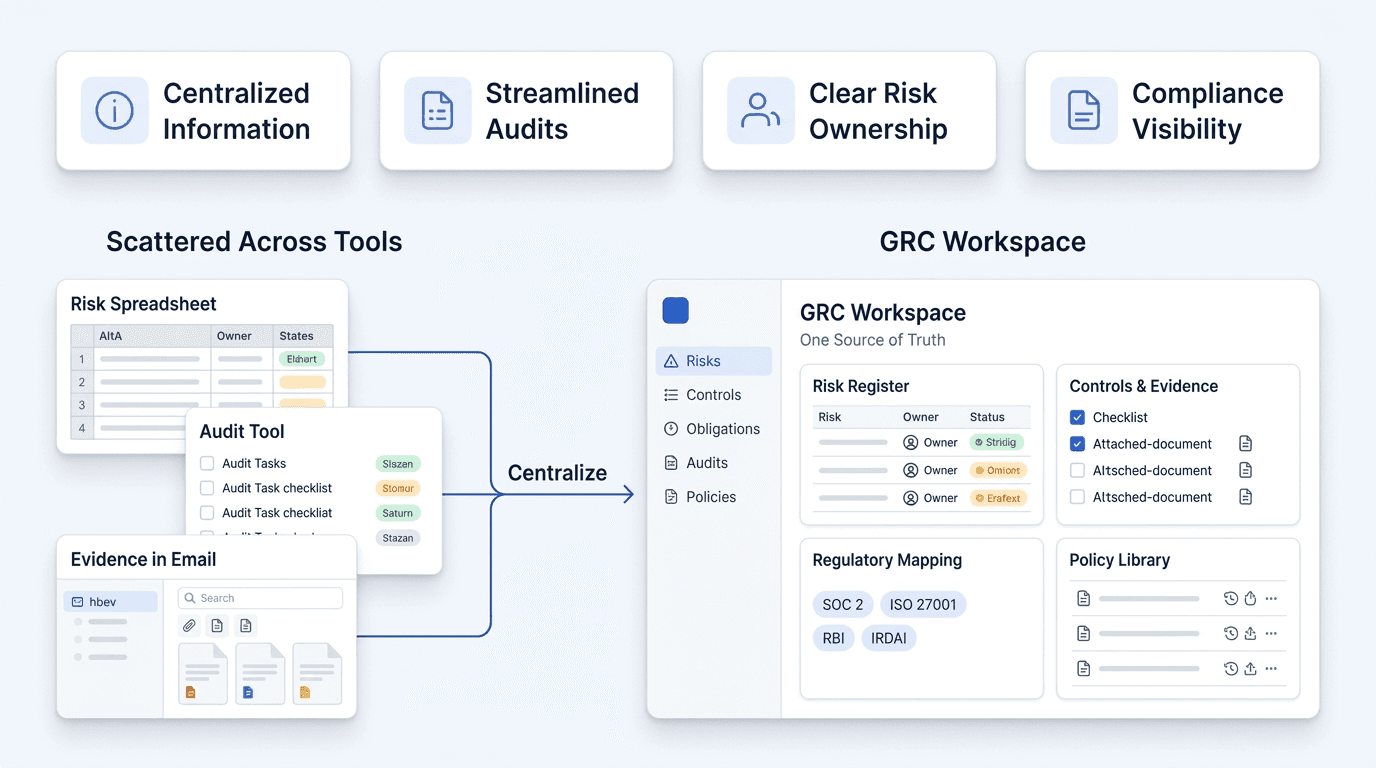
A GRC (Governance, Risk, and Compliance) platform is software that centralises an organisation's governance policies, risk management processes, and compliance activities into a single system. Instead of tracking risks in spreadsheets, managing audits in a separate tool, and maintaining compliance evidence in email folders, a GRC platform brings all of these together so compliance teams work from one source of truth.
GRC platforms typically provide: risk registers and risk assessment workflows, control libraries and control testing evidence collection, regulatory obligation mapping across multiple frameworks (SOC 2, ISO 27001, IRDAI guidelines, RBI master directions), audit management and evidence packaging, policy document storage and version tracking, and reporting dashboards for compliance posture visibility.
Leading GRC platforms in enterprise BFSI include MetricStream, Archer (RSA), OneTrust, Hyperproof, and ServiceNow GRC. Each is strong on the control and risk register dimensions. None were built specifically for the BFSI regulatory environment in India, and none address the specific problem of translating policy language into executable rule engine logic.
What does PolicyOS do that a GRC platform does not?
PolicyOS addresses a different and more specific layer of the compliance problem than a GRC platform.
Where a GRC platform manages the governance and risk register layer - tracking what controls exist, whether they are tested, and what the compliance posture looks like - PolicyOS manages the policy-to-rule translation layer: converting regulatory and internal policy language into the executable rule parameters that actually govern decisions in production systems.
The three things PolicyOS does that GRC platforms do not:
Policy-to-rule conversion. Reading a regulatory circular or internal policy document, extracting the embedded rule logic, and generating rule engine-ready output (YAML, JSON, BRE parameters) for deployment. GRC platforms store policy documents. PolicyOS converts them into executable logic.
Automated conflict detection across the full policy estate. Systematically scanning every policy in the estate when a change is proposed, identifying contradictions before deployment. GRC platforms track which controls map to which frameworks. PolicyOS identifies when two policies give contradictory instructions for the same decision.
Natural language policy querying for frontline teams. Allowing claims officers, underwriters, and customer service agents to ask a policy question in plain language and receive a sourced answer from the current policy version. GRC platforms provide compliance team dashboards. PolicyOS provides operational policy access for every person who needs to apply policy in their daily work.
Does PolicyOS replace a GRC platform?
No. PolicyOS and a GRC platform address different layers of the compliance infrastructure and are designed to work together, not to replace each other.
The GRC platform is the governance and risk management layer - it maintains the risk register, tracks control testing, manages audit evidence, and provides the compliance posture view that leadership and auditors need. This layer is essential and PolicyOS does not replicate it.
PolicyOS is the policy-to-rule translation layer - it sits between the policy document and the rule engine, handling the conversion, conflict detection, and audit trail that the GRC platform's policy document storage does not provide. The output of PolicyOS feeds into the institution's rule engine and its governance record feeds into the GRC platform as evidence of policy implementation.
In a well-architected BFSI compliance stack, both exist: the GRC platform provides the governance and risk management framework, PolicyOS provides the policy management and rule implementation layer that the GRC platform assumes exists but does not itself provide.
Capability | GRC Platform | PolicyOS |
|---|---|---|
Policy document storage | ✓ | ✓ |
Risk register and control library | ✓ | – |
Policy-to-rule engine conversion | – | ✓ |
Cross-policy conflict detection | – | ✓ |
Audit management and evidence | ✓ | Policy audit trail only |
Natural language policy querying | – | ✓ |
Regulatory framework mapping | ✓ | Via policy linkage |
Why don't GRC platforms handle policy-to-rule conversion for BFSI?
GRC platforms were designed for a compliance problem that is horizontal across industries: managing risk registers, tracking controls, and maintaining audit evidence. These problems are structurally similar whether the institution is a bank, an insurer, a technology company, or a manufacturing enterprise. The GRC platforms that lead the market - MetricStream, Archer, OneTrust - are built to solve this horizontal problem well.
Policy-to-rule conversion in BFSI is a vertical problem - specific to regulated financial institutions where policy language must be converted into rule engine logic that governs credit decisions, insurance underwriting, and claims adjudication. This conversion requires understanding both the regulatory language of BFSI frameworks (RBI, IRDAI, SEBI) and the technical requirements of BFSI rule engines. It is not a capability that general-purpose GRC platforms have invested in, because it is not relevant to the majority of their customer base outside financial services.
This is why most BFSI institutions that deploy a GRC platform find that it handles the governance and risk management layers well and leaves the policy-to-rule implementation layer to be managed manually by engineering teams - creating the implementation lag and translation risk that PolicyOS is specifically built to address.
Can PolicyOS integrate with existing GRC platforms?
Yes. PolicyOS is designed to complement rather than replace an institution's existing GRC infrastructure. The integration works in both directions.
From GRC to PolicyOS: policy documents and regulatory obligation records maintained in the GRC platform can be connected to PolicyOS for rule conversion and conflict detection processing. When the GRC platform identifies a new regulatory obligation, PolicyOS receives it as a policy change event and initiates the conversion workflow.
From PolicyOS to GRC: the audit trail and governance records that PolicyOS generates - policy versions, approval records, deployment timestamps, conflict resolution documentation - can be fed into the GRC platform's evidence repository as documented proof of policy implementation.
This closes the evidence gap that most GRC platforms have: they track that a policy exists and that it has been approved, but they cannot document that the policy was correctly implemented in the rule engine that actually governs decisions.
Which should a BFSI institution prioritise - a GRC platform or PolicyOS?
The answer depends on which problem is most acute.
If the institution has no GRC platform and is managing risk registers, control libraries, and audit evidence in spreadsheets, establishing a GRC platform is the higher priority - it provides the governance foundation that everything else builds on.
If the institution has a GRC platform but is experiencing regulatory implementation lags, rule engine mismatches, or policy conflicts being discovered after deployment, PolicyOS addresses the specific gap that the GRC platform cannot close. This is the situation most mid-to-large BFSI institutions in India find themselves in: a GRC platform that manages governance posture well, and a policy-to-rule implementation layer that is still manual, slow, and error-prone.
The full-maturity BFSI compliance stack has both. The sequencing depends on where the biggest compliance risk is concentrated - in the governance and risk management layer (GRC gap) or in the policy implementation and rule accuracy layer (PolicyOS gap).