

Somewhere in your compliance team right now, someone is maintaining a spreadsheet. It might be called a compliance calendar, a regulatory tracker, a policy obligation register, or something more institutional-sounding.
Whatever it is called, it is doing the same job: manually tracking whether each of the hundreds - possibly over a thousand - compliance obligations the institution carries has been met, is due, is overdue, or has been flagged for review.
The spreadsheet is not adequate for this job. It never was. But for a long time, there was no better alternative - so the spreadsheet grew, the team maintaining it grew, and the manual process scaled as best it could until the volume of obligations outpaced what a team of humans refreshing a tracker can reliably manage.
That inflection point has arrived for most mid-to-large BFSI institutions.
The number is not hypothetical: automating the tracking of 1,400 to 1,500 compliance touchpoints makes manual processes unsustainable, according to compliance operations benchmarking published in 2026. The institutions that have reached this scale are not dealing with an efficiency problem. They are dealing with a fundamental infrastructure problem - the wrong tool for a job that has grown beyond what that tool can do.
What 1,400 compliance touchpoints actually looks like
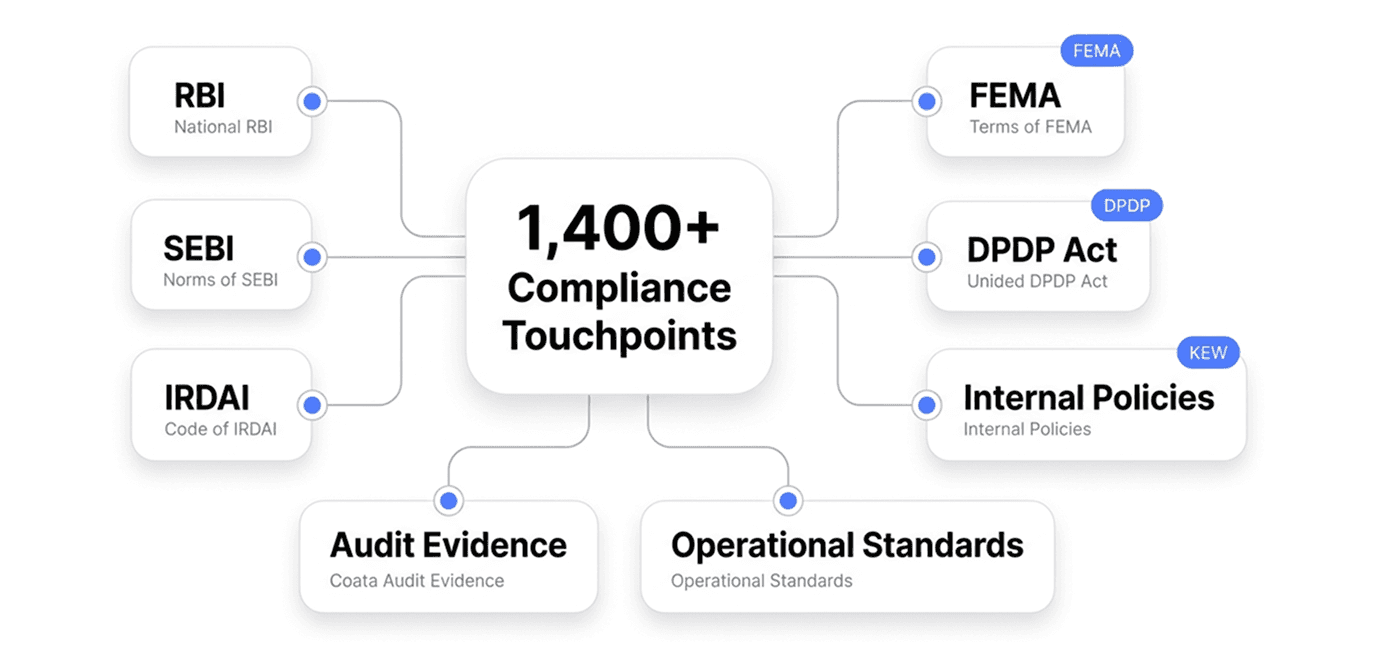
The number sounds large until you start counting. Then it starts to feel conservative.
A mid-sized private bank operating across retail lending, corporate banking, and wealth management carries regulatory obligations across RBI master directions, SEBI guidelines, IRDAI circulars if it has an insurance subsidiary, FEMA compliance for cross-border transactions, the DPDP Act for data handling, and any applicable state-level regulations.
Each regulatory framework generates multiple specific obligations - reporting deadlines, documentation requirements, process standards, disclosure mandates - that need to be monitored, evidenced, and renewed on different frequencies.
Layer on top of this the internal policy obligations: the product policies that must be reviewed annually, the credit policies that must be updated when the risk model is recalibrated, the KYC procedures that must be refreshed when the RBI master direction is amended, the IT security policies that must be updated when ISO 27001 controls are revised. Each internal policy has its own review cycle, its own approval chain, and its own dependencies on other policies that must be checked for consistency when a change is made.
Then add the operational process standards: the customer grievance redressal timelines that must be monitored, the loan disbursement documentation checklists that must be verified, the insurance claims turnaround standards that must be tracked against actual performance, the mis-selling prevention attestations that must be obtained from distribution partners.
The 1,400 number is the cumulative total of all of these obligations across a single institution. It is not an exaggeration. For larger institutions, with more product lines, more regulatory frameworks, and more distribution channels, the number is higher.
1,400+ compliance touchpoints at a typical mid-large BFSI institution 50-70% reduction in administrative time with integrated compliance automation 41% vs 60% breach rate - automated vs reactive compliance management
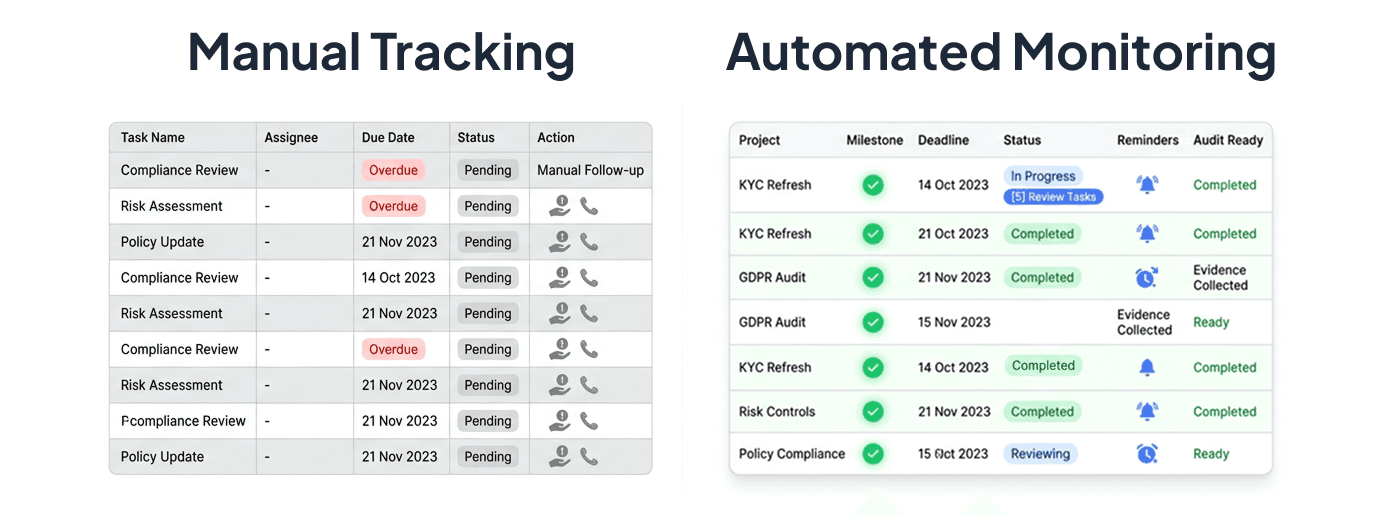
The actual cost of tracking 1,400 touchpoints manually
The cost of manual compliance tracking is real, specific, and distributed across the organisation in ways that make it easy to underestimate when looking at any single budget line.
Headcount cost. The most visible cost is the people whose primary function is maintaining compliance trackers, chasing evidence, and coordinating reviews.
This is not a small team at institutions operating at scale. A compliance operations function managing 1,400 touchpoints manually requires a meaningful headcount - and that headcount grows proportionally as the regulatory obligation count grows, not sub-proportionally. There is no economy of scale in manual tracking: each additional obligation added to the tracker is an additional unit of human attention required to monitor it.
Ops team tax. Beyond the dedicated compliance function, manual tracking creates a recurring burden on every operational team that has compliance obligations. The credit operations team that needs to provide evidence that loan disbursement documentation was complete. The customer service team that needs to confirm grievance resolution timelines were met.
The treasury team that needs to produce transaction records for regulatory reporting. Each of these teams spends time - time that is not tracked as compliance cost but is compliance cost - supporting the manual tracking function with evidence they need to gather, format, and submit on a recurring basis.
Sprint cost. When a policy or compliance obligation changes, the engineering team absorbs a sprint burden to implement the change in the systems that enforce it. This cost is well-understood in isolation but rarely aggregated across the full annual policy change volume.
A BFSI institution managing active regulatory updates across RBI, IRDAI, and SEBI frameworks may process twenty to thirty significant policy-driven engineering changes per year. Each consumes sprint capacity. Collectively, they represent a meaningful proportion of engineering bandwidth spent on compliance translation rather than product development.
Audit preparation cost. Regulatory audits and internal audits require assembling evidence that compliance obligations were met - evidence that should be continuously maintained but in manual tracking environments is frequently assembled reactively, under time pressure, when the audit is announced.
The preparation costs are real and significant: teams pulled off normal work, evidence hunted across systems, documentation reconstructed from emails and meeting notes. Organisations that have measured this find the total audit preparation cost per cycle runs into person-weeks across multiple functions.
Error cost. The cost that manual tracking creates and no tracker measures is the cost of what gets missed. An obligation that slips through because the tracker was not updated. A deadline that was missed because the responsible team was not notified in time. A policy that was updated in the document but not reflected in the monitoring framework.
Each of these misses has a cost - sometimes a regulatory finding, sometimes a process failure, sometimes a customer impact. The cost is not predictable in advance, which is why it is systematically underweighted in the case for automation.
Why the problem compounds with regulatory velocity
The 1,400-problem does not stay at 1,400. Every regulatory update adds obligations. Every product launch adds internal policy requirements. Every new distribution channel adds process standards that need to be tracked. The number of compliance touchpoints grows continuously, driven by an external regulatory environment that is accelerating rather than stabilising.
IRDAI's move to a principle-based regulatory framework in 2024 replaced prescriptive rules with broader principles that require active interpretation - each principle generates its own set of implementation obligations that the institution must define, document, and monitor.
RBI's digital lending guidelines, most recently updated in 2025, added new consumer protection obligations around cooling-off periods, disclosure standards, and grievance redressal that each require monitoring infrastructure.
The DPDP Act added a data governance dimension - data protection impact assessments, consent record maintenance, data retention compliance - that intersects with every policy that involves customer data.
Each of these regulatory developments is a legitimate and appropriate regulatory response to the risks the market has surfaced. Each of them also adds to the compliance obligation count - and a manual tracking system that was barely adequate at 1,400 touchpoints does not become adequate at 1,600 by adding more people or refining the spreadsheet further.
The failure pattern that surfaces when the system is overloaded
When a manual compliance tracking system is operating beyond its capacity, the failure pattern it produces is specific and consistent - and it is a pattern that most compliance leads will recognise.
High-priority obligations get managed well. The items with hard regulatory deadlines, the obligations with visible consequences for non-compliance, the requirements that senior management monitors directly - these get the attention they need. The compliance function is diligent and the highest-stakes items are handled correctly.
Medium-priority obligations get managed inconsistently. The items that are important but not urgent, the internal policy reviews that have soft rather than hard deadlines, the monitoring requirements that have never been tested in an audit - these get the attention that remains after the high-priority items have been serviced. In a well-staffed compliance function with manageable volume, this is fine. When the volume is 1,400 touchpoints and growing, it is not fine.
Medium-priority items become low-priority items by default, not by design.
Low-priority obligations become invisible. Not because anyone decided they do not matter, but because the manual tracking system does not have the capacity to maintain attention on items that have not recently produced a problem. They sit in the tracker, updated infrequently, monitored sporadically, until an audit or an incident makes them suddenly visible - at which point they are no longer low-priority in the eyes of the regulator.
The irony of manual compliance tracking at scale is that it tends to be most reliable exactly where it is least needed - for the high-profile obligations that multiple teams are already watching - and least reliable exactly where it matters most - for the medium and lower-priority obligations that fall through the cracks precisely because no single team is watching them closely.
What automated compliance monitoring actually changes
The comparison between manual and automated compliance monitoring is not a comparison between imperfect and perfect. It is a comparison between a system that degrades under load and one that does not.
An automated compliance monitoring system does not have a bandwidth ceiling. Every obligation is monitored with the same consistency regardless of whether the compliance function is managing a quiet period or an audit cycle.
Every deadline generates an alert at the same reliability regardless of whether the responsible team has the system top of mind. Every policy change triggers the same downstream update process regardless of whether the change happened in a period of high organisational activity or low.
The performance difference is measurable. Organisations with automated compliance monitoring experience a 41% breach rate compared to 60% in organisations using reactive compliance management. Three-year ROI from continuous compliance monitoring versus periodic manual audits exceeds 285% across enterprise sizes. Administrative time reductions of 50 to 70% are achievable through workflow automation.
These are not optimistic projections. They are 2026 benchmark figures from institutions that have made the shift. They reflect the difference between a system that scales with obligation volume and one that breaks under it.
The 1,400-problem is not an argument for a bigger compliance team. It is an argument for a different compliance infrastructure. The people in the compliance function are not the constraint - their bandwidth is. The fix is not to expand the constraint. It is to remove it.