

For COOs, compliance heads, and business leads at banks, NBFCs, and insurers who keep improving the process and keep getting the same results.
Every BFSI institution that has struggled with policy management has eventually arrived at the same diagnosis: the process needs to be better. The approval workflow needs more checkpoints. The change management protocol needs tighter sign-offs. The compliance review needs an additional layer of sign-off before anything goes live. The training material needs to be updated more frequently. The escalation path needs to be clearer.
So the process gets better. The workflows get tighter. The sign-offs multiply. The training material is updated. And six months later, the same problems surface. A rule engine that does not match the current policy. A frontline team applying an outdated version of a product guideline. A regulatory finding that traces back to a decision made under the correct process but still wrong relative to the current regulatory position.
The diagnosis was correct that something needed to change. The diagnosis was wrong about what. The problem is not the process. The process is as good as the people running it allow it to be. The problem is that policy management in BFSI has been designed as a human-dependent workflow in an environment where the volume, velocity, and complexity of policy change has long since exceeded what human-dependent workflows can reliably handle.
That is not a process failure. It is an architectural one.
What policy management actually requires at BFSI scale
To understand why human-dependent policy management breaks at scale, it helps to map what the function actually involves at a mid-to-large BFSI institution.
A bank or insurer of meaningful size is managing policy across multiple product lines, multiple distribution channels, multiple regulatory frameworks, and multiple jurisdictions - simultaneously.
At any given point, there are policies being drafted, policies under review, policies awaiting approval, policies that have been approved and are pending implementation, policies that have been implemented and are being monitored for compliance, and policies that are being revised in response to a regulatory update that arrived last week.
Each of these policies interacts with others. A change to a credit policy may conflict with an existing risk policy. An update to a claims procedure may require a corresponding update to an underwriting guideline. A new product variant may require a new policy that references clauses from three existing documents. Managing these interactions - identifying conflicts before they produce incorrect decisions, ensuring that every dependent policy is updated when a parent policy changes - is a combinatorial problem that grows faster than linear as the policy estate grows.
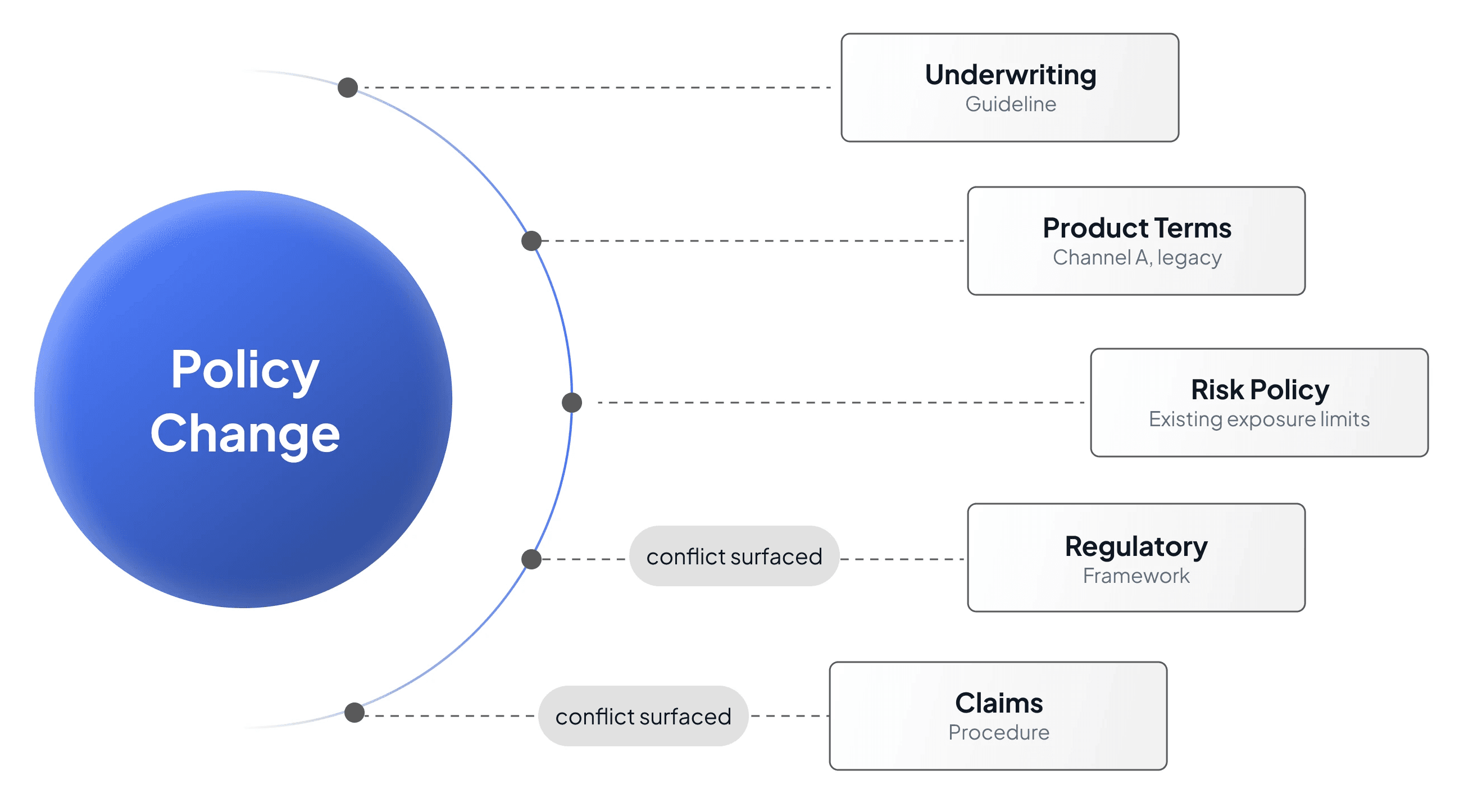
The humans running this process are skilled and diligent. They are also finite. They can review a certain number of documents per week. They can identify conflicts they are aware of. They cannot systematically surface conflicts they are not aware of, because awareness requires comprehensively reading every policy that might interact with the one being changed - which, at scale, is not operationally feasible within normal review timelines.
"Policies are necessary, but they don't create compliance. Controls do. And in 2026, the most durable governance pattern is not ethics theatre - it is automated controls that run at machine speed, continuously, without depending on human attention to work."
The three failure modes that keep repeating
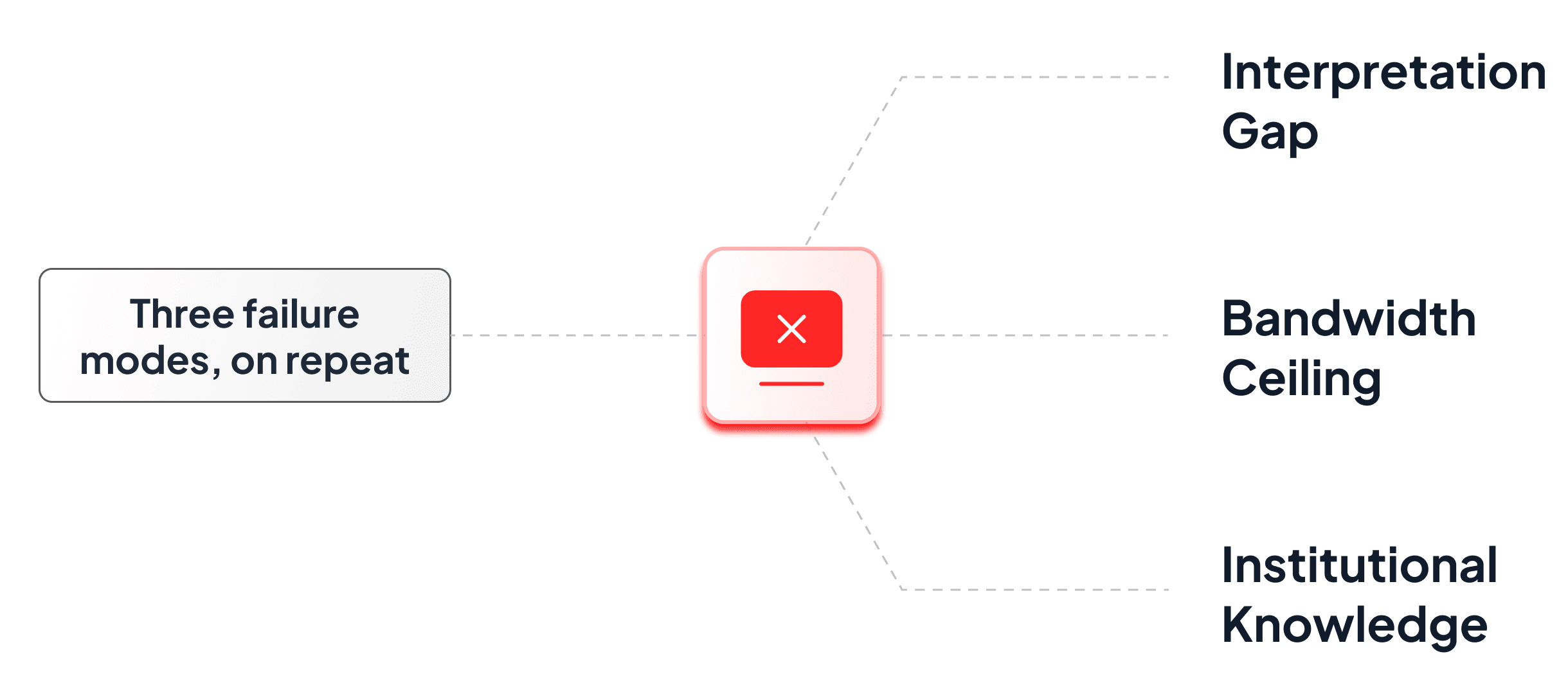
The people-dependency in BFSI policy management produces three failure modes that compliance teams recognise immediately because they encounter them repeatedly, across product lines and regulatory cycles.
The interpretation gap. A regulatory circular arrives. The compliance team reads it and produces an internal note on what needs to change. The product team reads the note and produces a change brief. Engineering reads the brief and implements it. Each reading introduces interpretation - each person makes judgment calls about what the original language means in operational terms. By the time the change reaches the rule engine, it may reflect the compliance team's understanding, the product team's interpretation of that understanding, and the engineering team's implementation of that interpretation. Three degrees of separation from the original regulatory text, each introducing the possibility of drift.
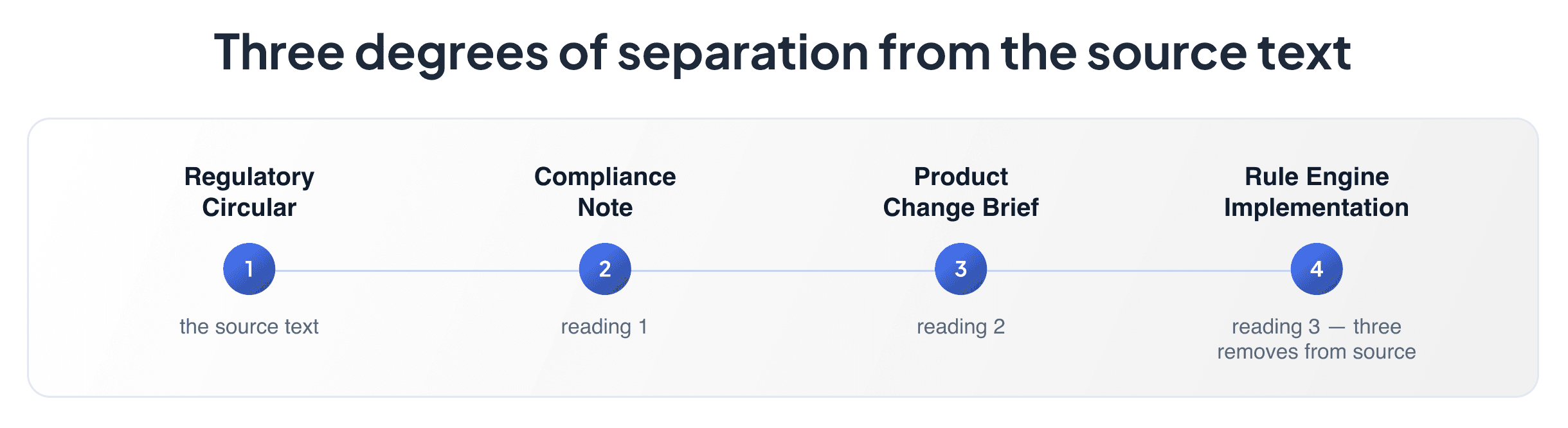
The drift is not malicious. It is inevitable when the translation chain is entirely human. The compliance team cannot anticipate every edge case in their note. The product team cannot fully convey every nuance in their brief. The engineering team cannot ask about every ambiguity they encounter without creating review delays that the business cannot absorb. The gap exists because human communication at speed is inherently lossy.
The bandwidth ceiling. Policy management competes for resource with every other priority in the institution. A compliance team asked to review a major product policy change alongside three regulatory updates and two new product launches in the same quarter will prioritise the highest-urgency items. The items that fall below the urgency threshold get reviewed more quickly, with less depth, or get queued for the next cycle.
This is rational resource management under constraint. It is also a structural source of compliance risk - because the items that fall below the urgency threshold are not necessarily low-risk items. They may simply be items that have not yet produced a visible problem. The risk exists. The bandwidth to address it properly does not. The result is a policy estate where some policies are maintained to a high standard and others are maintained to whatever standard the available bandwidth allows.
The institutional knowledge dependency. In most BFSI institutions, genuine policy expertise is concentrated in a small number of individuals. The person who understands how the three overlapping credit policies interact. The claims specialist who knows which exclusion clause was added to satisfy a specific regulatory observation and should not be interpreted too literally. The underwriter who knows that the written policy has a gap in it and what the informal resolution is.
This knowledge is valuable and genuinely hard to replace. It is also entirely fragile. When these individuals leave - which they do - the institutional knowledge leaves with them. The policies that seemed manageable become unclear. The interactions that were navigated by experience become sources of inconsistency. The informal resolutions that kept the system working become points of failure when the person who knew about them is no longer there to apply them.
Why better processes cannot fix an architectural problem
The natural response to each of these failure modes is a process improvement. The interpretation gap produces a call for more rigorous review protocols. The bandwidth ceiling produces a call for more headcount or better prioritisation frameworks. The institutional knowledge dependency produces a call for better documentation and knowledge management.
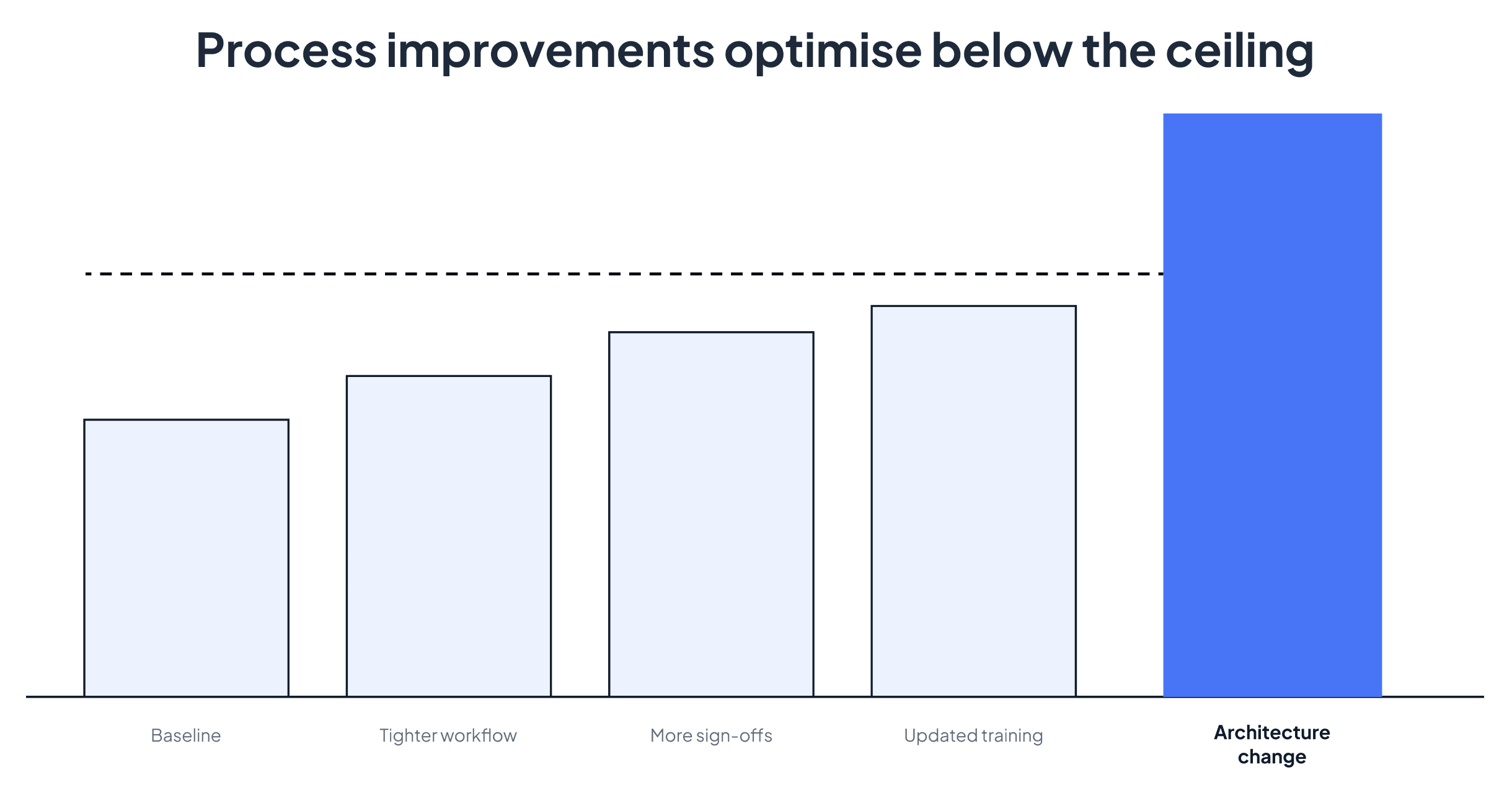
These responses are not wrong. They are insufficient - because they attempt to fix an architectural problem with operational solutions. The architecture of human-dependent policy management has a ceiling. That ceiling is defined by human reading speed, human attention, human memory, and human availability. No process improvement raises the ceiling. Process improvements optimise the performance below the ceiling. The ceiling stays where it is.
This is the point at which the diagnostic changes from "our process needs to be better" to "our process architecture needs to change." The question is not how to get humans to manage policy more effectively. The question is which parts of policy management should not require human attention at all - because they are mechanical enough, repetitive enough, and consequence-laden enough that they should be running at machine speed, continuously, with human attention reserved for the genuinely complex judgments that only humans can make.
What the regulatory environment is making unavoidable
The regulatory environment in BFSI is not getting simpler. IRDAI collapsed 37 regulations into 7 in 2024 and then issued the Insurance Products Regulations 2024, effective April 2024, with immediate compliance obligations. RBI's digital lending guidelines have been amended multiple times since their initial publication. The DPDP Act adds a data governance dimension that interacts with every policy that touches customer data. The pace of regulatory change is, if anything, accelerating.
Each regulatory change is a policy management event. Each policy management event is a process burden. At the current pace of regulatory output, the process burden is growing faster than institutions can expand the human resource to absorb it - even with the best-designed workflows and the most diligent compliance teams.
Large enterprises deploying integrated compliance tools can expect to cut administrative time by 50 to 70% through workflow automation, according to 2026 contract management benchmarks. That figure is not achievable through process improvement alone. It requires changing the architecture - automating the parts of policy management that are currently consuming human time on tasks that are mechanical, not judgmental.
The reframe that changes the conversation
The most useful reframe for a BFSI COO or compliance head looking at this problem is to stop asking "how do we improve policy management?" and start asking "which parts of policy management should humans not be doing at all?"
Converting a policy document into rule logic - reading the clause, interpreting the condition, mapping it to a rule engine parameter - is mechanical. It requires precision, not judgment. It is exactly the kind of task where humans introduce inconsistency not because they are careless but because human reading introduces variability that machine reading does not.
Detecting conflicts between policies - systematically checking whether a new policy clause contradicts anything in the existing policy estate - is a combinatorial search problem. Humans do it approximately, by checking the policies they know might be relevant. A system does it completely, by checking every policy, every time.
Maintaining an audit trail of what policy was in force when, who approved what change, and what the rule engine state was at any given date - this is record-keeping, not judgment. It should run automatically, continuously, as a byproduct of the normal policy management workflow, not as a separate documentation exercise that competes for attention with substantive compliance work.
These three tasks - policy-to-rule conversion, conflict detection, and audit trail maintenance - consume a disproportionate share of BFSI compliance and technology team time.
They are also the tasks most susceptible to error when done at speed by humans under bandwidth pressure.
They are the architectural intervention point - not because the humans doing them are inadequate, but because the architecture of human-dependent execution has a ceiling that the volume and velocity of BFSI policy change has already exceeded.
The process is not broken. The architecture is. And process improvements cannot fix an architecture problem, no matter how many times they are applied.